
Is Raakh Worth Watching? Honest Review of Prime Video’s New Crime Thriller
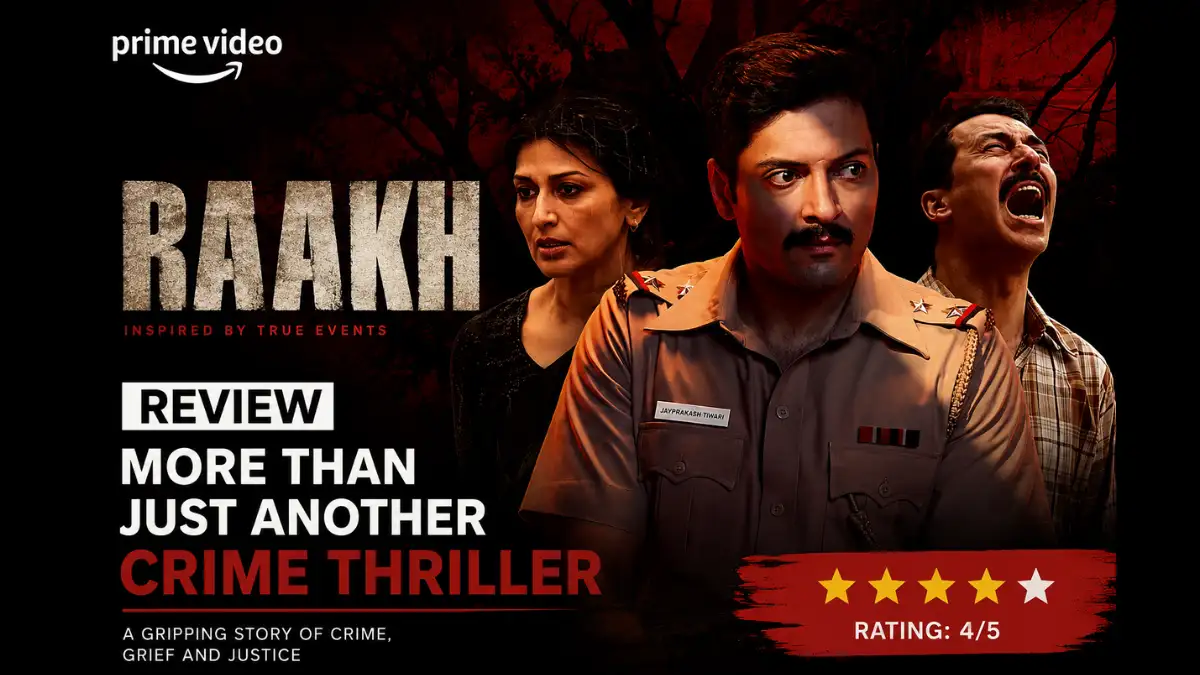
For viewers tired of formulaic whodunits that glorify the chase over the human cost, Raakh is a masterclass in atmospheric storytelling. Inspired by the infamous 1978 Geeta-Sanjay Chopra (Ranga-Billa) case, this 8-episode series flips the script on the traditional police procedural.
Instead of racing toward a sensationalized climax, it anchors itself in the devastating emotional aftermath of a tragedy, making it one of the most compelling, unsettling, and mature Indian crime dramas of 2026.
Quick Overview & Verdict
| Metric | Details |
|---|---|
| Format | 8-Episode Limited Series |
| Genre | Investigative Crime Thriller / Psychological Drama |
| Inspiration | 1978 Geeta-Sanjay Chopra case |
| Main Cast | Ali Fazal, Sonali Bendre, Aamir Bashir, Rakesh Bedi |
| Our Rating | ★★★★☆ (4/5) |
| The Verdict | Raakh isn’t a mindless, suspense-driven must-watch. It is a haunting examination of grief, systemic failure, and the lasting scars of a national tragedy. Despite early pacing issues, its raw emotional payoff and chilling realism make it essential viewing. |
Core Storyline: Beyond the Crime
The narrative kicks off with the abrupt disappearance of two teenagers in 1970s Delhi. While Sub-Inspector Jayprakash (Ali Fazal) unpicks a thread that leads into a dark world of brutality and systemic failure, the show’s real focus remains on Colonel Ashok Arora (Aamir Bashir) and Mona Arora (Sonali Bendre) – the parents left behind.
Raakh is less about finding the monsters and more about examining what remains after a family loses everything.
Major Strengths: What Makes It Stand Out
1. Grief as the Primary Narrative Driving Force
While most thrillers prioritize forensic tech and high-speed chases, Raakh shifts its lens to the victims’ living room. The show captures the paralyzing trajectory of parental loss with painful accuracy:
- Mona’s protective denial shields her from immediate collapse.
- Ashok’s quiet emotional breakdown dismantles the stoic military facade. The series connects you directly to the victims’ pain, making the stakes feel deeply personal.
2. Chillingly Human Antagonists
The villains, Babu and Rajjo, have emerged as major talking points among critics and audiences alike. Instead of painting them as one-dimensional, Bollywood-style monsters, the writers dive deep into their unsettling bond and warped psychology.
By grounding their evil in recognizable human behavior, they become far more terrifying than a cartoonish caricature.
3. Ali Fazal’s Restrained Maturity
Playing Sub-Inspector Jayprakash, Ali Fazal delivers a masterclass in internal acting. He steers completely clear of loud, desk-thumping tropes. Jayprakash is calm, deeply observant, and carries an understated emotional weight.
He lets his silences do the heavy lifting, marking this as one of the finest performances of his career.
4. Flawless 1970s Production Design
The production team’s recreation of 1970s Delhi is stunningly accurate. From the muted color palettes and period-specific costumes to the low-tech, slow-burn investigation methods of the era, the social atmosphere feels entirely lived-in and authentic.
Room for Improvement: The Flaws
- A Sluggish First Act: Episodes 1 to 3 take considerable time to establish the baseline infrastructure of the investigation. Viewers expecting immediate narrative momentum might find the initial world-building a bit slow.
- Over-Explanation: The writing occasionally loses its subtlety. Rather than letting the audience piece clues or emotional cues together organically, certain scenes explicitly spell out character motivations.
- Uneven Pacing: The series takes a sharp turn in momentum from Episode 4 onward, where the narrative and emotional stakes pick up drastically, making the first half feel disconnected from the high-octane second half.
Deeper Themes Explored
- Crime & Structural Punishment: The show avoids glorifying the criminals, choosing instead to map out how a singular act of violence ripples outward to fracture an entire community and social fabric.
- Parenting and National Fear: Reflecting the real-world impact of the 1978 case, the narrative explores the exact cultural moment when “stranger danger” and institutional anxiety permanently changed Indian parenting.
- Toxic Masculinity & Prejudice: Through the villains, the show examines the toxic intersection of performance-based masculinity and violence, while subtly highlighting how marginalized communities and queer individuals were perceived and treated in late-70s India.
Audience Sentiment Analysis
An evaluation of viewer discussions across platforms like Reddit and critical reviews reveals a distinct consensus.
What Audiences Love
- The raw, deeply moving emotional impact that lingers post-credits.
- The humanized, profoundly disturbing depiction of the antagonists.
- Ali Fazal’s quiet charisma and controlled screen presence.
- The immersive, highly nostalgic production value.
What Audiences Criticize
- The slow-burning narrative pace of the opening episodes.
- Limited screen time for Sonali Bendre’s character.
- The deliberate creative liberties taken away from the factual real-world case file.
Final Review Verdict
4 out of 5 Stars. Raakh requires patience, but it rewards you with profound psychological depth. It stands tall as a haunting post-mortem of fear, trauma, and justice that refuses to take the easy way out.