
System Movie Review: Does Sonakshi & Jyotika’s Legal Drama Defy Bollywood Traps?
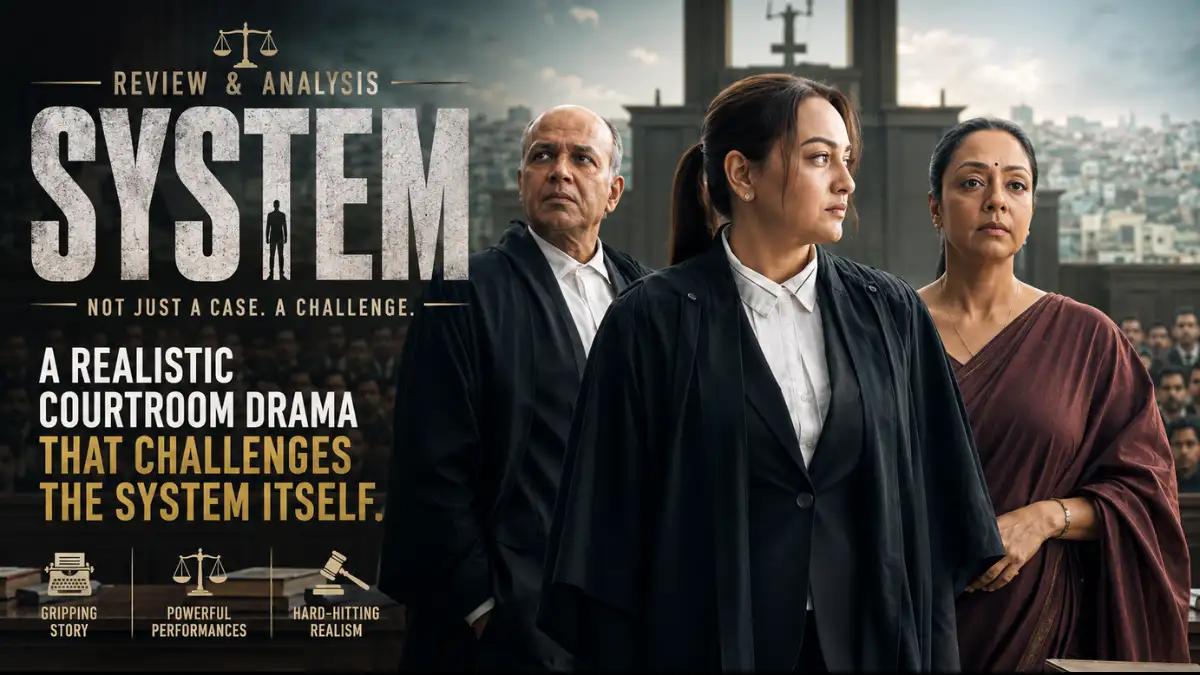
Let’s be completely honest – most Bollywood courtroom dramas are less about actual law and more about who can scream “Tareekh pe Tareekh” the loudest. We are used to grand, theatrical monologues where heroes magically produce a smoking gun in the final two minutes.
But Ashwiny Iyer Tiwari’s System, streaming fresh on Amazon Prime Video, tries to pull off a very different heist. It chooses stillness over spectacles and subtle strategy over shouting matches. But does this slow-burn experiment actually land its punches, or does it collapse under its own heavy cinematic ambitions? Let’s dive deep into the legal machinery.
The Premise: A Numbers Game Wrapped in Golden Cages
The film brilliantly sets up a chess match of privilege versus survival. We follow Neha Rajvansh (played with a remarkably grounded restraint by Sonakshi Sinha), a rookie public prosecutor desperate to shake off her “nepo-baby” label. She lives under the intimidating shadow of her father, Ravi Rajvansh (Ashutosh Gowariker), an elite legal tycoon who treats the law like an exclusive country club.
Ravi throws down an unyielding ultimatum: Win 10 consecutive cases in the messy trenches of the state prosecutor’s office, and you earn a partnership in my multi-million dollar firm. No losses allowed.
Enter Sarika Rawat (Jyotika), a quiet, fiercely observant courtroom stenographer from Delhi’s lower-middle-class clusters. Sarika doesn’t wear a black coat, but she has spent decades sitting literally at the feet of power. She types the truth, handles a disabled husband at home, and possesses a sharp, unsentimental wisdom about how the legal gears actually grind. Neha quickly realizes that to win her gamified race, she needs Sarika’s street-smart instinct, quietly hiring her as a backroom consultant at ₹20,000 per case.
System Movie At A Glance
Before analyzing the core themes, here is a quick overview of how the key elements of the film stack up against each other:
| Feature / Theme | What ‘System’ Promised (The Ideal) | What ‘System’ Delivered (The Reality) |
|---|---|---|
| Courtroom Battles | Grounded, document-based legal strategy. | Fast-tracked, simplified cases just to hit the ’10-win’ mark. |
| Female Lead Dynamics | A complex partnership between an elite rookie and a street-smart stenographer. | An engaging bond that unfortunately gets sidelined by the thriller plot later on. |
| The Antagonist | The corrupt legal machinery and patriarchal expectations (The Father). | A generic corporate builder/real estate villain in the second half. |
The Goods (What Worked Beautifully)
- Unspoken Sisterhood Over Loud Feminism: The absolute crown jewel of System is how it treats female solidarity. It completely ignores standard Bollywood clichés. There are no scenes of women downing shots at a bar to prove they are “liberated.” Instead, their partnership is established in fleeting, brilliant micro-moments.
- The Washroom Scene: Take their very first interaction in the ladies’ washroom. Neha is sweating over a case, and Sarika silently reaches out to straighten the creased barrister bands on Neha’s collar. Sarika gives a warm, knowing smile and walks out. That single, silent gesture conveys a mountain of information – it tells us that these two women, despite their massive class divide, are instinctively ready to hold up each other’s mirrors.
- Stellar Performances: Sonakshi Sinha brings a quiet vulnerability to Neha, while Jyotika anchors the film as its emotional backbone. Ashutosh Gowariker radiates calm authority as the legal patriarch.
The Bads (Where It Falters)
- The Checklist of Victories: To get Neha to her 10th case, the screenplay fast-tracks her early legal battles (ranging from a restaurant fire to an influencer murder case) a bit too conveniently. The wins don’t feel entirely “earned” because the script disposes of the legal technicalities far too quickly.
- The Formulaic Shift: The real friction starts when the 10th case pits Neha directly against a toxic corporate builder (Vijayant Kohli) – who happens to be defended by her own father, Ravi. Suddenly, the gritty, realistic atmosphere shifts. Neha begins acting like an amateur detective, sneaking into unsafe corners of Delhi to solve a murder puzzle. It feels uncharacteristically implausible for a movie that initially prided itself on authentic procedural paperwork.
- A Predictable Final Move: By the final act, the legal thriller stops being a mystery and turns into a highly readable, paint-by-numbers checklist of corporate-politician nexus tropes.
What Could Have Been Better (Audience Perspective)
Watching the film unfold, a few adjustments could have transformed this decent attempt into an absolute masterpiece:
- Fewer, Bigger Cases: Instead of rushing through 10 fast cases, focusing on 3 or 4 detailed legal battles would show Neha’s true growth. This would make her victories feel earned, not scripted.
- Keep Her in Court: A professional lawyer playing detective in dark alleys breaks the realistic tone. It would be much more thrilling to see Neha defeat the corrupt builder using legal loopholes and sharp wit inside the courtroom.
- More Focus on Sarika’s Gray Area: Sarika isn’t purely “good” – she manipulates the system to survive. Exploring her internal conflicts and moral gray areas would create a much stronger psychological bond between her and Neha.
The Final Takeaway
System deserves praise for its realistic feel, natural acting, and complex characters. It smartly highlights how women face everyday struggles in a male-dominated system – even showing the lack of clean ladies’ washrooms in public courts.
However, the film cleans up Delhi’s chaotic courts too much with overly perfect visuals and rushes its ending. Because of this, it loses the emotional impact it promised. While it is still a highly watchable and interesting film, you are ultimately left wishing the script was as sharp as its brilliant female leads.
Sources & References
- To read about the divided critical reception and detailed cinematic breakdowns, explore the comprehensive review on The Hindu Movie Analysis.
- For an in-depth perspective on production design and casting choices, check out the editorial on The Times of India Entertainment.