
CBFC Certification Explained: U, UA and A Ratings
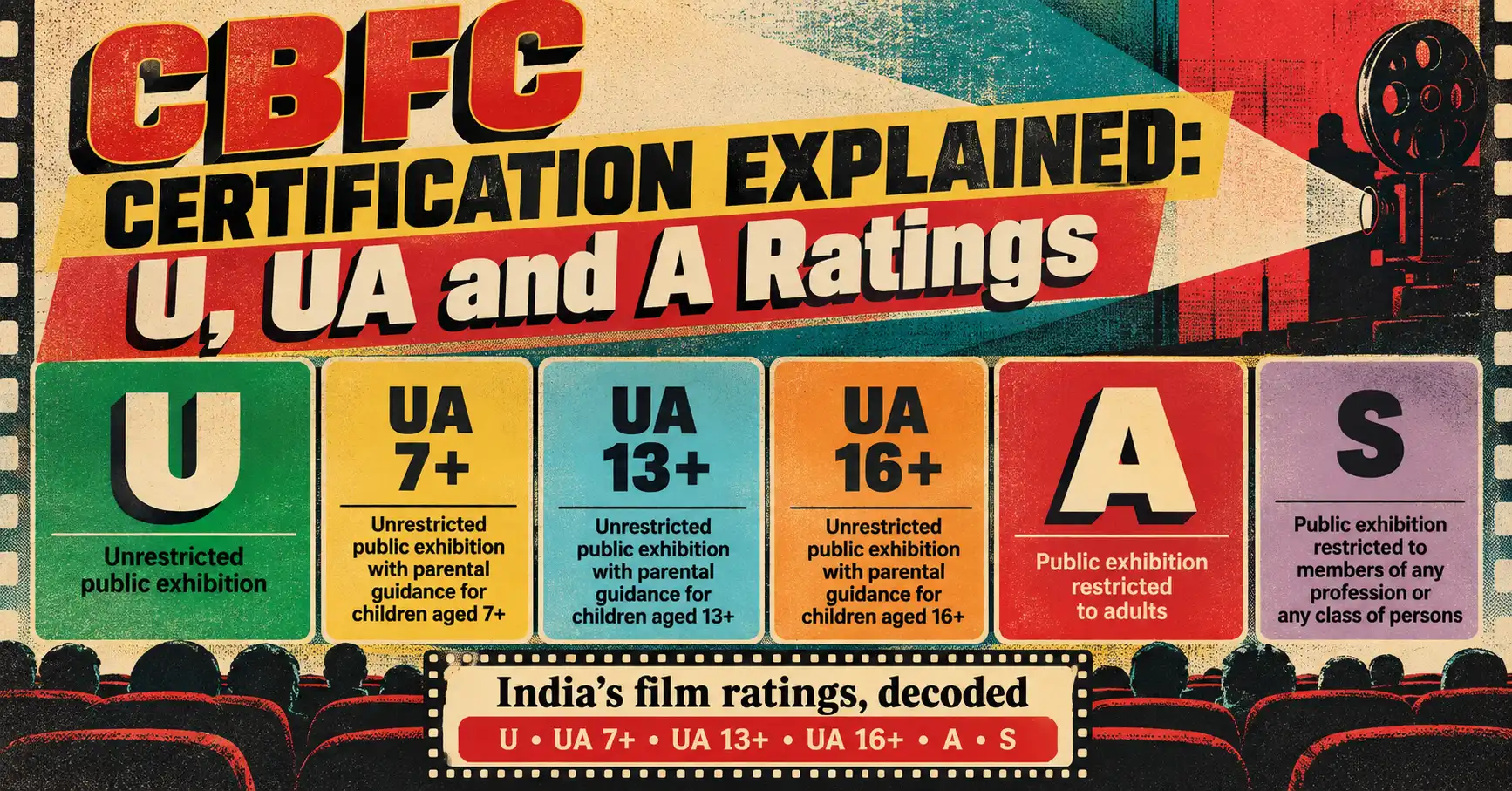
Every ticket you book comes with a tiny label next to the runtime. U. UA 13+. A. Most of us scroll right past it. Then one day you’re at the gate with your 14-year-old cousin, and the duty manager wants to see an ID. So here it is: CBFC certification explained, with U, UA and A ratings broken down tier by tier.
We’ll also cover the newer UA 7+, 13+ and 16+ tags, the almost-mythical S certificate, and the stuff nobody else answers properly. Can a theatre actually stop you? Does Netflix care? And how does a Vijay film end up in the High Court over one letter?
Bookmark this one. Every time a release-day post on AllYourChoice mentions a certificate, this is the page it’s talking about.
What Is the CBFC, and Why Does Every Film Need Its Sticker?
CBFC stands for the Central Board of Film Certification. People still call it the “censor board”, but certification is its legal job.
It’s a statutory body under the Ministry of Information & Broadcasting. It works under the Cinematograph Act, 1952, and it runs nine regional offices: Mumbai (the headquarters), Delhi, Bengaluru, Chennai, Kolkata, Hyderabad, Kochi, Guwahati and Thiruvananthapuram.
Here’s the non-negotiable part. No film gets a public theatrical release in India without a CBFC certificate. No certificate, no show. Doesn’t matter if it’s a ₹500 crore tentpole or a two-hour indie.
Since March 2024, the detailed rulebook is the Cinematograph (Certification) Rules, 2024. They replaced rules that had been in place since 1983. More on what changed later, because it’s a big deal for parents.
CBFC Certification Explained: U, UA and A Ratings, Tier by Tier
The CBFC now hands out six certificates: U, UA 7+, UA 13+, UA 16+, A and S. Here’s what each one really tells you, according to the CBFC’s own certification page.
U: Universal
Unrestricted public exhibition. Anyone can watch, from your nani to your five-year-old nephew. U is also the only certificate that lets a film go straight to television as it is. Any film edited for TV broadcast has to go back to the CBFC for re-certification.
UA 7+, UA 13+ and UA 16+: Parental Guidance, Now With Numbers
UA also means unrestricted exhibition, with a caution attached. The CBFC’s base wording asks parents and guardians to consider whether any child below twelve should see the film.
That old single “UA” was vague. Twelve-year-old or four-year-old, the label said the same thing. So the 2024 rules split it into three age markers:
- UA 7+: suitable for kids aged seven and up, with a parent’s call.
- UA 13+: aimed at teenagers aged 13 and up.
- UA 16+: the heaviest UA tier, pitched at viewers 16 and above.
The key detail? These markers are recommendations for parents, not locked doors. The government’s own framing calls them a tool “for parents or guardians to determine whether the film is suitable for their children.” That wording matters a lot when we get to enforcement below.
A: Adults Only
This is the only mainstream certificate with real legal teeth. A means 18+, and exhibition to minors is prohibited. Cinemas actually check, as you’ll see.
S: Specialised Audiences
The rare one. An S certificate restricts a film to specialised professional audiences, such as doctors or scientists. You won’t find S films at your local multiplex. They’re typically educational, technical or medical content, and mainstream cinema basically never lands here.
Fun bit of history: UA and S both arrived in June 1983. Before that, India only had U and A.
U vs UA vs A: The Real Difference in One Table
Screenshot this. Seriously.
🏷️ Certificate |
👥 Who Can Watch |
⚖️ Is It Enforced? |
💡 What It Signals |
|---|---|---|---|
| U Universal |
Everyone | ✔ No restriction needed | Family-safe, can air on TV as is |
| UA 7+ Advisory |
Everyone | Parental guidance only | Fine for most kids 7 and up |
| UA 13+ Teen Advisory |
Everyone | Parental guidance only | Pitched at teens |
| UA 16+ Mature Teen |
Everyone | Parental guidance only | Heavy themes, older teens |
| A Adults Only |
18+ only | ENFORCED Minors prohibited | Adult content, expect ID checks |
| S Specialized |
Specialised professionals | RESTRICTED Restricted audience | Not for general public release |
Notice the jump between UA 16+ and A? That gap is where most fights happen. A UA 16+ film still reaches every family audience. An A film loses every under-18 ticket buyer, overnight. For a star vehicle, that difference can show up in the box office numbers (if you’ve ever wondered how those numbers get calculated, here’s our box office collection explainer).
Can a Theatre Turn You Away? How Ratings Actually Get Enforced
This is the question people actually Google. Short answer: it depends entirely on the letter.
A films: yes, they will check your ID
Theatre chains treat ‘A’ as a hard line, and they stack several checkpoints on top of it.
- PVR Cinemas: CEO Gautam Dutta put it plainly: “In case of any doubt about the age of a patron, the duty manager may request proof of age in original.”
- Carnival Cinemas: Mohan Umrotkar described security staff checking tickets and verifying age with photo ID at the entrance. They also run spot inspections before the screening begins.
- Miraj Cinemas: Amit Sharma said the chain denies entry, with a refund, if adults try to bring minors into an A-rated film.
- BookMyShow: shows an explicit 18+ disclaimer twice, once in the terms and again at seat selection.
So yes, that “I look 18, na?” gamble can fail. And if you’ve dragged a younger sibling along, the whole group may end up with a refund instead of a movie.
UA 7+, 13+ and 16+: it’s your call, not the usher’s
Here’s where most people get it wrong. The UA tiers are guidance, not an ID gate. Legally, nobody turns a 15-year-old away from a UA 16+ film.
The label exists to help you decide. It doesn’t decide for you. A 12-year-old who’s watched every Marvel film might handle a UA 13+ action film just fine. A sensitive 14-year-old might hate a UA 16+ thriller. You know your kid better than a committee in Mumbai does.
OTT: the CBFC has zero say
Netflix, Prime Video, JioHotstar and the rest sit completely outside the CBFC and the Cinematograph Act. The IT Rules, 2021 govern them instead.
Under those rules, platforms self-classify their shows and films into U, U/A 7+, U/A 13+, U/A 16+ and A. They also have to appoint a Grievance Redressal Officer for complaints. The Minister of State for I&B reconfirmed this split in comments reported in December 2025.
The practical upshot? Nobody’s checking Aadhaar at your living-room door. The platforms aren’t legally required to ID-check viewers the way cinemas do for A films. Parental controls and profile PINs are your real safety net. If you’re picking a platform partly on how family-friendly it is, our Netflix vs Prime Video vs JioHotstar breakdown is worth a look.
How the CBFC Actually Certifies a Film
The process looks simple on paper. It rarely feels simple to producers.
Step by step
- Submission: the producer applies at one of the nine regional offices.
- Examining Committee: a panel watches the film and decides the certificate.
- Cuts and modifications: the CBFC tells the applicant what it wants changed.
- Revising Committee (optional): unhappy producers can request a second look. None of its members can have sat on the original Examining Committee.
- Certificate: once the producer complies, the CBFC issues it.
An appeal against a Revising Committee decision has a tight window. Producers get 14 days to file.
What happens after that? The High Court
Until 2021, producers had one more stop: the Film Certification Appellate Tribunal (FCAT). The government scrapped it that year. Now, if you want to fight the CBFC beyond its own committees, you go straight to the High Court.
That’s slower, costlier and way more public. Which brings us to the best real-world example you’ll find.
Case study: the Jana Nayagan saga
Vijay’s Jana Nayagan shows the whole pipeline in one messy, very public fight.
The CBFC initially refused to certify the film, citing concerns about religious content. The makers took it to court. A single-judge bench of the Madras High Court ordered the CBFC to issue a UA 16+ certificate. The CBFC then got that order stayed by a division bench.
The film finally cleared on 12 July 2026, with an ‘A’ certificate after 12 mandated modifications, as NewKerala reported. Start to finish, the dispute ran about seven months.
Think about what that means. The makers went to court chasing a family-friendly UA 16+. They walked away with an adults-only A and a dozen changes. For a mass Thalapathy entertainer whose fans include plenty of teenagers, that’s a painful trade. Curious how it played out at the ticket counter? Our Jana Nayagan box office Day 6 report has the numbers.
Why India Added UA 7+, 13+ and 16+ (And What Else Changed in 2024)
The Cinematograph (Certification) Rules, 2024, notified on 26 March 2024 under the Cinematograph (Amendment) Act, 2023, rewrote a lot of the system. Drishti IAS has a solid summary if you want the full legal picture. Here’s what matters for you:
- Three UA age tiers. One blanket under-12 warning became 7+, 13+ and 16+. Parents finally get a sharper signal.
- Certificates never expire. The old rule made certificates valid for only 10 years. Now they’re perpetual.
- More women on the Board. At least one-third of CBFC Board members must be women.
- Accessibility features. The rules mandate accessibility for viewers with disabilities.
- A fast lane. A priority screening track lets producers get certified quicker.
- TV re-certification. Films edited for TV broadcast need fresh certification. Only U films go on air untouched.
Our honest read? The three UA tiers are the most useful change here for regular moviegoers. The old UA told you almost nothing. “UA 16+” on a booking screen tells a parent exactly what kind of evening to expect.
Our Take: Read the Letter Before You Book
Here’s the thing most people miss. The certificate isn’t a quality score. A U film can be a masterpiece, and an A film can be total time waste. The letter tells you who a film is for, not whether it’s good.
But it absolutely should shape your booking. Taking the family out? Check for U or the right UA tier. Planning an A film with a friend who’s 17 and a half? Save everyone the awkward refund.
And keep an eye on those UA 16+ vs A battles. As the Jana Nayagan fight showed, one letter can cost a star film its entire teen audience. Is that fair on the makers, or exactly the protection parents asked for? Honestly, a bit of both. Just don’t be the one arguing with a PVR duty manager over it.