
OTT Release Window India: How Long Until Movies Stream?
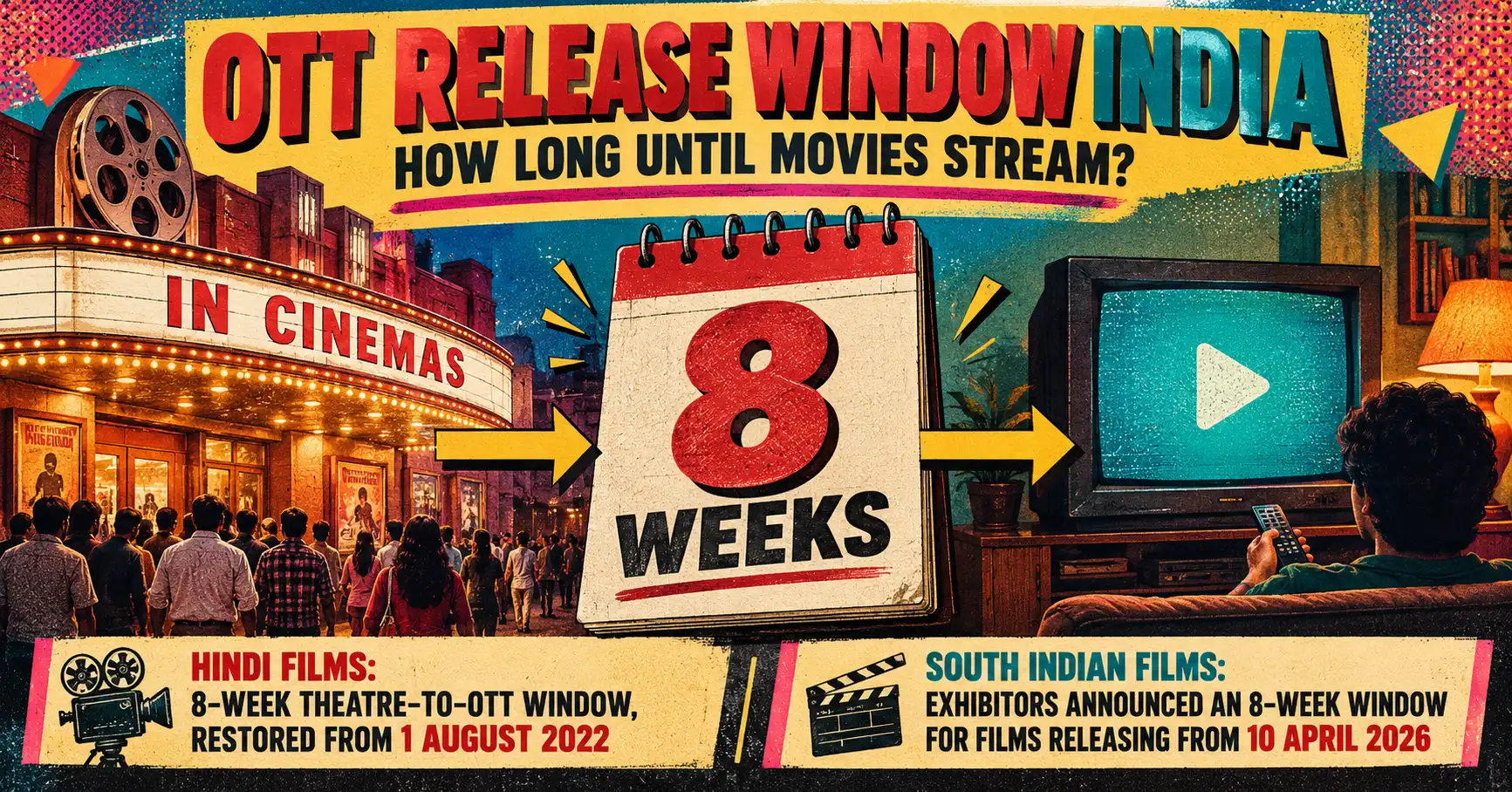
You skipped the theatre this Friday and you’re now refreshing Netflix every other night. Good news, bad news. The OTT release window in India decides exactly how long you’ll wait, and for most Hindi films that answer is 8 weeks. For South Indian films, the number just changed, and not everyone agrees on it.
Here’s the thing most “when will it stream?” posts miss. This isn’t a law. No ministry signs off on it. It’s a deal between cinemas and producers, and cinemas enforce it with real muscle.
So let’s get you the short answer first, then the messy backstory.
Quick Answer: The OTT Release Window in India, by Industry
🎬 Industry / Market |
⏳ Typical Theatre-to-OTT Gap |
📌 How Settled Is It? |
|---|---|---|
|
Hindi / Bollywood
National Circuits |
8 weeks (about 56 days) |
✔ Stable since 1 Aug 2022
|
|
Tamil, Telugu, Kannada, Malayalam
South Indian Cinema |
8 weeks (60 days)
From 10 April 2026; roughly 4 weeks before that
|
Exhibitor Mandate
Contested by producers
|
|
Hollywood releases in India
International Studios |
Follows each studio’s own global windowing | No fixed India-specific number |
|
Box-office flops (any industry)
Underperformers |
⚡ Fast-Track Can be far quicker, even under 3 weeks |
“The exception nobody admits to” |
If you want a rule of thumb, count eight Fridays from the release date. That’s when a Hindi film normally shows up on a streaming app. For a South film released after April 2026, count 60 days and keep an eye on the news, because this one is still a tug-of-war.
What Is the OTT Release Window (and Why Does It Exist)?
The window is simply the minimum gap between a film’s theatrical release and its streaming debut. Think of it as the theatre’s exclusive period.
Why do cinemas care so much? Because every week a film sits only in theatres, you have one way to watch it: buy a ticket. The day it lands on OTT, the popcorn money dries up. If you’ve read our breakdown of how box office collection is calculated in India, you already know those later weeks still add real crores for long-running hits.
Producers see it from the other side. A longer window means they wait longer for OTT money, and during the pandemic that money got very fat.
How the pandemic broke it
When lockdowns shut cinemas, the window basically vanished. Films went straight to streaming. Once theatres reopened in November 2021, the gap sat at roughly 4 weeks.
The poster child for that era? Bhool Bhulaiyaa 2. It reached Netflix within about a month of hitting cinemas. For exhibitors, that was the moment the alarm bells rang.
Money explains the rest. Karan Taurani, SVP at Elara Capital, told afaqs that the premium on digital rights had jumped 30–40% over those two pandemic years. His read on the longer window was blunt: “With this it will come back to pre-covid numbers.”
The 8-Week OTT Rule: How Multiplexes Enforce It
In mid-2022, Hindi-film exhibitors and the Multiplex Association of India (MAI) brought back the pre-pandemic norm. From 1 August 2022, Hindi films had to wait 8 weeks before streaming.
Notice what didn’t happen there. Nobody held a long negotiation. MAI and the big chains set the rule themselves and backed it with a simple threat: break it, and your future films may not get our screens.
Pradeep Dwivedi, Group CEO of Eros Media World, framed it as a correction rather than a war. “OTTs have already carved a niche for themselves and are here to stay,” he said. “This will ensure the right valuation for the right content.” He also predicted that small-budget films would either go direct-to-OTT or move online faster. Spoiler: he was right about the second part.
Proof the rule has teeth: the Indian 2 case
Plenty of people assume the 8-week window is a gentleman’s agreement that producers ignore at will. It isn’t.
Indian 2 opened in cinemas on 12 July 2024. Its team then agreed a Netflix premiere for the Hindi version on 6 September 2024. MAI didn’t grumble quietly. According to Bollywood Hungama, the association sent the team a legal notice for violating its OTT release guidelines, reported by 29 August 2024.
That’s the part to remember. Multiplex chains don’t just complain. They send lawyers, and they can threaten to ban a producer’s next release. For a big-ticket star film, losing PVR Inox-scale screens is not a risk anyone takes lightly.
Bollywood vs South Cinema: Why the OTT Windows Differ
This is where the OTT release window in India gets genuinely interesting in 2026.
For years, the two industries ran on different clocks. Hindi cinema settled on 8 weeks back in 2022. Many South Indian films, meanwhile, hit streaming after roughly 4 weeks. Big Telugu and Tamil releases would often be on your phone before a Hindi film from the same Friday.
That changed on paper this year.
The South’s 60-day mandate (April 2026)
Exhibitors across Tamil Nadu, Andhra Pradesh, Telangana, Kerala and Karnataka mandated an industry-wide 8-week window, or 60 days, effective 10 April 2026. They’re also pushing to move away from a flat weekly rental towards a revenue share on ticket sales. The exact split? Still unannounced.
The exhibitors openly admit they’re copying Bollywood. Tiruppur Subramaniam of the Tamil Nadu Theatre Owners and Exhibitors’ Association told DT Next that Hindi producers “strictly follow an 8-week window plan and it is a win-win situation for everyone.”
Why producers are fighting it
South producers aren’t buying the “win-win” line. They formed a body to oppose the mandate. Their main complaint, as reported by Gulte: “the Exhibitors should not have gone ahead without prior consultations.”
Sound familiar? It’s the same playbook MAI used in 2022. Exhibitors inform, they don’t negotiate.
Our take: the Hindi window is settled, the South window is not. If you’re waiting on a Tamil or Telugu film, treat 60 days as the new target, but don’t be shocked if a producer finds a way around it. The fight is still live.
Exceptions: Flops, Direct-to-OTT and the Double Standard
Every rule has a back door. In Indian cinema, the back door has a name: a bad opening weekend.
Flops jump the queue
Take the Telugu film Mowgli. It released in theatres on 13 December 2025. After a poor box-office run, it premiered on ETV Win on 1 January 2026. That’s 20 days. Not 8 weeks. Not even 4.
This is the quiet double standard. Producers lobby for long windows when a film is working. When it tanks, many of them quietly want the fastest possible digital exit. Honestly, can you blame them? An empty screen earns nothing, and OTT money is guaranteed money.
So here’s a practical tip. If a film collapses in its first week, start checking the apps around the three-to-four-week mark instead of waiting for eight.
Direct-to-OTT is mostly dead (for now)
Remember when Sherni, Haseen Dillruba and Shershaah all skipped theatres and dropped straight on streaming? That was the pandemic wave. It didn’t last.
After Dasvi on 7 April 2022, only a handful of films went direct-to-OTT that year: Forensic (24 June 2022), Good Luck Jerry and Cuttputlli. The platforms changed their minds, and the reason is pretty sensible.
Producer Anand Pandit pointed out that films promoted for a theatrical release do better on OTT. The theatre campaign builds hype organically. With a direct release, the platform has to pay for all of that buzz itself.
The money followed. Govinda Naam Mera‘s OTT rights reportedly fetched ₹62 crore in 2022, against the ₹75–80 crore comparable films commanded before the shift. For producers, that gap is the whole argument for going to theatres first.
Which Platform Gets Which Films?
There’s no neat rule here, and anyone who tells you “all Dharma films go to Netflix” is guessing. The streaming home depends on who bought the digital rights, and those deals rarely become fully public.
What we can say with confidence:
- Big platforms tend to sign longer-term deals with major Hindi producers rather than bidding film by film. No authoritative public source lists the exact studio-by-studio split, so treat any “X always goes to Y” claim with suspicion.
- JioHotstar is now one giant umbrella. JioCinema and Disney+ Hotstar formally merged into JioHotstar on 14 February 2025, after Reliance and Disney agreed their $8.5 billion media merger in February 2024. In India, it now carries Disney, HBO/Warner Bros., NBCUniversal, Peacock and Paramount content. If you’re wondering why a Hollywood film isn’t on a dedicated app anymore, that’s why.
- Regional platforms still matter. Mowgli went to ETV Win, not a global giant. So don’t assume every South film will turn up on Netflix or Prime Video.
Choosing which subscriptions are worth keeping? Our Netflix vs Prime Video vs JioHotstar comparison breaks down who’s paisa vasool in 2026.
How to Track When a Specific Movie Will Stream
No official tracker exists. Nobody publishes a master calendar of OTT release dates in India. So you have to piece it together yourself. Here’s the method we use:
- Note the theatrical release date. Everything counts forward from that Friday.
- Add the window. Roughly 56 days for a Hindi film, 60 days for a South film released after 10 April 2026. For a Hollywood release, check the studio’s own pattern.
- Check the box office. A strong run means the window holds. A crash in week one means you could see it in three or four weeks.
- Watch for announcements around weeks six to eight. Producers and platforms usually reveal the streaming date close to the end of the window, not before release.
- Follow a trusted “where to watch” source. We do exactly this in posts like Demon Slayer Infinity Castle: where to watch in India, and we update them as dates firm up.
Want to plan further ahead? Our monthly release calendars, like the upcoming Bollywood movies for July 2026, give you the theatrical dates. Add eight weeks and you’ve got a rough OTT calendar for the rest of the year.
So, Theatre or Wait for OTT?
Here’s our honest verdict. The 8-week OTT release window in India isn’t going anywhere for Hindi films, and the South is dragging itself towards the same number, producer protests and all. Two months is a long wait for a film everyone’s spoiling on Instagram.
But notice who gets the fast pass: the films nobody bought tickets for. If a movie is good, the system is built to make you pay for it in a theatre first. If it’s bad, you’ll probably get it on your phone before the month’s out.
Which, when you think about it, is the most brutal box-office review of all.