
Dubbing vs Subtitles India: How Indians Really Watch Films
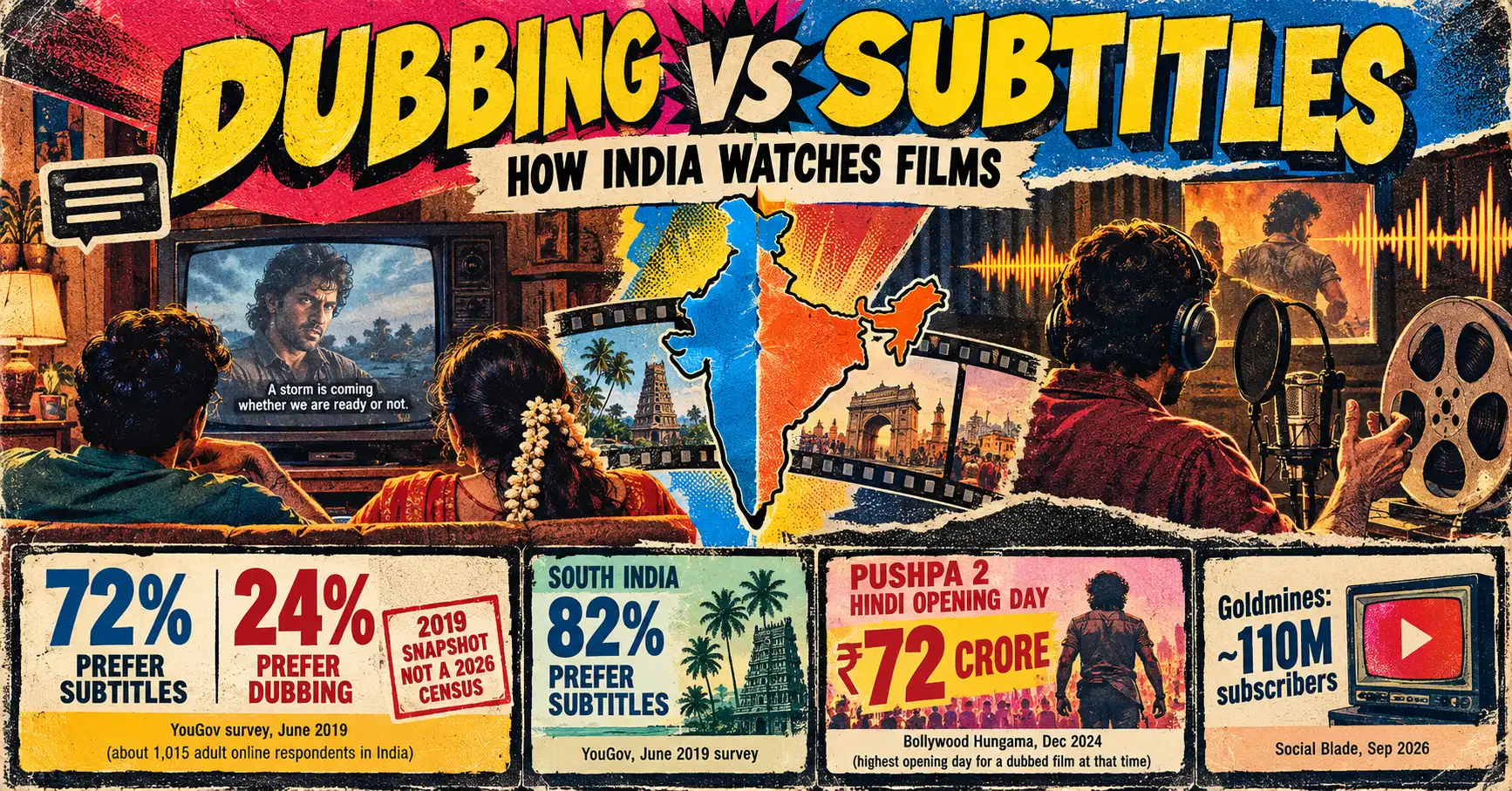
Put a friend from Chennai and a friend from Lucknow on one sofa. Press play on a Malayalam thriller. Before the opening credits end, you’ve got the entire dubbing vs subtitles India fight playing out in one living room. One of them wants the subtitle menu. The other is already hunting for the Hindi audio track.
Who’s right? Both, kind of.
But here’s the twist nobody talks about. Ask Indians what they prefer, and subtitles win by a mile. Look at what actually smashes box office records, and Hindi dubs win by an even bigger one.
Short version: subtitles win the argument, dubbing wins the ticket counter. The long version is way more fun, so numbers first, drama after.
Dubbing vs Subtitles India: What the Numbers Actually Say
The biggest India-specific survey on this is YouGov’s poll on how Indians watch foreign and regional content, and its headline number is blunt. 72% of Indians prefer subtitles. Only about 24% prefer dubbing.
Quick honesty check before we go further. YouGov ran that survey in 2019. Nobody has published a bigger India-specific study since, so it’s still the most recent large-sample data we have. Treat the exact percentages as a snapshot, not a 2026 census.
Now the juicy part, the regional split:
- South India: 82% prefer subtitles, the highest of any region. Just 16% want a dub.
- North India: 34% prefer dubbing.
- East India: 33% prefer dubbing.
So a viewer in the North or East is roughly twice as likely to reach for a dub as someone in the South. That’s not a small gap. That’s two different movie cultures sharing one remote.
Then comes the question of which subtitles. Among Indians who want foreign or regional content translated, 71% pick English and only 23% pick Hindi. Malayalam (14%) and Tamil (12%) speakers were the most likely to want content translated into their own language.
My read? English subtitles have quietly become the country’s neutral ground on screen. They don’t ask a Tamil viewer to accept Hindi. They don’t ask a viewer in Patna to learn Tamil. Everyone reads the same line of text and gets on with the film.
Why South India Prefers Subtitles (and the North and East Don’t)
You can’t explain that 82% without going back to 1965.
On 26 January 1965, Hindi was due to become India’s sole official language. Tamil Nadu erupted. Two months of anti-Hindi agitation followed, with around 70 deaths by official count and up to 500 by unofficial estimates. The movement also swept the DMK into power in 1967.
That history left a long shadow over the South: a deep wariness of anything that smells like “Hindi imposition.” A Hindi dub of a Tamil film isn’t imposition, obviously. But for some viewers, it can feel like a nudge in that direction.
Subtitles sidestep the whole issue. The original Tamil, Telugu or Malayalam voice stays on screen, untouched. Nobody’s language gets replaced.
The North and East see the same choice very differently. For a Hindi-speaking viewer, a Hindi dub carries zero political baggage. It’s just convenient. You can scroll your phone, chop onions, half-listen, and still follow the plot. No wonder the dubbing numbers roughly double once you leave the South.
So when your Chennai friend insists on subtitles, it’s rarely snobbery. More often, it’s identity. And that brings us to the money.
The Pan-India Boom: How Hindi Dubbing Made Baahubali 2, KGF 2 and Pushpa 2 National Hits
Here’s the contradiction I promised. The survey calls dubbing a minority taste. The box office says that minority is enormous.
The day-one ladder
When Pushpa 2: The Rule landed in December 2024, its Hindi-dubbed version opened to ₹72 crore on day one. Bollywood Hungama’s box office report called it the highest opening day ever for a dubbed film in India. Look at what it knocked down:
- Pushpa 2: The Rule (Hindi): ₹72 crore
- KGF: Chapter 2 (Hindi): ₹53.95 crore, the previous record holder
- Baahubali 2 (Hindi): ₹41 crore
Read that first line again. A Telugu film pulled ₹72 crore from its Hindi version alone, on a single day.
Put that next to the YouGov data and the logic gets simple. A 24% preference sounds small on a pie chart. Spread it across the Hindi-speaking North and East, and it becomes a huge crowd that wants to hear the hero talk in their language. Want the full picture of how these films get planned and sold across states? Our explainer on what a pan-India film actually is breaks it down.
Goldmines got there first
This is the part most “pan-India” think-pieces skip. Bollywood studios didn’t build this audience. A dubbing company did, years earlier.
Manish Shah founded Goldmines Telefilms in 2000. In 2007 the company pivoted to dubbing South Indian films, mostly Telugu and Tamil, into Hindi. Its first one? Mass (2004), re-released as Meri Jung: One Man Army.
Then it went big on YouTube, and things got a little absurd. As of 18 September 2026, the Goldmines channel sits at 110.4 million subscribers and 32.91 billion views. That puts it among the largest movie channels anywhere on the planet.
Think about what that means. Before trade analysts ever said “pan-India,” Hindi-speaking viewers were already bingeing South Indian action heroes, in Hindi, on YouTube. Those record openings didn’t come out of nowhere. Goldmines had spent more than a decade warming up the crowd.
Remakes are the other road South stories take into Hindi, and we’ve tracked that whole history in our guide to Bollywood remakes of South Indian films. A dub has one big edge over a remake, though. It keeps the original star on screen.
Sub vs Dub, Platform by Platform
Your OTT app makes half of this decision for you. Here’s how the big ones stack up on what we could actually verify.
Prime Video
Prime Video India gives you 41 language options. You can save up to five of them at a time as account-level audio and subtitle preferences. The list covers Hindi, Telugu, Tamil, Kannada, Malayalam, Bengali, Marathi, Punjabi and Gujarati, plus English and international languages.
That account-level setting matters more than it sounds. Set it once and you stop fiddling with menus every time a new Malayalam release drops. For a mixed sub-and-dub household, it’s the most flexible setup we could confirm.
Netflix, JioHotstar and SonyLIV
All three carry multiple audio tracks on plenty of titles, and all three lean on regional originals. What we couldn’t find is a verified, India-specific count of their dub and subtitle languages. So we’re not going to invent one.
Our advice? Before you pay for a plan, open the audio menu on two or three titles you actually want to watch. That tells you more than any spec sheet. If price is the deciding factor, our 2026 guide to OTT plans and prices in India lays out every option. If you mostly watch Tamil, Telugu or Malayalam films, check our JioHotstar vs SonyLIV vs ZEE5 verdict for South Indian content too.
Language, Pride and Identity: Why This Is Never Just About Convenience
Here’s what outsiders miss about the sub vs dub debate in India. People treat it like a settings choice. It isn’t.
Look at those YouGov numbers one more time. Malayalam and Tamil speakers are the most likely to want content translated into their own language. The same South that rejects Hindi dubs wants the world’s films in Malayalam and Tamil. So it’s not anti-dubbing at all. It’s about whose language gets the microphone.
Hindi viewers rarely feel that tension. Their language is usually the default dub, so the question never becomes personal.
Then there’s the performance itself. Voice is half of acting. A dub swaps out the actor’s timing, their breath, the crack in their voice during the big emotional scene. Sometimes the dubbing artist nails it. Often they just get close enough. Subtitles cost you some attention, sure, since you can’t scroll Instagram while reading. But you get the real performance.
That trade-off sits at the heart of the whole dubbing vs subtitles argument in India. Convenience on one side, authenticity on the other, and a lot of history in between.
Where India’s Dubbing Industry Is Headed in 2026
Whatever the surveys say, the dubbing business is booming.
Sukudo Studios, a dubbing vendor, puts India’s domestic dubbing market at ₹2,500–3,500 crore (roughly $300–420 million) in 2026. Its projection has the market roughly doubling to ₹5,000–7,000 crore by 2029. A caveat, though: this is an industry vendor’s estimate, not a government or FICCI figure. Take it as a direction of travel, not gospel.
That estimate covers a lot more than movies:
- Film dubbing
- OTT localisation
- Micro-dramas
- Creator and YouTube content
- Corporate and e-learning videos
Sukudo points to streaming growth, micro-drama localisation and AI-assisted dubbing as the big drivers.
AI dubbing is the one I’d watch closely. Cheaper dubs could mean more languages on more titles, which is great for a country with this many mother tongues. It could also mean a flood of flat, lifeless voices if studios cut corners. The dubbing vs subtitles question in India might get a third answer soon: a machine voice nobody asked for.
Verdict: Dub or Sub, Which One Is Paisa Vasool?
No single answer fits every film. But here’s how we’d call it.
Go with subtitles when:
- The performance is the whole point, like a slow-burn Malayalam thriller or a dialogue-heavy family drama.
- You’re watching alone and can give the screen your full attention.
- You’re in a mixed-language group. English subtitles keep everyone on the same page, literally.
Go with the dub when:
- It’s a loud mass entertainer and the family’s watching together.
- You’re half-watching while cooking, commuting or scrolling.
- Nobody in the room reads fast enough to keep up with rapid-fire dialogue.
Our take? Subtitles by default. They’re the only way to see the film the director actually made. Keep the Hindi dub for the big masala nights, when the whistles matter more than the nuance.
And honestly, the numbers suggest India has already made its peace with both. Seventy-two percent of us say we want subtitles, yet a dubbed Telugu film still pulled ₹72 crore in Hindi on one day. So which camp are you in, and has one film ever made you switch sides?