
History of Indian Cinema: Raja Harishchandra to Pan-India
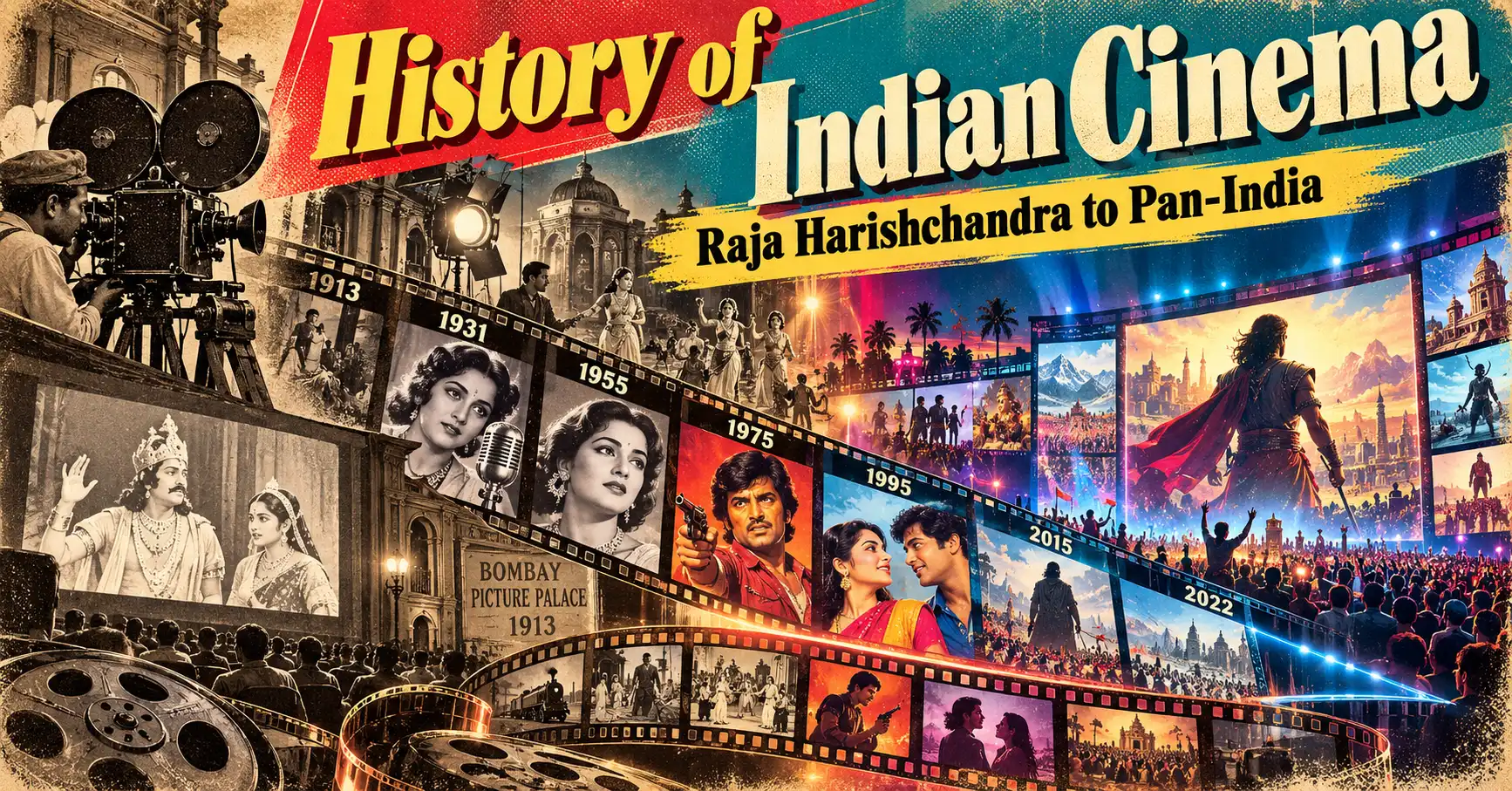
A king, a queen played by a man, and a 40-minute film that only half survives. That’s where the history of Indian cinema really begins: 3 May 1913, in a hall in Girgaon, Bombay.
Fast-forward a century. A song from RRR wins an Oscar. A Kannada film posts the biggest Hindi opening day India had seen. And in 2022, Telugu films sell more tickets than Hindi ones.
How did we get here? Below you’ll find every major era, one must-watch film for each, and the box office numbers behind the pan-India shake-up. No textbook tone, promise. Chalo, rewind.
History of Indian Cinema at a Glance: The Quick Timeline
Short on time? Here’s the whole story in 12 stops.
- 1896: Lumière films screen in Bombay, the same year they reach London.
- 1913: Dadasaheb Phalke’s Raja Harishchandra premieres. The silent era begins.
- 1931: Alam Ara arrives on 14 March and Indian films start talking (and singing).
- 1934: Bombay Talkies opens. The studio era takes shape.
- 1955: Satyajit Ray’s Pather Panchali premieres. The Golden Age hits its stride.
- 1957: Mother India earns an Academy Award nomination.
- 1960: Mughal-E-Azam becomes the most expensive Indian film of its time.
- 1975: Sholay releases and runs for over five years in one Mumbai theatre.
- 1986: India’s output hits 833 films a year, the most of any country.
- 1995: DDLJ releases. It was still playing as of January 2026.
- 2015: Baahubali: The Beginning kicks off the pan-India wave.
- 2022: KGF: Chapter 2 and RRR land, and Telugu admissions overtake Hindi.
Now let’s slow down and do this properly.
Before 1913: Bombay Watched Movies the Same Year as London
The history of Indian cinema starts earlier than most people think. Lumière films played in Bombay in 1896, the same year they reached London.
Think about that for a second. No six-month lag, no “coming soon to India.” Bombay audiences saw moving pictures right alongside Londoners.
Watching is one thing, though. Making a full Indian feature, with an Indian crew, took one very stubborn man.
The Silent Era (1913–1931): Dadasaheb Phalke Starts It All
Dadasaheb Phalke didn’t just direct Raja Harishchandra. He handled the editing and the film processing himself too, with an all-Indian crew. A one-man film school, basically.
The film premiered on 3 May 1913 at the Coronation Cinematograph and Variety Hall in Girgaon. It ran about 40 minutes, roughly 3,700 feet of film across four reels.
The casting had its quirks:
- Dattatraya Dabke played King Harishchandra.
- Bhalchandra, Phalke’s own son, played the prince Rohitashva.
- Anna Salunke, a man, played Queen Taramati.
Raja Harishchandra also carried intertitles in English, Marathi and Hindi. Three languages on one print. Call it pan-India thinking, 102 years before Baahubali.
Why You Can’t Watch the Whole of Raja Harishchandra
Here’s the gut-punch. The film survives only in part. The National Film Archive of India holds just the first and last reels (Raja Harishchandra on Wikipedia).
A 1917 fire destroyed the original prints. Phalke then shot the film again. Historians still argue over which version those surviving reels come from.
That’s a sad pattern in the history of Indian cinema. Some of its biggest milestones barely exist anymore.
Must-watch (sort of): Hunt down what survives and read up on the rest. Knowing a man played the queen makes those fragments way more fun.
1931: Alam Ara and the Talkie Revolution
On 14 March 1931, Indian films found their voice. Ardeshir Irani directed Alam Ara for the Imperial Film Company. Master Vithal, Zubeida and Prithviraj Kapoor starred.
It packed seven songs. That detail matters more than it looks.
Alam Ara showed that audiences wanted films in a language they actually understood. It also made songs part of the DNA of the Indian film. Every chartbuster you’ve hummed on the walk out of a theatre traces a line back here.
Now the bad news. No print of Alam Ara survives. In 2017 the BFI called it “the most important lost film of India.”
India’s first talkie, and nobody alive can watch it. Oof.
The Studio Era: Bombay Talkies, Prabhat and the 1930s–40s
Once films could talk, studios moved in. Bombay Talkies opened in 1934. Over in Pune, Prabhat Studios made Marathi films.
So even in the 1930s, the history of Indian cinema wasn’t a Hindi-only story. Marathi had a serious studio of its own from early on. Keep that in your head, because the regional thread pays off big later.
Must-watch: We won’t pretend there’s a clean pick. Alam Ara is gone, and this era’s surviving films deserve their own deep dive. Treat the studio years as your bridge to the Golden Age.
The Golden Age of Indian Cinema (Late 1940s–1960s)
Ask a film buff to name the best stretch in Indian cinema’s history and plenty will point here. Social realism, parallel cinema and grand spectacle all thrived in the same two decades.
Three films tell you most of what you need to know.
Pather Panchali (1955): Made on Pawned Insurance
Satyajit Ray’s debut is a proper underdog story. He pawned his life insurance and sold records to fund it. The budget sat somewhere between ₹70,000 and ₹1.5 lakh.
The shoot dragged on for three stop-start years. Ray later credited plain luck for getting it finished. Apu’s voice didn’t break. Durga didn’t grow up. And the actor playing Indir Thakrun lived long enough to wrap.
Then comes a lovely coincidence. Pather Panchali premiered at New York’s Museum of Modern Art on 3 May 1955. That’s exactly 42 years to the day after Raja Harishchandra.
It reached Indian screens on 26 August 1955. In 1956 it won the Best Human Document award at Cannes. Ray finished the Apu Trilogy by 1959.
Mother India (1957): India Knocks on the Oscar Door
Mother India earned an Academy Award nomination. That put it at the top of a very short list. When Lagaan earned its nod decades later, only Mother India and Salaam Bombay! (1988) had done it before.
Mughal-E-Azam (1960): The Biggest Gamble of Its Time
K. Asif started developing Mughal-E-Azam in 1944. It finally released on 5 August 1960, 16 years later. Patience level: legendary.
It cost somewhere between ₹1.05 crore and ₹1.5 crore. That made it the most expensive Indian film of its era. The gamble paid off, too. It stayed the highest-grossing Hindi film for 15 years, until Sholay showed up.
On 12 November 2004, a colourised version hit theatres. Mughal-E-Azam became the first black-and-white Hindi film to get that treatment.
Must-watch: Pather Panchali for the heart. Mughal-E-Azam for the spectacle (the 2004 colour version is a great entry point).
The Masala Era: Sholay and the 1970s–80s
If the Golden Age was poetry, the 70s were pure paisa vasool.
Sholay landed on 15 August 1975. Ramesh Sippy directed it and Salim-Javed wrote it. People call it a “Curry Western,” and the label fits. It mixes the old dacoit-film tradition with spaghetti western swagger.
The numbers are wild:
- It earned around ₹35 crore at the box office.
- It ran for more than five years at Mumbai’s Minerva theatre.
- It ended Mughal-E-Azam’s 15-year reign and stayed the highest-grossing Indian film until Hum Aapke Hain Koun in 1994.
Quick reality check: box office figures for films this old are estimates. Treat them as ballpark numbers, not tracker-grade data.
The industry got huge in this stretch, too. By 1986 India was making 833 films a year, the most of any country on the planet.
Must-watch: Sholay. Non-negotiable. If you’ve only seen the memes and the dialogue clips, watch the real thing start to finish.
The 90s: DDLJ and the Romance That Never Left the Theatre
Hum Aapke Hain Koun finally knocked Sholay off the top in 1994. A year later came the film that simply refuses to leave.
Dilwale Dulhania Le Jayenge released on 20 October 1995. As of January 2026, it’s still running at Mumbai’s Maratha Mandir. No other film in Indian cinema history has run longer.
It crossed 1,000 weeks there in December 2014. Its worldwide gross stands at ₹102.5 crore.
Three decades. One theatre. Let that sink in.
Must-watch: DDLJ. Even if you swear you’re too cool for 90s romance.
The 2000s: Lagaan Takes India Back to the Oscars
Lagaan released on 15 June 2001, directed by Ashutosh Gowariker. It earned a Best Foreign Language Film nomination at the 74th Academy Awards.
It lost to No Man’s Land. Still, it was one of the proudest moments in Indian cinema history. Lagaan became only the third Indian nominee ever, after Mother India and Salaam Bombay!
For a generation of viewers, that nomination said something simple. Our stories travel.
Must-watch: Lagaan. Block out an evening for it.
The Pan-India Era: How Baahubali Rewrote the History of Indian Cinema
Everything above is mostly a Hindi-centric story with regional side plots. Then 2015 flipped the script.
Baahubali: The Beginning (2015)
S. S. Rajamouli’s film released on 10 July 2015 in Telugu, Tamil, Hindi and Malayalam. Its ₹170 crore budget made it India’s most expensive film at the time.
It made ₹600–650 crore worldwide. Its Hindi dub became the highest-grossing dubbed film in Hindi.
Bigger than any number, though, was the idea it proved. A film from one language could be everybody’s film. That’s what “pan-Indian” means, and Baahubali kicked the door wide open.
2022: KGF: Chapter 2 and RRR
RRR came out on 25 March 2022. It cost ₹550 crore and grossed ₹1,300–1,387 crore worldwide. Then “Naatu Naatu” won Best Original Song at the 95th Academy Awards. No song from an Asian film had won that category before.
KGF: Chapter 2 followed on 14 April 2022. Prashanth Neel made it in Kannada, with four dubbed versions. Its Hindi version opened at ₹53.95 crore, the biggest Hindi opening day at that point.
A Kannada film. The biggest Hindi opening. Read that twice.
KGF 2 went on to collect ₹1,200–1,250 crore worldwide. Every mega-budget epic now gets measured against these two. Our Ramayana vs Adipurush breakdown asks whether the next big mythological film can clear that bar.
The Numbers Behind the Shift
Here’s where it gets spicy. Deadline crunched India’s ticket sales for 2019 and 2022 (Deadline via Yahoo News):
- Hindi admissions fell from 341 million to 189 million.
- Telugu admissions rose from 182 million to 233 million.
- Hindi’s market share slid from 44% to 33%. Telugu’s jumped from 13% to 20%.
- Total admissions dropped from 1.03 billion to 892 million.
And the kicker? 32% of Hindi’s 2022 share came from Hindi-dubbed South films like KGF 2 and RRR. Even Bollywood’s own numbers leaned on the South.
One caution before you start a fan war. Gross collections can mislead, because tickets got pricier. The average ticket rose from $1.28 to $1.44 over those years, about 12%. Admissions tell you who actually showed up. Want the full math? Read our explainer on how box office collection is calculated in India.
Not Just Bollywood: The Regional Thread That Runs Through Everything
Step back and look at the full history of Indian cinema, and one thing jumps out. Regional cinema was never a side plot.
- The first feature carried Marathi intertitles alongside Hindi and English.
- Prabhat Studios made Marathi films in Pune in the 1930s.
- Baahubali, the film that started the pan-India wave, released in Telugu, Tamil, Hindi and Malayalam.
- KGF 2, a Kannada original, set the Hindi opening-day record.
The difference now? The money finally matches the talent. Regional industries took roughly 60% of India’s 2024 box office, with Hindi at about 40%.
Where Indian Cinema Stands Today (2024–2025)
India’s box office grossed ₹11,833 crore in 2024. Then 2025 smashed it. The total hit ₹13,395 crore, the first year above ₹13,000 crore (Hollywood Reporter India).
Here’s how the 2025 pie split:
- Hindi: ₹5,504 crore (41%)
- Telugu: ₹2,377 crore (18%)
- Tamil: ₹1,805 crore (13%)
- International: ₹1,403 crore (10%)
- Malayalam: ₹1,164 crore (9%)
- Kannada: ₹528 crore (4%)
Bollywood hit a record high and still owned less than half the market. If you want the history of Indian cinema in one line, that’s it. It was never only Bollywood.
There’s a catch, though. Average ticket prices climbed 20% in 2025, even as attendance fell. Admissions came to 832 million. Fewer people, pricier seats.
My bet for what’s next? Fewer, bigger theatrical events, with multi-language releases as the default. The South wrote the template. Expect everyone else to copy it. You can track how this year’s contenders are doing in our list of the highest-grossing South Indian movies of 2026.
Your Era-by-Era Watchlist: Indian Cinema History in 10 Films
Want to actually experience the evolution of Indian cinema instead of just reading about it? Start here, in order:
- Raja Harishchandra (1913), Dadasaheb Phalke. Only the surviving reels, but it’s where everything starts.
- Pather Panchali (1955), Satyajit Ray. The underdog debut that went from MoMA to Cannes.
- Mother India (1957). India’s first Oscar nominee.
- Mughal-E-Azam (1960), K. Asif. Sixteen years in the making. You’ll see why.
- Sholay (1975), Ramesh Sippy. The Curry Western that ran for five-plus years in one theatre.
- Dilwale Dulhania Le Jayenge (1995). Still playing at Maratha Mandir. Respect.
- Lagaan (2001), Ashutosh Gowariker. The Oscar run that made a generation believe.
- Baahubali: The Beginning (2015), S. S. Rajamouli. Patient zero of pan-India cinema.
- RRR (2022). Stay for “Naatu Naatu,” obviously.
- KGF: Chapter 2 (2022), Prashanth Neel. The Kannada film that broke the Hindi opening record.
Not sure where to stream the older ones? Catalogues keep shifting, so check our Netflix vs Prime Video vs JioHotstar comparison before you pay for yet another subscription.
Picture Abhi Baaki Hai
Here’s the part of the history of Indian cinema that gets me. India’s first feature survives in fragments. India’s first talkie doesn’t survive at all. Meanwhile, DDLJ has played in the same Mumbai theatre for three decades.
Indian cinema has always been terrible at saving its past and brilliant at reinventing its present. The next big shift won’t come with an announcement, either. It’ll show up in the admission numbers first, exactly like Telugu’s did in 2022.
So which era are you starting with tonight? Sholay for the masala, or Pather Panchali for the heart? Tell us in the comments, and fight for your pick.