
How Much Do Bollywood Stars Charge Per Film? South Stars, Profit Share and Why Budgets Balloon
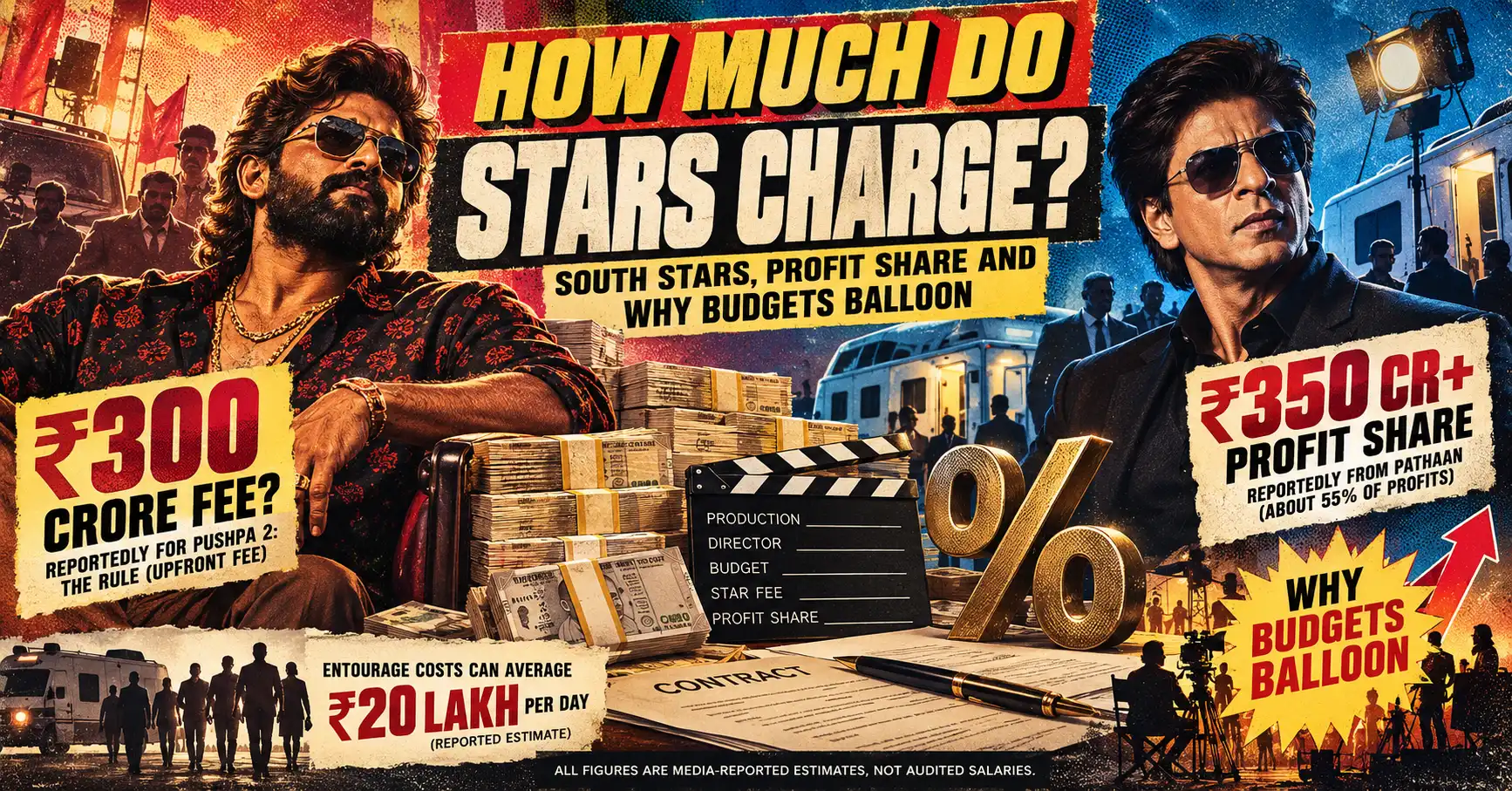
How much do Bollywood stars charge per film? Start with this number: Rs 300 crore. That’s what Allu Arjun reportedly took for Pushpa 2: The Rule. Not the budget, boss. The fee.
And he isn’t even a Bollywood star.
That’s the twist most fee lists skip. The biggest upfront cheques in Indian cinema now go south. Shah Rukh Khan, meanwhile, reportedly made Rs 350 crore-plus from Pathaan by taking a cut of the profit. Salman Khan reportedly earns through satellite and digital rights. Same industry, completely different payslips.
One promise before the numbers. Every figure here is a reported estimate, because nobody in India publishes audited star salaries. So we tell you who reported what, and when. We won’t pass off a gossip gallery as a payslip.
How Much Do Bollywood Stars Charge Per Film? The Short Answer
Here’s the quick-scan version. Unless we say otherwise, the figures come from The Hollywood Reporter India’s star-fee roundup, last updated on 24 December 2024. It’s still the most complete single list we’ve found. Better still, it explains how each star gets paid, not just how much.
| Star | Industry | Reported Fee or Deal | How They Get Paid |
|---|---|---|---|
| Shah Rukh Khan | Hindi | Rs 350 crore-plus from Pathaan | Profit share (about 55%) |
| Allu Arjun | Telugu | Rs 300 crore (Pushpa 2: The Rule) | Upfront fee |
| Vijay | Tamil | Rs 275 crore (Thalapathy 69); Rs 200 crore-plus (GOAT) |
Upfront fee |
| Salman Khan | Hindi | About Rs 200 crore-plus | Satellite & digital rights |
| Prabhas | Telugu | Rs 150-200 crore | Upfront fee |
| Hrithik Roshan | Hindi | Rs 100 crore (Fighter) | Fee + profit share (YRF) |
| Ranbir Kapoor | Hindi | About Rs 80 crore | Fee + profit share (select) |
| Akshay Kumar, Ajay Devgn | Hindi | Rs 70-80 crore each | Standard fee |
| Aamir Khan | Hindi | About 60% of profits | Profit share |
| Deepika Padukone | Hindi | Rs 20 crore-plus | Upfront fee |
| Mohanlal, Mammootty | Malayalam | Rs 6-12 crore (Mohanlal up to Rs 14 crore) | Upfront fee |
All figures are media-reported estimates, not audited. Source: THR India, December 2024.
Spot the pattern? The three biggest upfront fees on this list all belong to South stars. The Khans don’t even compete in that column. They play a different game, and on a hit, it pays better.
THR India splits star pay into four modes. Once you know them, every “XYZ charges Rs 200 crore!” headline starts making sense. Or stops making sense, depending on the headline.
1. Upfront fee (the flat fee)
The producer agrees a fixed amount with the star. Hit or flop, that money belongs to the star. Allu Arjun, Vijay and Prabhas all sit in this bucket in THR’s reporting.
For the actor, it’s zero risk. For the producer, it’s a fixed cost. The film has to earn it back before anyone sees a rupee of profit.
Here the star bets on the film. Instead of a giant fixed cheque, they take a percentage of whatever profit the film makes. THR puts Shah Rukh Khan’s cut at about 55% and Aamir Khan’s at about 60%.
It isn’t only a Khan thing. THR names Hrithik Roshan (on his YRF films) and Ranbir Kapoor (on some films). Varun Dhawan went the same way on Jugjugg Jeeyo and Bhediya. Alia Bhatt reportedly works in her Rs 10-15 crore range “with profit options”.
3. Distribution or rights deals
Some stars skip the cash and take a slice of the film’s business instead. Salman Khan reportedly takes satellite and digital rights revenue, worth about Rs 200 crore-plus. He doesn’t take a theatrical share.
The cleverest example comes from Malayalam cinema. Dulquer Salmaan took the Kerala distribution rights for his cameo in Kalki 2898 AD, through his own banner, Wayfarer Films. A cameo, paid for with a whole state’s distribution. Full marks for that one.
THR lists this as the fourth mode. The difference from profit share is simple. Revenue is the money coming in. Profit is what’s left after costs. So a revenue cut starts paying out earlier. Safer for the star, pricier for the producer.
Worked example: the Pathaan math
Let’s run THR’s own numbers on Pathaan:
- Global gross: about Rs 1,000 crore
- Profit: Rs 600 crore-plus
- SRK’s reported cut: about 55%
- 55% of Rs 600 crore = Rs 330 crore
THR reports SRK’s take at Rs 350 crore-plus. That fits, since the profit figure itself is “600-plus”. Treat this as back-of-envelope arithmetic, not his actual contract.
Still, it proves the point. On a monster hit, a backend deal can beat even the fattest flat fee in this guide.
Now flip it. If Pathaan had tanked, 55% of zero is zero.
Confused by gross, nett and share? Our explainer on how box office collection is calculated in India breaks down why no two trackers agree.
How the Khans Get Paid
Three superstars. Three completely different playbooks.
Shah Rukh Khan, the backend king. About 55% of profit, per THR. Pathaan alone reportedly earned him Rs 350 crore-plus. SRK doesn’t need a headline fee. He needs a hit, and Pathaan was one.
Aamir Khan, the bigger slice. THR puts his cut at about 60%, a notch above SRK. That’s a bigger bet, and a bigger reward when the film lands.
Salman Khan, the rights man. No theatrical share, per THR. Instead, he takes satellite and digital rights revenue worth about Rs 200 crore-plus. Translation: his money comes from TV and streaming deals, not the ticket window.
One caution. Neither the 55% nor the 60% figure has been independently confirmed. Hold them loosely.
Our read? The Khans can pull this off because they have leverage most actors can only dream of. A mid-tier actor on profit share who delivers a flop goes home with very little. That’s why most of Bollywood still takes the cheque.
Bollywood Star Fees: A-List, Mid-Tier and Actresses
Below the Khans, how much Bollywood stars charge per film drops fast. Here’s THR’s December 2024 snapshot for the rest of the Hindi A-list and the mid-tier.
| Actor | Reported Fee Per Film |
|---|---|
| Hrithik Roshan | Rs 100 crore (Fighter); Rs 60-70 crore (Vikram Vedha) |
| Ranbir Kapoor | About Rs 80 crore |
| Akshay Kumar | Rs 70-80 crore |
| Ajay Devgn | Rs 70-80 crore |
| Ranveer Singh | Rs 50-60 crore |
| Kartik Aaryan | Rs 40 crore (after Bhool Bhulaiyaa 3) |
| Varun Dhawan | Rs 30 crore |
| Shahid Kapoor | Rs 30 crore |
| Vicky Kaushal | Rs 25-30 crore |
| Ayushmann Khurrana | Rs 15-18 crore |
| Rajkummar Rao | Rs 15-18 crore |
Two things jump out. Hrithik’s price climbed from Rs 60-70 crore for Vikram Vedha to Rs 100 crore for Fighter. And Kartik Aaryan’s Rs 40 crore figure came after Bhool Bhulaiyaa 3. That’s how this market works. A hit resets the rate card.
Want to see who’s actually earning back these fees this year? Our running list of the highest-grossing Bollywood movies of 2026 is the real scoreboard.
Actresses: the pay gap is brutal
| Actress | Reported Fee Per Film |
|---|---|
| Deepika Padukone | Rs 20 crore-plus |
| Nayanthara | Rs 15 crore |
| Alia Bhatt | Rs 10-15 crore (with profit options) |
| Kareena Kapoor | Rs 10-15 crore |
| Shraddha Kapoor | Rs 10 crore |
| Kiara Advani | Rs 6-7 crore |
| Kajol | Rs 6-7 crore |
| Kriti Sanon | Rs 4-6 crore |
| Triptii Dimri, Ananya Panday, Sara Ali Khan, Janhvi Kapoor | Rs 2.5-3 crore each |
Deepika Padukone tops the list at Rs 20 crore-plus. That’s a fifth of Hrithik’s Fighter fee. Next to Allu Arjun’s Pushpa 2 cheque, it’s roughly one-fifteenth.
Lower down, it gets grim. Triptii, Ananya, Sara and Janhvi sit at Rs 2.5-3 crore each. Varun Dhawan alone reportedly charges about ten times that.
Honestly? Alia’s “profit options” might be the smartest move on this table. Bet on your own film, and the ceiling stops being someone else’s decision.
South Indian Actors’ Remuneration Per Film
This is where the big upfront money lives now.
Telugu: Allu Arjun and Prabhas
Allu Arjun’s reported Rs 300 crore for Pushpa 2: The Rule is the biggest upfront figure in this guide. Prabhas sits in the Rs 150-200 crore upfront bracket.
Both take flat fees, and that tells you something. Producers sign cheques that size only when they believe the star can open a film on his own.
Tamil: Vijay and Nayanthara
Vijay reportedly took Rs 200 crore-plus for The Greatest Of All Time. For Thalapathy 69, the reported figure climbs to Rs 275 crore. Wondering why fans treat him like a one-man industry? Start with our Thalapathy Vijay movies ranked.
Nayanthara’s reported Rs 15 crore puts her behind only Deepika on THR’s actress list. She’s level with the top of Alia and Kareena’s range.
Malayalam: smaller cheques, smarter deals
Mammootty and Mohanlal reportedly take Rs 6-12 crore, with Mohanlal going up to Rs 14 crore. Tiny next to Telugu or Tamil, sure. But Malayalam is also where Dulquer pulled off that Kerala rights deal. We’d love to see more stars think like that.
What about Kannada? We couldn’t find a Kannada fee figure solid enough to print, so we haven’t guessed one.
To see how these fees stack up against actual collections, check our tracker of the highest-grossing South Indian movies of 2026.
Why Film Budgets Balloon (It’s Not Just the Fee)
“It is not so much about production cost — it is more about star fees.” That’s producer Ramesh Taurani, speaking to AFP. The same AFP report puts star fees at up to US$22.18 million per film.
Then come the extras. One actor usually brings 10 to 15 staff, according to AFP. A single trailer on a shoot can cost up to US$18,000.
The entourage bill
Storyboard18 laid out the daily math:
- Each entourage member charges Rs 50,000-60,000 a day. Think hair and makeup, assistant, security, chef, trainer and physio.
- Hair and makeup alone runs Rs 1-2 lakh a day.
- Over a 60-day shoot, producers pay more than Rs 1 crore on top of the star’s fee.
THR India ran its own entourage breakdown in September 2025. It puts a major star’s full daily setup at about Rs 20 lakh. Some line items:
- Stylist: Rs 75,000 to Rs 1 lakh-plus
- Vanity van: Rs 50,000
- Spot boy: Rs 20,000-25,000
- Security: Rs 15,000
One anonymous producer told Storyboard18 that a Rs 100 crore film needs another Rs 100 crore for the lead actor and entourage. That’s one voice, unnamed. Read it as a mood, not a measurement.
Here’s the bit we found fascinating. Entourage pay rides on the star’s own rate. THR found a makeup artist whose pay fell from Rs 3 lakh to Rs 1 lakh. Why? The actress’s endorsement rate had dropped from Rs 20 lakh to Rs 10 lakh. One line from that report says it all: “If their films don’t work, we won’t earn.”
Perks and agencies
AFP describes first-class travel, five-star hotels, multiple trailers and “work-shy hours” as routine. Producers foot all of it.
Who sets these terms now? Storyboard18 argues talent agencies do. In its telling, agencies dictate deals and inflate fees, and producers lost control. Producer Viveck Vaswani put it bluntly: “Previously, we had control. Now, we’re just a cog in a corporate machine.”
Karan Johar sounds just as fed up. “There are about ten viable actors…and they are all asking for the sun, moon, and earth.”
What producers (and one star) say
Producer Mukesh Bhatt didn’t hold back either: “The kind of demands stars make is obnoxious.” Zoya Akhtar’s fix is even simpler: “You have to just stop paying. That’s it.”
Kartik Aaryan sees it differently. “If your star value gives profit to the entire team, the math adds up.” Fair point, if the film actually makes that profit.
Blame isn’t one-sided, though. THR’s entourage report carries a view we half agree with. Nobody forces producers to spend this money, so complaining afterwards gets a bit circular.
Do Stars Get Paid If the Film Flops?
It depends entirely on the deal. None of our sources tests this on a specific flop, so here’s the plain logic:
- Flat fee: Yes. The money’s already theirs. The producer eats the loss.
- Profit share: Only if there’s profit. A flop means little or nothing from the backend.
- Revenue share: Usually something, because revenue comes in even when a film loses money.
- Rights deals: It depends on what those rights fetch.
That’s exactly why producers keep pushing profit share. Trade analyst Fenil Seta told Storyboard18: “Ideally, all major actors should opt for profit sharing.” Mukesh Bhatt points to Hollywood, where actors get equity stakes alongside their earnings. India, by contrast, still runs mostly on upfront fees.
You can see the shift happening. In 2024 the talk was mostly about fees being too high. By 2025, producers were openly calling for profit share instead.
Can You Trust These Numbers?
Not completely. Ask five sites how much Bollywood stars charge per film and you’ll get five answers.
Take SRK. Some fee galleries quote him at Rs 150-300 crore. THR reports Rs 350 crore-plus. Both can sound right, because one may count a fee and the other a profit cut. Don’t average them. You’d get a number nobody ever reported.
Our quick checklist for any star-fee headline:
- What’s being counted? Fee, profit share, or rights are three different things.
- When was it reported? A 2024 figure isn’t a 2026 figure.
- Who said it? No named source, no trust.
- Is it a range? Wide ranges usually mean guesswork.
We dropped a couple of widely shared Pathaan and Jawan economics pages for exactly this reason. We couldn’t verify them, so they’re not here.
Here’s where we land. Flat fees made sense when one star could guarantee an opening. Now producers are paying Rs 300 crore cheques plus a Rs 20 lakh-a-day entourage, and they’re still the ones taking the hit on a flop. That’s not a partnership. That’s a loan with no repayment clause.
SRK and Aamir already show the other way works. If a star truly believes in the film, a backend deal is the most confident move there is. So the next time someone asks how much Bollywood stars charge per film, maybe the better question is this: how much are they willing to risk?
Who on these lists do you think is actually worth the money? Drop your pick in the comments. We’re keeping this guide updated as new fee figures surface.