
How Movie Break-Even Point Works in India: Budget vs P&A
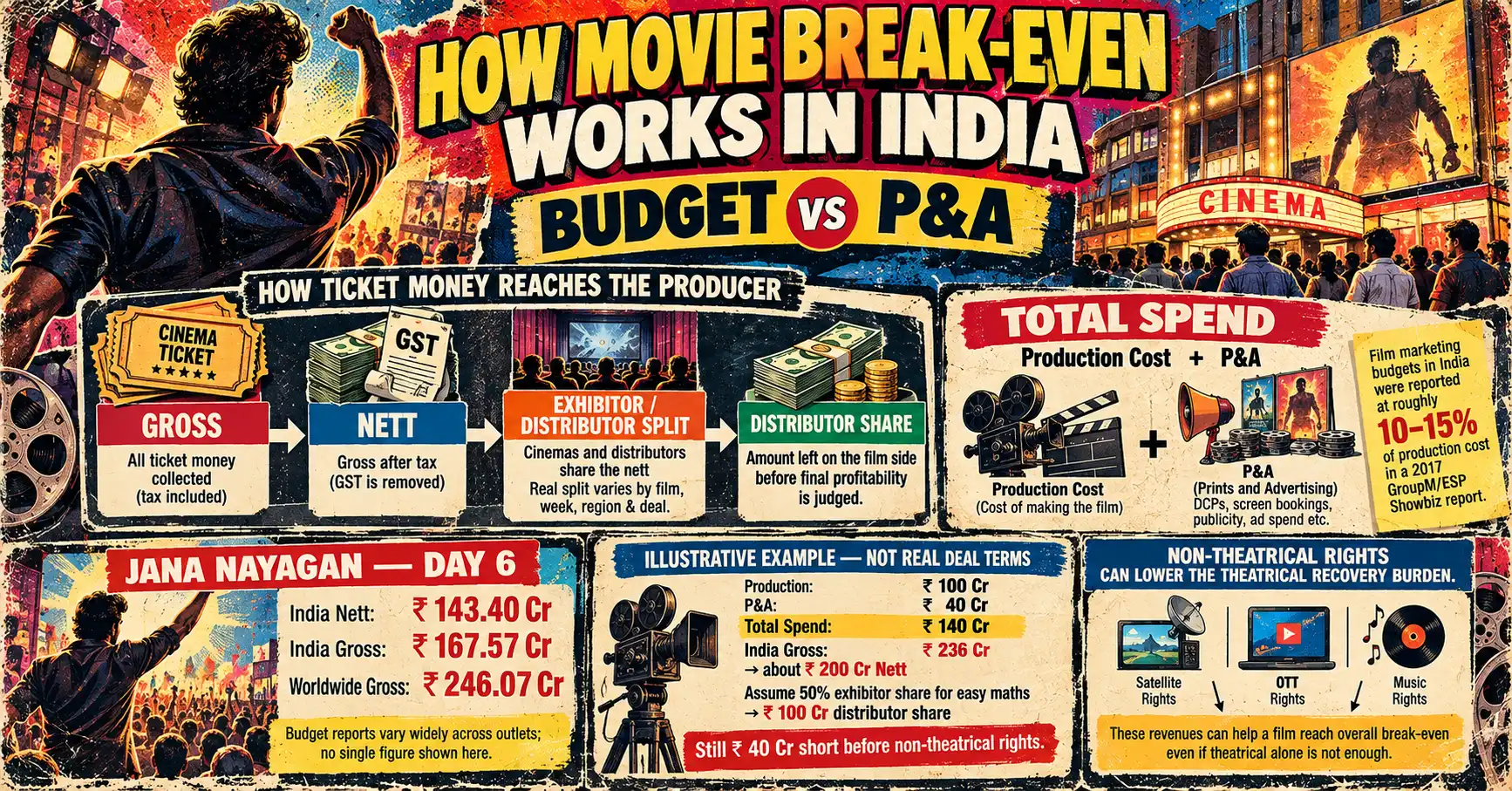
Jana Nayagan made over ₹246 crore worldwide in six days. Massive, right? Yet trade estimates said the film had recovered only about 42% of its cost by the end of that first week. That gap is the whole story of how movie break-even point works in India, and hardly anyone explains it properly.
Here’s the short version. The number on the poster isn’t the number the producer banks. Taxes take a slice. Cinemas take a slice. Marketing eats a chunk that never shows up in the “budget” headlines. Only after all that do you find out whether a film actually made money.
If you follow our day-wise trackers, you’ve probably wondered about this yourself. So let’s settle it, with real rupee maths and a real film.
Why a ₹100 Crore Film Can Still Lose Money
Budget isn’t break-even. Treat them as two completely different numbers and half the confusion disappears.
A film’s verdict depends on what it cost, not on some fixed rupee target. NewsX puts it neatly: a movie earning ₹150 crore on a ₹50 crore budget is a clear success. The same ₹150 crore against a ₹300 crore budget reads as a flop.
Same collection. Opposite verdicts.
So when a tracker screams “₹100 crore club!”, ask two quick questions. ₹100 crore against what budget? And ₹100 crore of which number? Gross, nett and distributor share are three very different things. The gap between them decides whether the producer celebrates or quietly starts selling off assets.
Production Cost vs P&A: The Two Budgets Every Film Has
When a news report says “₹300 crore budget”, it usually means the production budget. That’s the cost of actually making the film.
Then there’s P&A, short for prints and advertising. This is the money a film spends getting released and sold to you. According to Thoolie’s P&A explainer, it covers:
- DCP creation, the digital “prints” cinemas actually screen
- Screen bookings
- Publicity, including publicist fees
- Ad spend
Here’s the bit that surprises most people. On a wide theatrical release, P&A “frequently rivals or exceeds production costs,” per the same explainer. Readers constantly mix the two up, but they’re separate line items.
Hollywood has some wild examples. Get Out (2017) cost $4.5 million to make and spent around $30 million on P&A. That’s about 6.7 times its production cost, just on releasing and marketing it. The Nun (2018) spent $25–35 million on P&A against a $22 million budget.
Does every Indian film spend like that?
No, and it’s worth being fair here. A small, limited release folds marketing into a much smaller line. A pan-India wide release is where P&A balloons into a bill close to the production budget itself.
Our take: whenever a producer announces a budget, mentally add P&A on top. The real spend is bigger than the headline, sometimes by a lot.
How Theatrical Revenue Actually Reaches the Producer
Think of ticket money as water running down a staircase. Each step keeps some and passes the rest along.
Step 1: Gross collection
Gross is everything the ticket counters take in, tax included. It’s the biggest, shiniest number. No surprise that promotional posters love it.
Step 2: Nett collection (gross minus GST)
Nett is gross minus GST. DNA India’s box office explainer uses a clean example: a ₹118 crore gross works out to roughly ₹100 crore nett.
That’s ₹18 crore gone before a single rupee reaches the film’s side of the table.
Step 3: The exhibitor’s cut
Next, the cinema owner (the exhibitor) keeps its agreed share. There’s no single fixed split. It changes by film, by region and even by week.
The deal usually favours the distributor in week one, then tilts steadily toward the cinema as the run continues. This is why the opening weekend matters so much. A rupee earned in week one is worth more to the producer’s side than a rupee earned in week four.
Whatever survives steps 2 and 3 is the distributor share. Trade analysts treat this as the truest profitability signal. It means far more than the headline collection number you see in trackers.
This is the money that has to recover distribution costs and, eventually, turn a profit.
A quick warning about mismatched numbers
One wrinkle before we do the maths. Hindi trade coverage usually quotes nett figures. South Indian coverage more often quotes worldwide gross under the same “100 crore” label.
We untangled that mess in our guide on how box office collection is calculated in India. The short version? Never compare two films unless both numbers measure the same thing.
How Movie Break-Even Point Works in India: The Formula
Put the steps together and the logic clicks. The producer’s side only nets a fraction of what audiences pay at the counter. So the gross has to be a multiple of the total spend before that fraction covers the bill.
Here’s the formula in plain words:
- Total spend = production cost + P&A
- Nett = gross − GST
- Distributor share = nett − exhibitor’s cut
- Break-even = the point where distributor share, plus any rights income, covers total spend
That’s where the famous industry rule of thumb comes from. A wide release needs to earn roughly twice its production budget just to cover P&A and distribution costs. Thoolie describes this as a structural result of theatrical revenue-sharing, not an arbitrary markup.
But treat “2x” like a compass, not a calculator. Contract terms shift it. So does the region mix. And the biggest lever of all is money the producer has already locked in before release.
Non-Theatrical Rights: Satellite, Digital & Music as a Head Start
Theatres aren’t the only cash register. Producers also sell:
- Satellite rights for TV broadcast
- Digital rights for OTT streaming
- Music rights for the soundtrack
Producers commonly negotiate these deals, and sometimes close them, before the film even hits screens.
Every rupee from those deals lowers the theatrical bar. Say a star-driven film has already pre-sold a meaningful share of its budget to a streamer and a TV channel. Its theatrical run now only has to cover the rest.
That’s also why a film can underperform in cinemas without wrecking its producer. The rights money cushions the fall.
We’re deliberately not quoting exact rupee figures for rights deals here. Plenty of numbers float around online, but few of them hold up when you try to verify them. We’d rather not pass rumours off as facts.
Worked Example: Break-Even Maths on a Made-Up Film
Let’s run one film all the way down the staircase. These are round, illustrative numbers, not real deal terms. The point is the shape of the maths.
Say Film X looks like this:
- Production cost: ₹100 crore
- P&A: ₹40 crore
- Total spend: ₹140 crore
Now suppose it grosses ₹236 crore in India. Using DNA India’s ₹118-to-₹100 ratio, that’s about ₹200 crore nett.
Next, assume the exhibitors keep half of that across the whole run. We picked half purely for easy maths, since real splits vary. That leaves ₹100 crore as distributor share. Distribution costs come out of that too, so the real gap is wider still.
₹236 crore gross. A proper “double century” headline. And the theatrical run is still at least ₹40 crore short of the ₹140 crore spend.
If the producer pre-sold satellite, digital and music rights worth more than that gap, Film X lands in profit. If not, that “₹236 crore blockbuster” lost money. Same film, same audience, completely different ending.
That’s how movie break-even point works in India in practice. And it’s exactly the part a Day 1 tracker can’t show you.
Real-World Check: Jana Nayagan’s First Week
Now a real film. Here’s what our Jana Nayagan box office Day 6 report tracked:
- Reported production budget: ₹300–350 crore
- India nett (Day 6): ₹143.40 crore
- India gross (Day 6): ₹167.57–169.22 crore
- Overseas gross (Day 6): ₹78.50 crore
- Worldwide gross (Day 6): ₹246.07–247.72 crore
- Cost recovered, trade estimate after week one: roughly 42%
Look at the gap. Worldwide gross already sits somewhere between 70% and 83% of the reported budget. Yet trade pegged recovery at only about 42%.
That difference is the staircase in action. GST comes off the gross. Exhibitors keep their cut. Only what’s left counts toward getting the money back.
And remember, ₹300–350 crore is the production budget. Add P&A on top, and the real finish line moves further out.
So is Jana Nayagan a flop? Not on six days of data, no. A week-one snapshot can’t give you a final verdict, especially when rights income isn’t public. What it does tell you is that the film still had serious ground to cover in theatres.
Watch out for tracker noise
One more reason to stay patient with early break-even talk: trackers don’t even agree on the same day.
For Spider-Man: Brand New Day’s India Day 1, Sacnilk reported ₹35.38 crore nett and ₹41.75 crore gross. Bollywood Hungama put the gross at ₹55.18 crore. We covered that split in our Spider-Man: Brand New Day Day 1 verdict.
That’s over ₹13 crore apart on gross alone. One film, one day.
When the inputs wobble that much, a Day 2 “already recovered its budget!” claim deserves a raised eyebrow.
Hit, Flop, or Just Broke Even? Reading the Real Verdict
So how do you judge a film yourself? This is the checklist we use:
- Find the production budget, and assume P&A sits on top of it.
- Check which number the tracker quotes: gross, nett or worldwide gross.
- Mentally strip out GST and the exhibitor’s cut before comparing anything to the budget.
- Remember the rights cushion. It can quietly move the finish line.
- Use roughly 2x the production budget as a gut check, not gospel.
And don’t be shocked when two outlets hand the same film different labels. Trade analysts use different verdict methods, so there’s no single industry-wide threshold for “hit”.
Want to try this on this year’s big releases? Our list of the highest-grossing Bollywood movies of 2026 so far is a good place to start. Pick a film, dig up its budget, and run it down the staircase yourself.
So, Should You Trust the “₹100 Crore Club”?
Honestly? Only halfway. The club tells you people showed up. It doesn’t tell you anyone made money.
Our view is simple. Box office chatter in India would get a lot saner if trackers put distributor share next to gross by default. Until that happens, you’ll have to do the break-even maths in your head.
Next time a poster brags about crores, check the budget before you call it paisa vasool. The producer certainly will.