
How Box Office Collection Is Calculated in India (And Why No Two Trackers Agree)
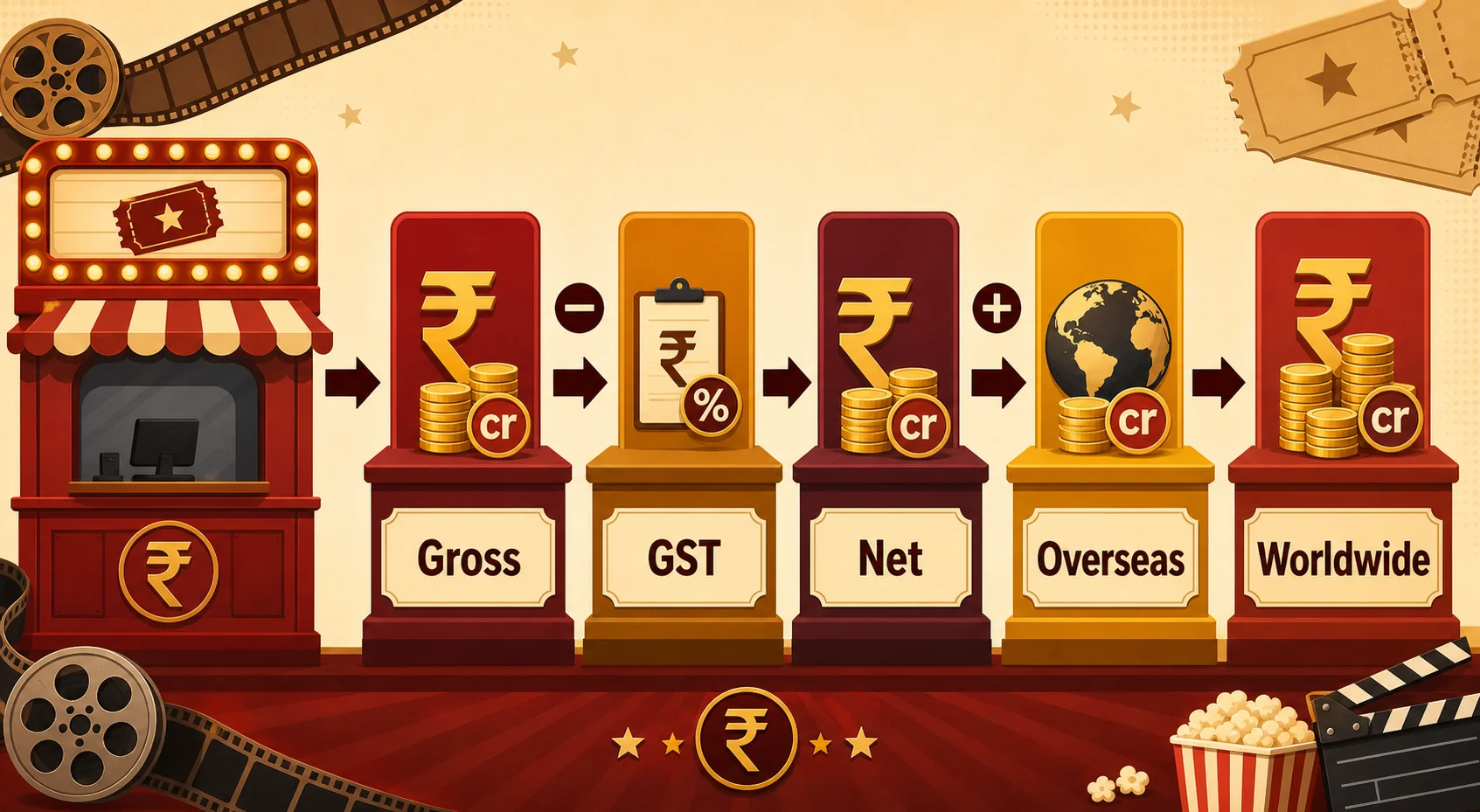
You’ve seen this movie before. A film opens on Friday. By Saturday breakfast, Sacnilk, Bollywood Hungama and Box Office India each flash a different “Day 1” figure for the same release. So how box office collection is calculated in India turns into a genuine puzzle. The disagreement between trackers only deepens it.
Here’s the blunt truth. India has no official box office scorekeeper. There’s no Comscore, no audited national tally like the US runs. Every figure you read is a blend of producer claims, distributor estimates and trade-analyst math (India Herald).
Net vs gross. Day-wise reports. The crore clubs. And the real reason three portals rarely land on one figure. Grab a chai. We’re untangling all of it, in plain Hinglish.
What “Box Office Collection” Actually Means
Strip away the drama and the phrase means one thing: the money the ticket counter takes in. Box Office India’s own glossary defines Total Gross as “the amount collect[ed] at the box office,” nothing fancier than that (Box Office India glossary).
The confusion starts right after. Net, share, worldwide, adjusted. Each one is a fresh layer stacked on that base ticket revenue. Same underlying sales, several “collection” numbers. Quote one layer instead of another and the figure shifts, even though nobody lied.
This trio trips up almost everyone. Here’s the plain version:
- Gross — every rupee the ticket takes in, tax included. The raw counter total.
- Net (or nett) — gross minus tax. Box Office India defines Total Nett Gross as the box office amount “minus entertainment and service tax” (Box Office India glossary).
- Share — the distributor’s or producer’s cut of the net. Box Office India calls it “our estimate of the share of the producer/distributor from the nett collections.” Note the word estimate (Box Office India glossary).
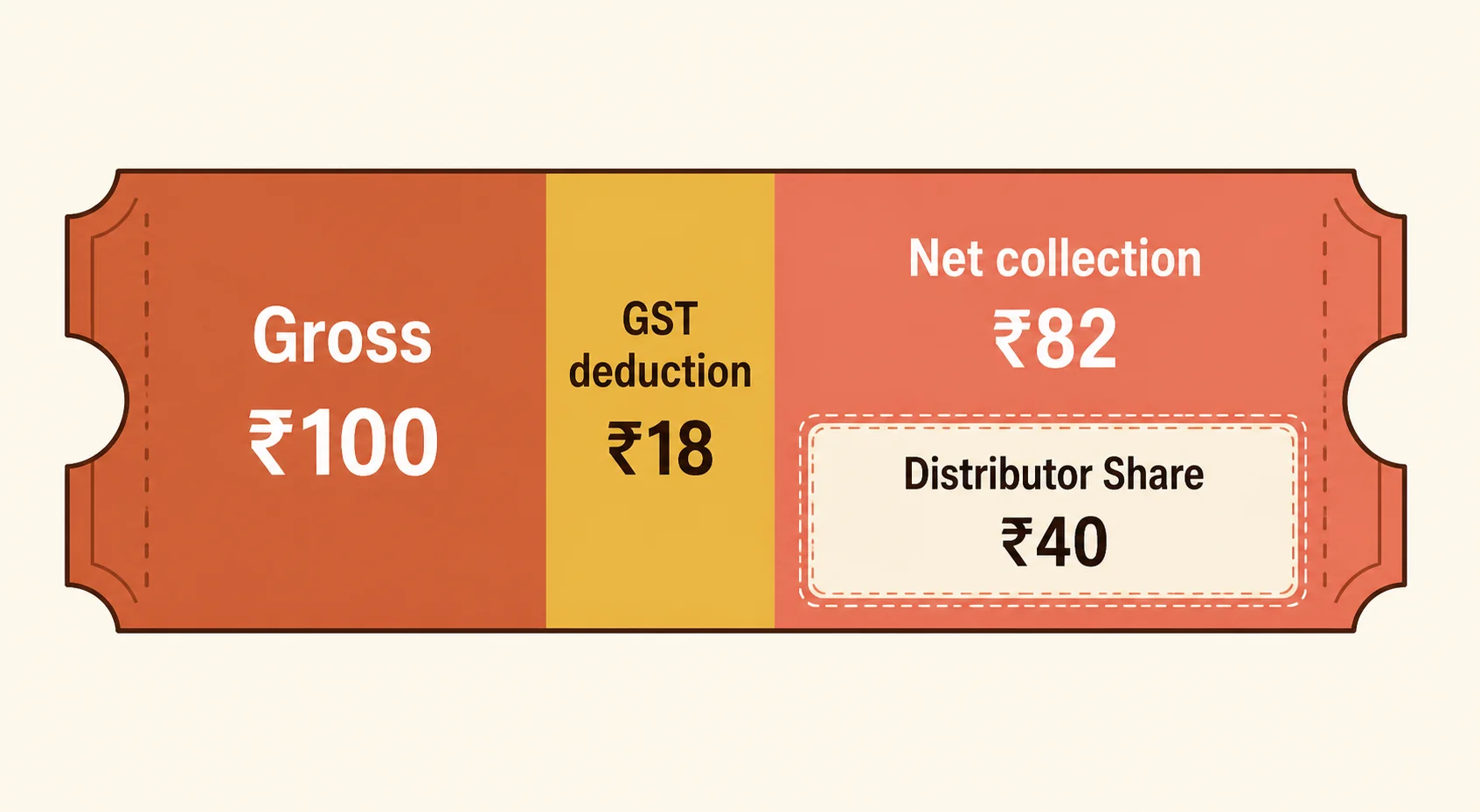
How much does tax eat? Right now GST takes 5% on tickets priced ₹100 or below and 18% on anything above ₹100. It used to be 12% and 18% before the 2026 slab reshuffle (Bajaj Finserv).
Before GST arrived on 1 July 2017, states charged their own entertainment tax. That ranged anywhere from 15% to a brutal 110% depending on the state (Razorpay). Big reason old “net” figures swung so wildly across territories.
There’s a language twist too. Hindi trade usually headlines the India net figure, so a “100 crore” claim means net. South Indian coverage more often quotes worldwide gross (100 Crore Club, Wikipedia). Same label, different measuring stick.
One more wrinkle for the finance nerds. A distributor’s share of net isn’t fixed. In multiplexes it’s front-loaded, roughly 52.5% in week one, dropping to about 44.5% in week two and 38% from week three onward (Koimoi). That’s why an exhibitor happily keeps a fading film running. Their slice grows even as daily collections shrink.
What “Day-Wise Collection” Really Measures (DCR, Explained)
Every “Day 3 collection: ₹18 crore!” headline starts life as a boring internal document. It’s called the Daily Collection Report, or DCR: territory- and theatre-level sheets that distributors, exhibitors and trade analysts pass around (Cinema Collections). Portals summarise those into the numbers you actually read.
Here’s the catch with speed. The big multiplex chains, PVR INOX, Cinepolis and Miraj, hand over fairly standardised occupancy and revenue data, and they make up an estimated 40-50% of India’s theatrical revenue (Cinema Collections). Single-screen data lags a day or two, and trackers approximate it.
So that “Day 1” number posted within hours of release? Partial by design. It leans hard on metro multiplexes and fills in the rest later. Final, producer-confirmed audited numbers usually land 2-4 weeks after a film’s run ends, and early daily estimates can drift 5-15% from them (Cinema Collections).
Scroll any of our day-wise trackers, like the Drishyam 3 collection report, and you’re reading the public face of exactly this process.
Why Sacnilk, Bollywood Hungama and Box Office India Never Post the Same Number
Now the big one. Why do these three portals show different numbers for the same movie? Three reasons, none as scandalous as fans assume.
They all admit they’re estimating
Read the fine print. Sacnilk’s disclaimer says its data “can be approximate or may have huge difference from producer figure,” and that it makes no claims about authenticity (Sacnilk). Bollywood Hungama runs near-identical wording on its box office pages (Bollywood Hungama). The portals themselves are telling you not to treat these as gospel.
They count different things
Scope matters. Box Office India deliberately leaves dubbed Tamil, Telugu and Kannada versions of Hindi films out of its Hindi totals, and it skips Far East and Russia overseas collections (Box Office India, Wikipedia). A tracker that folds those in shows a bigger “total.” Nobody’s lying. They’re measuring different boxes.
They’re often not even on the same day
This one’s my favourite, because it’s so mundane. Take Welcome to the Jungle. Checked on the same July 2026 date, Bollywood Hungama’s page showed India Nett ₹94.84 crore and Worldwide Gross ₹136.49 crore (Bollywood Hungama). Sacnilk showed India Net ₹93.15 crore and Worldwide Gross ₹137.36 crore (Sacnilk).
Why the gap? Bollywood Hungama was on “Day 8” and had folded in a ₹3.93 crore paid preview night. Sacnilk timestamped that preview separately, so its page was effectively a “Day 7” count. You’re comparing eight days against seven. That’s it. Our Welcome to the Jungle review covers the film itself if you want the verdict.

And sometimes they’re not even tracking the same film. Sacnilk ran a full 30-day tracker for Drishyam 3 (Malayalam), reporting worldwide ₹239.55 crore and India Net ₹110.23 crore across 62,244 shows (Sacnilk). Bollywood Hungama’s “Drishyam 3” box office page, meanwhile, read “No data to Display,” because it was set up for a different, later Hindi-market release window (Bollywood Hungama). Same title on your screen. Two different releases underneath.
A distribution-side source put it bluntly to India Herald: “Everyone in the trade knows the difference between an India net and a gross worldwide number, but the audience reading a tweet does not” (India Herald).
So which tracker should you trust? Cross-check two, note the date, and confirm whether the number is net or worldwide before you believe it.
Worldwide Collection: How Overseas Money Gets Added In
“Worldwide” sounds precise. It’s really just addition: India gross plus overseas gross (List of highest-grossing Indian films overseas, Wikipedia). Overseas money comes in first as local currency from markets like North America, the UK and the Gulf. Trackers then convert it into rupee-crore for the headline.
That overseas slice is the shakiest part of any total. Individual foreign distributors self-report it, with no standard chain behind it. That’s exactly why Box Office India chooses to exclude some overseas territories from its own numbers (Box Office India, Wikipedia).
Karuppu makes the math concrete. Its worldwide gross of ₹310.06 crore breaks down as ₹228.91 crore India gross plus ₹81.15 crore overseas (Sacnilk). Add the two, and you land on the number that ends up in the celebratory tweet.
The 100 Crore Club Means Two Different Things
The “100 Crore Club” is the most misused phrase in Indian film Twitter. In Hindi cinema it means ₹100 crore net domestic. In South Indian cinema the same phrase usually means ₹100 crore gross worldwide (100 Crore Club, Wikipedia). Two completely different bars wearing one badge.
The club has history. Ghajini (2008) was the first Hindi film to cross ₹100 crore net, which is where the term got its name; by 2012 it was a routine benchmark (100 Crore Club, Wikipedia). Ticket prices and screen counts have climbed a lot since, so the bar means less in real terms than it once did.
The 500 and 1,000 crore clubs follow the same worldwide-gross logic for pan-India giants (Sacnilk; 1000 Crore Club, Wikipedia). If you like watching these milestones fall, our roundup of the highest-grossing South Indian movies of 2026 tracks who’s clearing them this year.
Are These Numbers Even Real? Occupancy, Block Booking and Inflation
Fair question. And the honest answer is: mostly real, sometimes juiced.
Start with occupancy. Trade analysts call 30-35% healthy weekday occupancy for a mainstream release. Several 2025-2026 “blockbusters” have actually run at 15-25% in metros (India Herald). When reported crores keep climbing but the halls look thin, that gap is the tell.
Do the arithmetic and it clicks. A film reported at ₹30 crore across 3,000 screens averages roughly ₹1 lakh per screen. At 20% weekday occupancy in a 300-seat hall, that’s about 60 filled seats per show (India Herald). A “crore” headline and a half-empty theatre can absolutely coexist.
Then there’s block booking. Producers, stars or linked brands buy up big blocks of tickets, often routed through fan clubs or housing societies, to pump Day 1 numbers and manufacture a “hit” story for satellite and streaming deals (Hollywood Reporter India; India Herald). Veteran critic Komal Nahta called the practice “very disgusting” and warned it quietly inflates star fees across the industry (Hollywood Reporter India).
Even the trade admits it. “Some people, perhaps, I’m not saying every producer, some might inflate figures, I don’t deny that,” Taran Adarsh, Bollywood Hungama’s long-time tracker, told the portal (Bollywood Hungama).
But here’s the balance. Not every mismatch is fraud. Occupancy-based estimates are approximate by nature, single-screen data lags, and Ormax Media, one of the more transparent trackers, still books a 5-10% margin of error into its own figures with zero bad faith involved (Ormax Media).
Zoom out and even the industry-wide totals fight each other. For 2025, the FICCI-EY report logged theatrical revenue up 14% (Variety), while Astute Analytica reported a 13% revenue drop for the same year, with multiplex occupancy at 22-24% and an average ticket price near ₹280 (Astute Analytica). Two credible sources, one calendar year, opposite directions. That’s how un-standardised this whole ecosystem is.
How Box Office Collection Is Calculated in India: A Step-by-Step Karuppu Breakdown
Enough theory. Let’s walk one real film through the whole stack, using Suriya’s Karuppu and Sacnilk’s own dated reports.
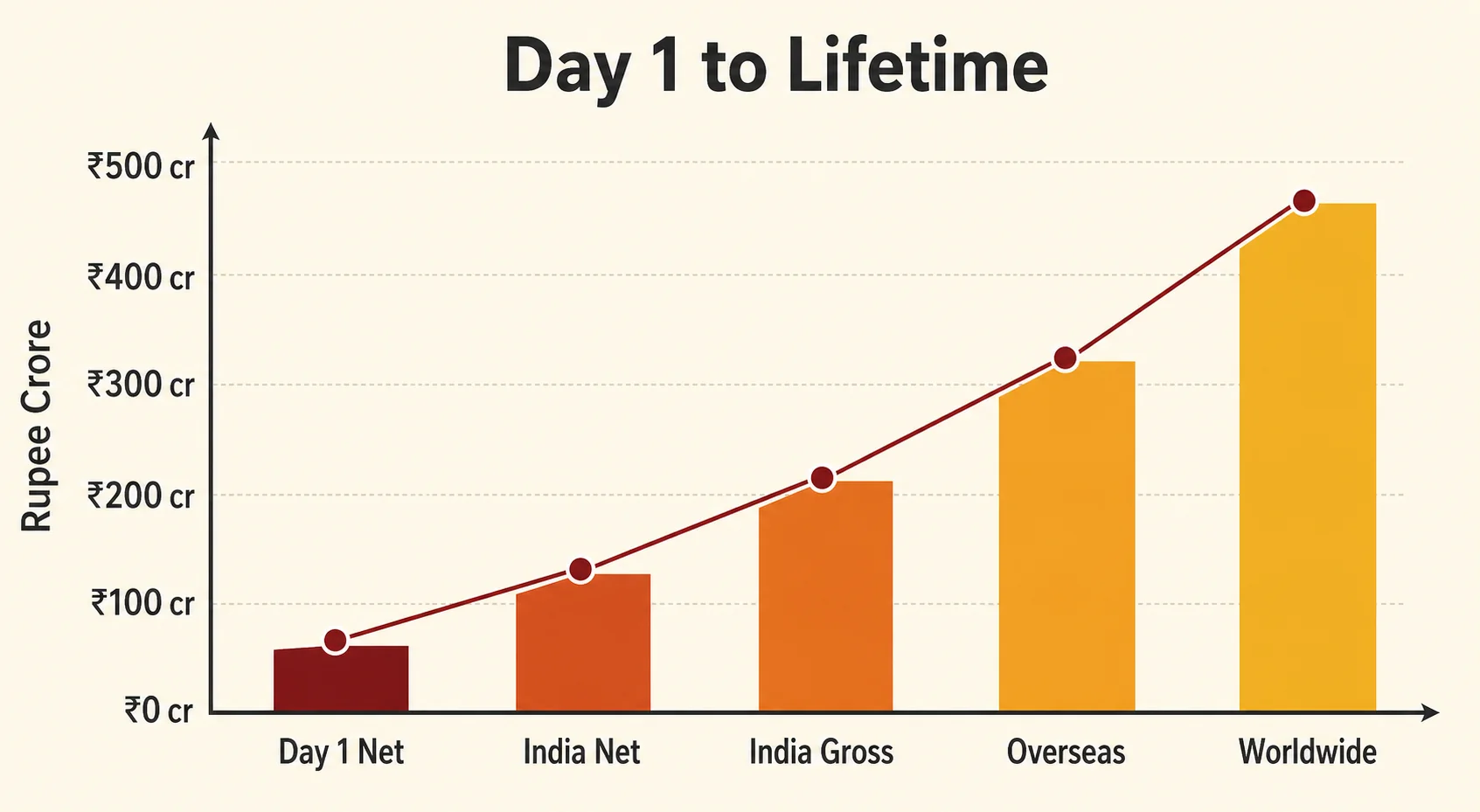
- Day 1 net: ₹15.50 crore from 4,891 shows across India (Sacnilk).
- Add the tax back for gross: that same opening day came to ₹17.93 crore India gross (Sacnilk).
- Bolt on overseas: ₹11.00 crore gross rolled in from foreign markets on Day 1 (Sacnilk).
- Total the worldwide Day 1: ₹17.93 crore plus ₹11.00 crore lands at ₹28.93 crore worldwide gross (Sacnilk).
Fast-forward to the end of its run. Karuppu closed on India net ₹198.12 crore and worldwide gross ₹310.06 crore across 104,632 shows (Sacnilk). Every layer we’ve covered, net, gross, overseas and worldwide, sitting in one final line. You can watch the daily build in our Karuppu collection tracker.
Next Time a Number Drops, Do This
Next time a portal screams a Day 1 figure, don’t just retweet it. Ask three quick things. Net or worldwide? Which day-count? Which tracker? Answer those and half the “controversy” quietly evaporates.
None of this makes the numbers worthless. Sacnilk, Bollywood Hungama and Box Office India are still the best public window we’ve got. They’re just estimates with a fan-culture megaphone attached, not audited accounts.
So stay a little skeptical, cross-check when a claim feels too clean, and enjoy the number-watching for what it is: a sport. Bookmark our upcoming Bollywood movies for July 2026 and you’ll have plenty of fresh openings to run this checklist on.