
Nett vs Gross Box Office Collection Explained (India)
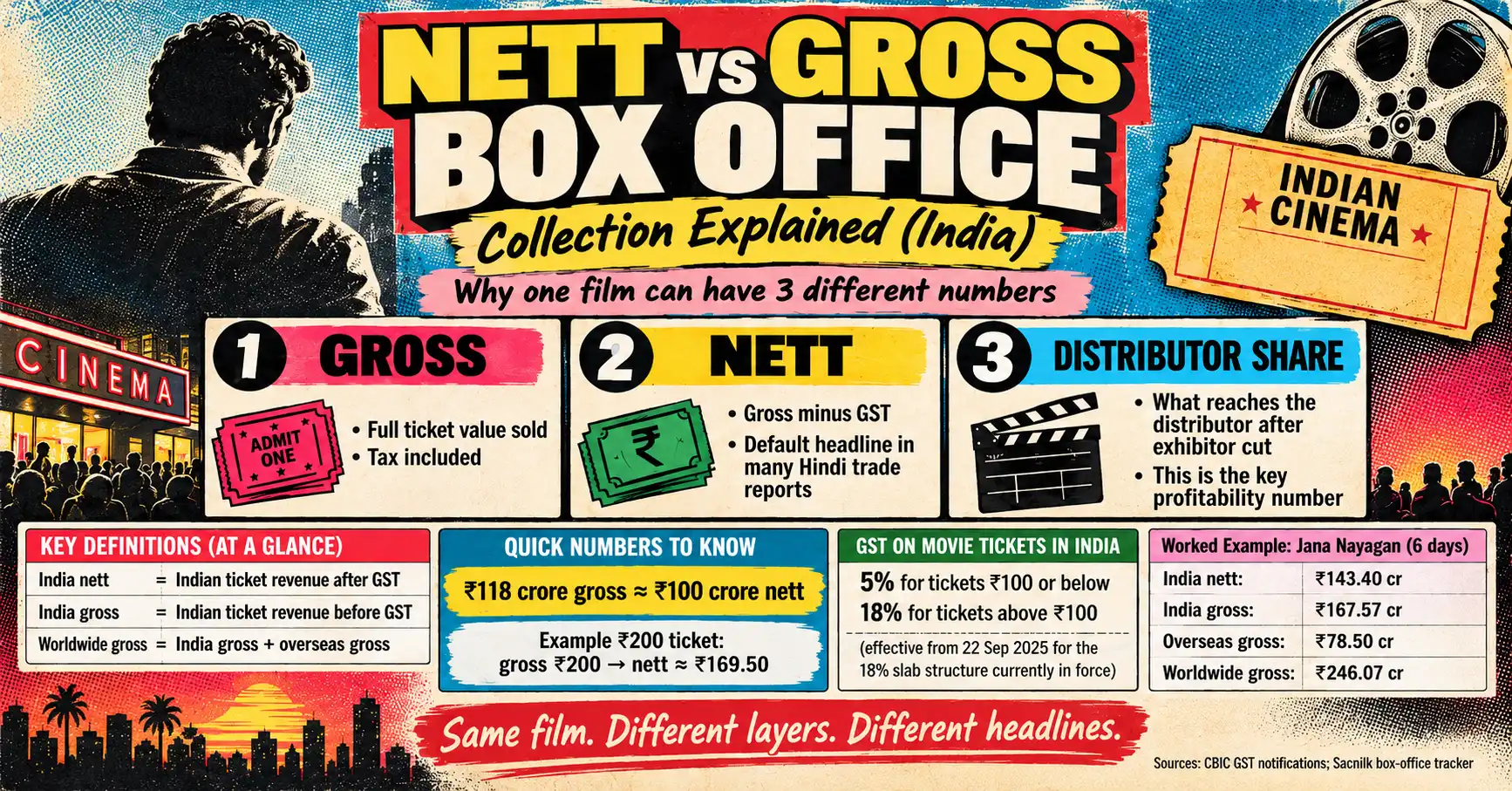
You read that a film did ₹35 crore on Day 1. Your friend swears it did ₹55 crore. Neither of you is lying. That’s the whole problem with nett vs gross box office collection in India, and it trips up fans every single Friday.
Here’s the short version. Gross is the money that came through the ticket window. Nett is what survives after the taxman takes his slice. Distributor share is what the people who made the film actually get to touch. Three different numbers, one film, and trade portals switch between them without warning.
This page is the one we’ll keep pointing back to. Bookmark it, then go read any collection report on the internet and you’ll instantly know which number you’re looking at.
Why box office numbers confuse literally everyone
Blame the reporting system first. India has no central box office database. No official body publishes a verified daily total the way studios do in some other markets.
So trackers build their numbers from a patchwork of producer estimates, distributor reports and their own show-count sampling. Multiplex chains push roughly 40 to 50 percent of their data through quickly. Single screens can take days. An early Day 1 figure will often drift 5 to 15 percent before it settles.
Then add the second problem: nobody agrees on which unit to quote. Hindi trade reports lean on nett. South Indian reports lean on gross, usually worldwide gross. Same milestone, different maths. We broke the mechanics of this down in how box office collection is calculated in India, and this post handles the vocabulary side.
Gross box office collection, explained
Gross collection is the simplest number in the entire system. Take every ticket sold, add up the price printed on it, and you have the gross.
That’s it. Ticket price times seats filled, across every show, in every theatre. No deductions of any kind.
Because it includes tax, gross is always the bigger figure. Publicity teams love it for exactly that reason. A “₹500 crore worldwide” poster almost always quotes gross, not nett.
One quirk worth knowing. In South Indian cinema reporting, “gross” by convention usually means worldwide gross already. Hindi cinema reporting defaults to domestic nett. Two industries, two house styles, and a lot of pointless Twitter arguments.
Nett box office collection, explained
Nett collection is gross minus GST. Nothing more complicated than that.
Before 2017 the deduction was entertainment tax, which varied wildly by state. GST replaced it and made the maths cleaner. Today two slabs apply: 5 percent on tickets priced ₹100 or below, and 18 percent on tickets above ₹100. That 5 percent slab is fairly new, arriving with the GST Council’s rate cut effective September 2025 (Razorpay).
Run the numbers and it clicks fast. A film that pulls in ₹118 crore including GST lands at roughly ₹100 crore India nett. The ₹18 crore never belonged to the film. It went to the government the moment the ticket printed.
Nett is the default headline figure for Hindi films on most Indian trade portals. When a Bollywood release “crosses ₹100 crore,” that’s nearly always nett domestic.
Nett vs gross box office collection: the quick comparison table
If you remember only one thing from this page, make it this table.
| Metric | Gross collection | Nett collection |
|---|---|---|
| What it counts | Full ticket value sold | Ticket value after GST |
| Tax included? | Yes | No |
| Size | Always higher | Always lower |
| Typical use | Marketing posters, South Indian trade reports, worldwide totals | Hindi trade portals, domestic milestone claims |
| Rough relationship | ₹118 crore gross | ≈ ₹100 crore nett |
| Real example: Jana Nayagan, 6 days (India) | ₹167.57–169.22 crore | ₹143.40 crore |
| Tells you profit? | No | No |
Notice the last row. Neither figure tells you whether the film made money. That takes one more step down.
Where your ₹200 ticket actually goes
Picture a single ticket at a metro multiplex. Say ₹200. Follow it all the way down.
GST comes off first. That ticket sits above the ₹100 line, so the 18 percent slab applies. The tax is baked into the printed price, not added on top, so you back it out rather than subtract 18 percent of ₹200. The maths: ₹200 divided by 1.18 gives about ₹169.50. The remaining ₹30.50 is the government’s. Your ₹200 gross ticket is a ₹169.50 nett ticket before anyone in the film business sees a rupee.
Next comes the exhibitor. The cinema owner keeps a contracted cut of that ₹169.50 for the screen, the staff, the electricity and the projector. What’s left flows up to the distributor pool. That split is where the interesting variation lives.
The industry rule of thumb puts distributor share near 50 percent of nett. On that basis our ₹200 ticket sends roughly ₹85 upward and leaves roughly ₹85 with the cinema. But the rule of thumb hides how lopsided real deals get.
A big theatrical release with a huge opening can command as much as 90 percent of nett in week one. Run that through our ticket and about ₹152.50 goes to the distributor. The cinema keeps around ₹17. A small film with no leverage might land nearer 70 percent, which is roughly ₹118.60 up and ₹50.90 kept.
Then the share decays. Our own modelling of a typical release has it sliding to about 38 percent of nett by week three. That’s about ₹64.40 from the same ₹200 ticket. Same seat, same price, and by the third week less than half as much money reaches the distributor.
Stack those three numbers and the funnel is obvious. ₹200 at the counter. ₹169.50 as nett. Somewhere between ₹64 and ₹152 as distributor share, depending entirely on the film’s clout and the week.
And the producer still isn’t paid at that point. Distribution costs, prints, marketing and P&A all come out of the pool that’s left. The popcorn you bought never enters the box office number at all. That’s the exhibitor’s own business, and for many single screens it’s the part that keeps the lights on.
So a headline collection figure is the top of a funnel, not the bottom.
Distributor share is what’s left after GST comes out of gross and after the exhibitor takes their cut. It sits one layer deeper than nett collection, and people confuse the two constantly.
Trade analysts care about this figure far more than the headline nett, because it reflects theatrical profitability (NewsX).
You saw the percentages move a moment ago, and that movement is the whole point. The share isn’t a fixed contractual constant. It’s negotiated on the strength of a film’s opening, then it erodes as the crowds thin. A distributor who paid up front for a marquee week-one split gets badly exposed the moment the second Friday lands soft.
This is exactly why a film can post respectable third-week numbers and still disappoint the people who bought its rights.
So does ₹500 crore mean ₹500 crore profit?
Not even close. That figure is gross revenue sitting before GST, exhibitor share, distribution costs, marketing and P&A spend all get subtracted. Profit gets calculated from the producer and distributor share against the film’s total cost.
A ₹500 crore grosser with a ₹350 crore budget and a bloated marketing spend can still end up in trouble. A ₹90 crore grosser made for ₹18 crore is printing money.
India nett vs India gross vs worldwide gross
Three phrases, three scopes. Keep them straight and most box office headlines stop being confusing.
- India nett — ticket revenue from Indian screens, after GST.
- India gross — ticket revenue from Indian screens, before GST.
- Worldwide gross — India gross plus overseas gross, combined.
The arithmetic is plain. A film with ₹300 crore India gross and ₹150 crore overseas gross has a ₹450 crore worldwide gross.
Overseas figures come with their own mess, by the way. Currency conversion dates shift, and different trackers include or exclude certain territories. Two portals can report the same overseas run and land a few crore apart.
Worked example: reading Jana Nayagan’s Day 6 report
Real numbers make this stick. Take Jana Nayagan, which released on 23 July 2026.
| Layer | 6-day figure |
|---|---|
| India nett | ₹143.40 crore |
| India gross | ₹167.57–169.22 crore (tracker-dependent) |
| Overseas gross | ₹78.50 crore |
| Worldwide total | ₹246.07–247.72 crore |
One film. Same six days. And the number you’d quote ranges from ₹143 crore to ₹247 crore depending purely on which layer you pick. Our full day-wise breakdown sits in the Jana Nayagan box office collection Day 6 report.
Now imagine two fans arguing on Instagram. One quotes the nett, one quotes the worldwide gross. Both are right. Both think the other is inflating or downplaying. Every single week, this exact fight happens.
The 100 Crore Club trap
Here’s the definitional clash nobody warns you about.
The “100 Crore Club” label dates to 2008, when Ghajini became the first Hindi film to earn ₹100 crore nett domestically (Wikipedia). Hindi trade adopted that definition and stuck with it.
South Indian cinema uses the same phrase to mean ₹100 crore gross worldwide, with no tax deductions at all. Same club name, and a substantially easier bar. The arithmetic shows why.
Start with the tax. Multiplex tickets for a wide release mostly sit above ₹100, so the 18 percent slab applies. Back that tax out of ₹100 crore gross and you get ₹100 crore divided by 1.18, which is about ₹84.75 crore. Call it ₹85 crore nett. A film hitting the South-convention milestone has cleared roughly ₹85 crore of post-tax revenue. The Hindi convention asks for a full ₹100 crore post-tax.
Now stack the second difference on top. The Hindi ₹100 crore nett is domestic only. Overseas earnings don’t count towards it at all. The South-convention ₹100 crore gross is worldwide, so every rupee from the Gulf, Malaysia, the US and the UK counts too.
So the two clubs differ twice over. One strips tax out and the other doesn’t. One counts India only and the other counts the planet. We’re not putting a single gap percentage on that, because the real distance depends on each film’s ticket-price mix and its overseas footprint. But the direction is never in doubt.
That’s not South cinema cheating, to be clear. It’s just a different reporting convention that grew up separately. When a Telugu film and a Hindi film both “enter the 100 Crore Club” in the same week, they have not achieved the same thing.
A bit of history for context. Disco Dancer (1982) was the first Indian film past ₹100 crore worldwide. Hum Aapke Hain Kaun (1994) crossed ₹100 crore domestic India first. Dilwale Dulhania Le Jayenge followed past ₹100 crore worldwide in 1995. The milestone has meant several different things across four decades.
How a Day 1 figure is actually built
Nobody counts every ticket by Friday midnight. There is no turnstile feeding a national dashboard. A Day 1 number is a construction, and knowing how it’s assembled explains almost every argument you’ll ever have about one.
Step one is the show count. A tracker starts by logging how many shows the film got across chains and states. That number alone can differ between portals. On Spider-Man: Brand New Day‘s opening day, Sacnilk worked from 15,050 shows while Bollywood Hungama worked from 12,823. Different base, different total, before a single seat is counted.
Step two is occupancy sampling. This is where occupancy rate box office tracking does the heavy lifting. Nobody has seat-level data from every screen, so trackers sample a set of cinemas and read how full those shows ran. Morning shows tend to run thin. Evening and night shows carry the day. Those sampled occupancy rates then get extrapolated across the full show count.
Step three is average ticket price. Occupancy alone gives you bums on seats, not rupees. A recliner in Gurgaon and a stall seat in a Bihar single screen are the same “one seat sold” and wildly different money. So trackers apply an assumed average ticket price by format, chain and region. Two portals making slightly different price assumptions will part ways here even if their occupancy agrees.
Step four is actual chain reporting, and it arrives unevenly. Multiplexes push roughly 40 to 50 percent of the data through fast. Single screens can lag by days. So the first published Day 1 total is mostly modelled, with hard numbers replacing estimates over the following week.
Step five is the preview problem. Paid previews are the single messiest variable in Indian reporting. A big release now routinely runs paid shows the evening before the official opening. One tracker folds those into Day 1. Another parks them in a separate “previews” line, or pushes them into Day 2. That decision alone can move a headline by crores, and it then corrupts every subsequent day’s comparison. Day 3 on one site is Day 2 plus previews on another.
Put all five together and you get drift. Early figures typically move 5 to 15 percent before they settle. That drift is normal. It is not a tracker being dishonest, and it is not a producer inflating numbers.
Practical advice: treat a Friday-night number as a first draft. The Monday revision is closer. The full-week figure is the one worth quoting. If you’re going to argue with someone about an opening, at least wait for the weekend to finish.
Why our numbers may differ from Sacnilk or Bollywood Hungama
We track collections daily, and we get asked this constantly. So here’s a real case.
On Spider-Man: Brand New Day‘s opening day, 30 July 2026, Sacnilk posted ₹35.38 crore nett and ₹41.75 crore gross from 15,050 shows. Bollywood Hungama posted ₹55.18 crore gross from 12,823 shows. Same film. Same day. A gap of roughly ₹13 to ₹20 crore between two respected trackers.
Neither one made anything up. They counted differently. We logged the full discrepancy in our Spider-Man: Brand New Day India Day 1 verdict.
Four things drive gaps like that:
- No central database. Every tracker builds its own estimate from partial reporting.
- Reporting speed. Multiplexes report fast, single screens lag by days, so early numbers keep moving.
- Dubbed versions and territories. Some trackers fold Hindi-dubbed or specific overseas markets into the total. Others don’t.
- Day-count windows. A paid preview show can land in one tracker’s Day 1 and another’s Day 2. Instant mismatch on every subsequent day.
Treat a Day 1 number as a live estimate. It firms up over the following week.
Hit, super hit, blockbuster: what the verdict labels mean
This part frustrates people, and honestly it should. There is no fixed rupee threshold for any of these labels. The NewsX explainer linked above says it bluntly: the terms lack standardised definitions across trade analysts.
What the labels actually measure is collection relative to the film’s investment and recovery. Take two films. One cost ₹20 crore and returned ₹60 crore nett. The other cost ₹300 crore and returned ₹320 crore. The second number looks far better on a poster. The first film is the bigger success by a mile.
That’s why one portal calls a film a super hit while another calls it average. They’re weighing recovery differently, and neither is obliged to publish its formula. When you see a verdict label, check whether anyone mentioned the budget. If not, the label is close to meaningless.
The same logic applies to ranking lists. Our highest-grossing Bollywood movies of 2026 so far ranks by collections, not by profitability. Those are genuinely different leaderboards.
Read your next box office report like a trade analyst
Three questions. Ask them every time a collection number lands on your feed.
Nett or gross? If nobody says, assume gross for a South Indian or marketing claim, nett for a Hindi trade report.
India or worldwide? A ₹450 crore worldwide gross and a ₹143 crore India nett can belong to the same film in the same week.
What did it cost? Without the budget, no collection figure tells you success or failure.
Once nett vs gross box office collection stops confusing you, the weekend numbers get genuinely fun to follow. You start spotting which posters are quietly inflating, which films are holding their weekday drops, and which “record” is really a redefinition.
Our Box Office Reports section runs the day-wise trackers all week. Come argue with our numbers, now that you know exactly which number you’re arguing about.
See the numbers in practice: Hanuman Ansh’s box office run, Mirzapur: The Movie’s collection and Daayra vs Vibe.