
Filmfare Awards Explained: History, Categories & Winners
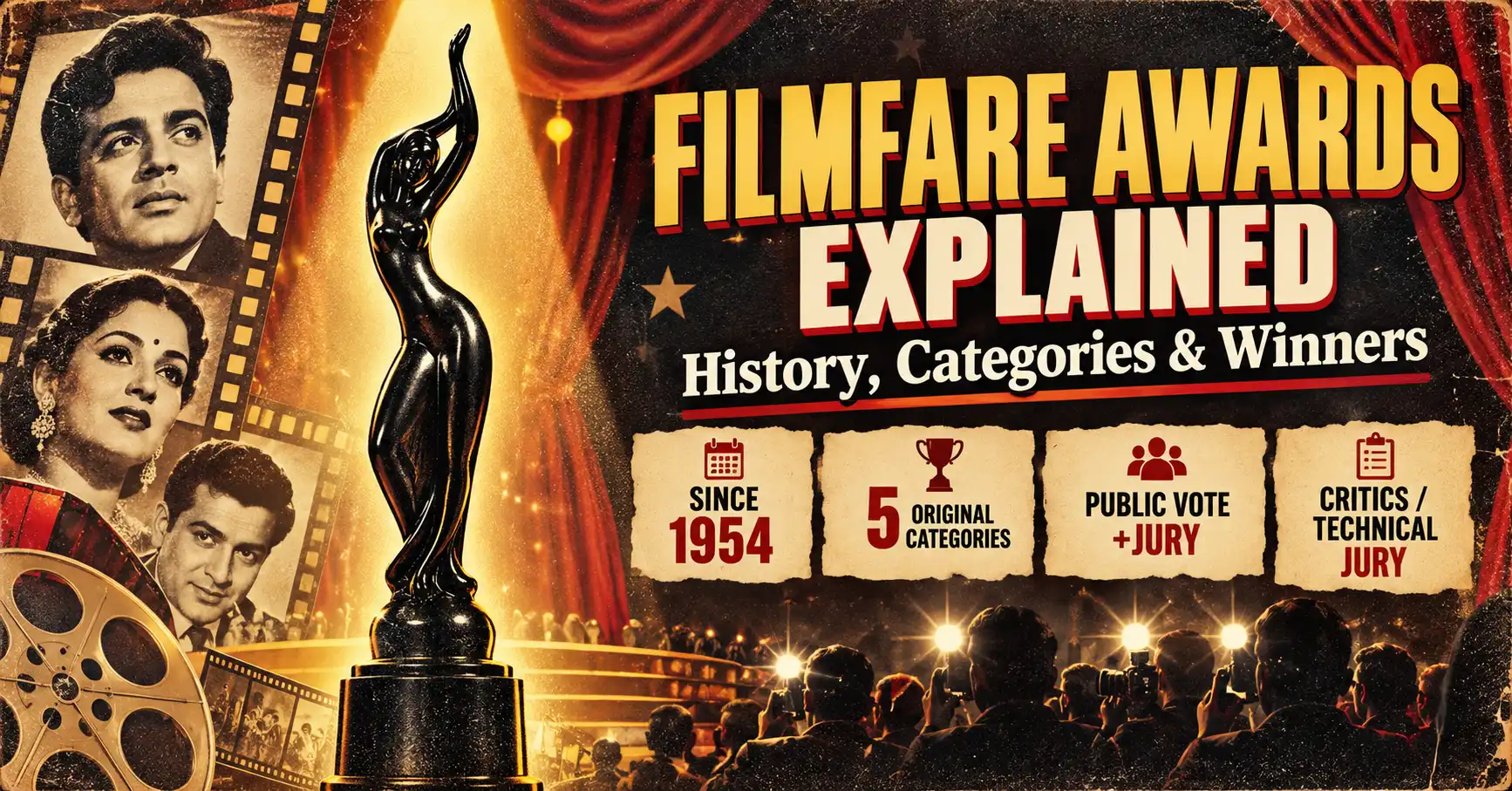
Every awards season, Bollywood Twitter splits in half over the Filmfare Awards. One side posts trophy pics. The other side posts “bikau awards” memes.
Both sides usually argue without knowing how the thing actually works. Who votes? Does your online poll click count for anything? Why does one film walk away with 13 statuettes while a ₹1,000-crore blockbuster gets nothing?
Here’s the full picture. The origin story, the trophy, every category tier, the voting machinery, and an honest answer to the question fans ask loudest: is it fixed?
What Are the Filmfare Awards, Exactly?
Filmfare magazine hands them out. That’s the first thing worth getting straight, because a lot of people assume there’s some official body involved.
There isn’t. It’s a private, magazine-run honour, published under the Times Group, and it has been since day one.
Quick snapshot:
- Started: 1954, by Filmfare magazine
- First ceremony: 21 March 1954, Metro Theatre, Bombay
- Original categories: five
- Trophy: the Black Lady, roughly 5 kg of bronze
- Voting: public vote plus industry jury, split by category tier
- Coverage: Hindi cinema first, plus South, Marathi, Bangla and Punjabi editions
That last line matters more than people realise. Filmfare isn’t one ceremony. It’s a franchise of them.
Filmfare Awards History: From “The Clares” to Bollywood’s Biggest Night
The first edition ran on 21 March 1954 at Metro Theatre in Bombay, and it had five categories: Best Film, Best Director, Best Actor, Best Actress and Best Music Director. Winners that year were the only nominees. No shortlist drama, no envelope suspense.
The awards also had a different name at the start. Everyone called them The Clare Awards, or just “The Clares,” after Clare Mendonça, a film critic at the Times of India (Wikipedia).
And the very first winners came straight from readers. Over 20,000 Filmfare subscribers across India mailed in their votes. That’s it. That was the whole system.
Two years later, in 1956, Filmfare changed the rules and added an expert committee alongside the public vote. Seventy years on, that basic hybrid still runs the show.
The Two Years Filmfare Skipped
Filmfare has missed only a couple of editions. Industry strikes wiped out the ceremonies for 1986 and 1987. The delayed 1985 winners finally collected their trophies on 28 January 1987.
Five categories in 1954. Somewhere between 30 and 40-plus today. The ceremony grew into a televised, host-driven spectacle, and the 70th edition proved the point: Shah Rukh Khan, Karan Johar and Maniesh Paul fronted it at EKA Arena in Ahmedabad on 11 October 2025, with Zee TV carrying the broadcast. It was SRK’s first hosting gig since the 63rd edition.
How Filmfare Award Winners Are Actually Chosen
This is the section nobody reads before tweeting, so read it.
Filmfare runs a dual voting system, and it has since 1956. It combines an expert committee with the public. But the split isn’t equal, and it isn’t the same across every award (nationalfilmawards.in).
Here’s the pipeline in plain terms:
- Eligibility. Films released in the calendar year go into the pool for that edition.
- Public voting. Fans vote online. This stage shapes the shortlist in the popular categories.
- Jury deliberation. An expert industry jury takes that shortlist and picks the winner.
- Critics tier. A jury of critics decides these separately. No public vote touches them at all.
- Special honours. Lifetime Achievement and similar awards come from Filmfare itself, not from any vote.
Notice what stage 2 does. It doesn’t crown anyone. It builds the menu.
And that’s the crux of every Filmfare argument you’ve ever seen. The jury can only pick from names the public already pushed forward. If a performance never trends, it rarely reaches the table. A quiet, brilliant turn in a small film competes against a mass hero with millions of followers, and the popular tier was never designed to be fair to the first one.
The Critics Awards exist precisely because Filmfare knew this. That’s the fix, built in decades ago.
Filmfare Award Categories, Explained
The award list splits into four groups. Once you see the structure, the winner sheet stops looking random.
| Tier | Who decides | Examples |
|---|---|---|
| Popular | Public shortlist, then jury | Best Film, Best Director, Best Actor, Best Actress, Best Supporting Actor/Actress, Best Music Director, Best Lyricist, Best Playback Singer |
| Critics | Jury of critics only | Critics Best Film, Critics Best Actor, Critics Best Actress |
| Technical | Jury / expert panel | Best Story, Best Screenplay, Best Cinematography, Best Editing, Best Sound Design, Best VFX |
| Special honours | Filmfare | Lifetime Achievement, R. D. Burman Award for New Music Talent |
The Popular tier is the one that gets the airtime and the memes. The Technical tier is where the actual craft gets recognised, usually to a half-empty hall and a quick cutaway.
Read a winner list with those columns in mind and it makes more sense. A film sweeping Popular while a different film takes Critics isn’t a contradiction. It’s the system working exactly as built.
The Awards Filmfare Retired
Two big ones are gone. Best Performance in a Comic Role ran from 1967 to 2007. Best Performance in a Negative Role ran from 1992 to 2007. Both got axed the same year, which quietly ended a whole era of villain-and-sidekick recognition.
Ask any nineties kid about the negative-role award and watch them list winners from memory. It deserves a comeback.
The Black Lady: What the Filmfare Trophy Actually Is
She’s a dancing woman, arms raised, fingertips touching. N. G. Pansare sculpted her under Walter Langhammer, the art director at the Times of India.
The specs are heftier than they look on TV. About 46.5 cm tall. Roughly 5 kg. Usually bronze.
Filmfare has broken that rule twice for milestone editions. The 25th edition statuettes came in silver. The 50th came in gold. The Award Gallery has manufactured them since 2000, and the design got a 3-D refresh in 2014.
Winners carry her in both hands for a reason. Five kilos is a real workout when your hands are shaking.
Is Filmfare Rigged? The Controversies, Explained
Short answer: no evidence of rigging. Longer answer: the design tilts the field, and fans can feel the tilt even when they can’t name it.
Go back to the pipeline. The public stage rewards visibility. The jury stage only narrows a list that visibility already built. Every famous Filmfare controversy traces back to that one structural quirk.
2020: The Gully Boy Sweep
The 65th Filmfare Awards, held in Guwahati on 15 February 2020, turned into the loudest backlash the show has faced. Gully Boy took 13 awards from 19 nominations.
Fans revolted. #BoycottFilmfare and “Bikau Awards” trended on Twitter. The complaints piled up fast: Alia Bhatt’s Best Actress win for a role with limited screen time, Ananya Panday winning Best Debutant over Pranutan Bahl, and snubs for Super 30, Mission Mangal and Teri Mitti. Someone even edited Gully Boy’s Wikipedia page to tag it a “Paid Award” (The Quint).
Now apply the mechanics. Gully Boy was the year’s biggest cultural conversation. Its cast dominated the public-vote stage across every popular category. The jury then chose from shortlists that Gully Boy had already flooded. A sweep wasn’t a conspiracy. It was arithmetic.
2024 and 2025: The Snubs Fans Won’t Forget
The pattern repeated. At the 69th edition, Ranbir Kapoor’s Best Actor win for Animal landed over Shah Rukh Khan, and Jawan walked away without a mainstream Filmfare award despite owning the box office that year. Fans read it as a snub of the biggest star on the planet.
Then came the 70th edition in October 2025. Laapataa Ladies set a record with 24 nominations for a single film and converted 13 of them, taking Best Film and Best Director for Kiran Rao. Best Actor ended in a tie between Kartik Aaryan for Chandu Champion and Abhishek Bachchan for I Want to Talk. Alia Bhatt won Best Actress for Jigra, a film that underperformed in theatres, and social media called it nepotism and manufactured validation while arguing that Yami Gautam deserved it for Article 370.
Same shape, different year. A buzzy title sweeps, a commercially huge title gets ignored, and the timeline explodes.
So, Is It Fixed?
Here’s our take. “Rigged” implies someone decides the winner in a back room. Nobody has shown that.
What’s real is a popularity filter sitting in front of a jury. Filmfare built a system that measures cultural noise first and merit second, then bolted on a Critics tier to compensate. That’s a bias in the design, not a bribe.
If you want the list that tracks pure merit, read the Critics winners. If you want the list that tracks what India was actually watching and posting about, read the Popular winners. Reading them as the same thing is where the outrage comes from.
Box office numbers work the same way, by the way. We broke down how box office collection is calculated in India and why no two trackers ever agree. Awards and grosses are both measurements, and both measure something narrower than “which film was best.”
Filmfare vs National Film Awards: The Real Difference
Here’s a fact almost nobody clocks. Both awards launched in 1954 and then went in opposite directions.
| Feature | Filmfare Awards | National Film Awards |
|---|---|---|
| Run by | Filmfare magazine (Times Group), private | Government of India |
| Languages | Hindi first, plus regional editions | All Indian languages |
| Decided by | Public vote plus jury | Jury only |
| Trophy | The Black Lady | Gold and silver lotus |
| Presented by | Film-industry hosts and stars | The President of India |
One measures popular resonance. The other measures state-recognised artistic merit. A film can sweep one and get nothing from the other, and neither result cancels the other out.
That’s why comparing the two winner lists is such a good time. They disagree constantly, and they’re supposed to.
Filmfare Beyond Hindi Cinema
Filmfare figured out early that Bombay wasn’t the whole industry. Filmfare Awards South launched in 1964 as the 11th ceremony, bringing Telugu, Tamil, Bengali and Marathi films into the fold that year. Malayalam joined in 1967. Kannada came in 1970.
Until 1976 the South ceremony ran in Mumbai alongside the Hindi one. Since then it has moved between Chennai and Hyderabad, with Bengaluru hosting in 2022 and Kochi taking the 70th South edition in 2026.
The South record books are ridiculous. Kamal Haasan has 19 Filmfare South awards, 17 of them Best Actor (Popular). A. R. Rahman leads music directors with 18. Try naming a Hindi-side equivalent.
There’s more beyond the South, too. Filmfare runs separate Marathi, Bangla and Punjabi ceremonies. The 8th Bangla edition took place in Kolkata on 18 March 2025 on Zee Bangla, and the Punjabi awards started in 2017.
If you follow the South slate closely, our roundup of the highest-grossing South Indian movies of 2026 pairs well with the awards calendar. Same for the highest-grossing Bollywood movies of 2026 so far if you want to guess which titles the public vote will carry.
The Records That Actually Impress
A few numbers to keep in your pocket for the next argument:
- 8 Best Actor wins — Dilip Kumar and Shah Rukh Khan, tied. Dilip Kumar took his for Daag, Azaad, Devdas, Naya Daur, Kohinoor, Leader, Ram Aur Shyam and Shakti. SRK’s came from Baazigar, DDLJ, Dil To Pagal Hai, Kuch Kuch Hota Hai, Devdas, Swades, Chak De! India and My Name Is Khan.
- 5 Best Actor wins — Amitabh Bachchan, third on the list.
- 3 straight years — Dilip Kumar again, winning Best Actor from 1956 to 1958. Nobody has matched that streak.
- 24 nominations — Laapataa Ladies, the most for a single film in one year.
- 19 South awards — Kamal Haasan’s all-time record.
Two of those belong to Dilip Kumar. The man built the template before most of the current jury was born.
Watch the Ceremony Differently This Year
Next time the nominations drop, skip the outrage tweet and do this instead. Check which tier the award sits in. If it’s Popular, ask which fandom mobilised. If it’s Critics, ask which performance the jury genuinely rated.
You’ll be right about the winners far more often than the people yelling.
We cover every Filmfare ceremony, nominee list and winner sheet as it lands, along with the wider awards circuit — including moments like Deepika Padukone’s Hollywood Walk of Fame star. Bookmark this page, come back when the next list drops, and tell us in the comments which snub you’re still not over. Ours is the negative-role award. Bring it back, Filmfare.
New to this topic? Our explainer on major film award shows in India covers the basics.