
Major Film Award Shows in India Explained: IIFA vs Zee Cine
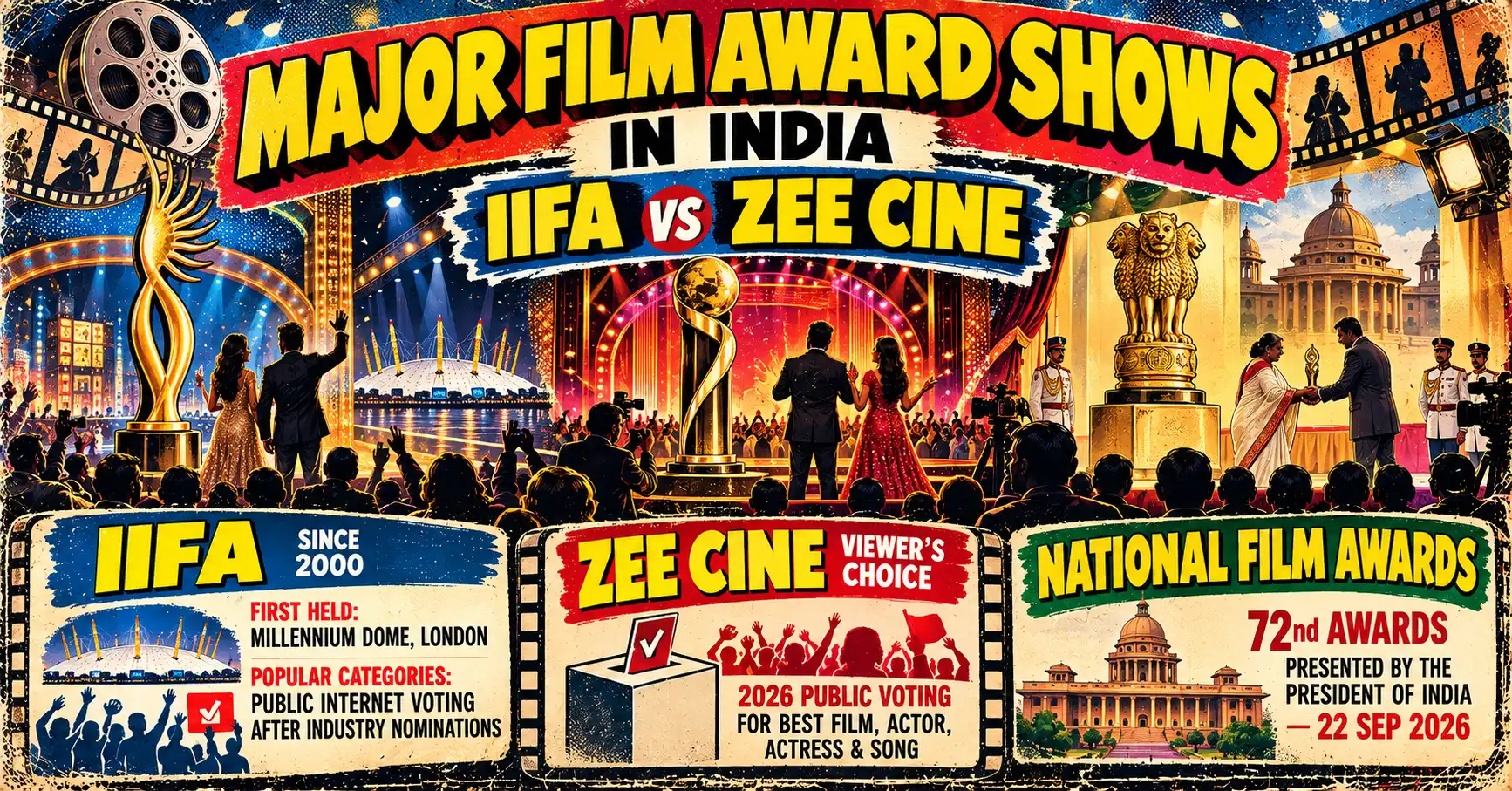
Every award season, the same fight breaks out in the comments. One person says Filmfare is fixed. Another calls IIFA an Abu Dhabi party with trophies. A third insists only the National Award counts. So here are the major film award shows in India explained properly: who runs each one, who actually picks the winners, and which trophy deserves your respect.
Quick spoiler? They’re not the same thing at all.
Some are TV events with a voting system bolted on. One is a state honour that the President of India hands over in person. And the Zee Cine Awards beat IIFA to the stage by more than two years, even though fewer people outside India know the name.
Major Film Award Shows in India, Explained at a Glance
Here’s the cheat sheet before we go show by show:
- National Film Awards (since 1954): run by the government. Government-appointed juries choose the winners, and the President presents them in New Delhi. No public vote.
- Filmfare Awards (since 1954): run by Filmfare magazine (Times Group). Popular awards mix public votes with an expert committee. A critics’ jury alone decides the Critics’ Awards.
- Screen Awards (since 1995): born at the Indian Express Group’s Screen magazine, later run by Star. Film-industry insiders traditionally chose the winners.
- Zee Cine Awards (since 1997): run by Zee Entertainment. Three tiers: public-voted popular awards, jury-picked critics awards and technical awards.
- IIFA Awards (since 2000): run by Wizcraft International Entertainment. Fans vote online worldwide for the major categories. Industry panels review the technical ones.
- SIIMA (since 2012): the South Indian heavyweight. A jury of senior professionals shortlists, and a public poll decides.
Notice the pattern. There are really only three ways to pick a winner here: fans, juries or insiders. Almost every “yeh award toh fixed hai” argument comes down to which model a show uses. Keep that in your head for the rest of this guide.
IIFA Awards: Bollywood’s Travelling Roadshow
Sabbas Joseph, Andre Timmins and Viraf Sarkari set up the International Indian Film Academy Awards in 2000 under Wizcraft. The very first ceremony took place on June 24, 2000, at the Millennium Dome in London.
That opening venue tells you the whole idea. IIFA never planned to sit still in Mumbai. It moves to a different city almost every year, carrying Hindi cinema to wherever the audience lives.
The stops so far include:
- London (2000), where it all began
- Toronto (2011)
- New York (2017)
- Abu Dhabi, three years running (2022 to 2024)
- Jaipur (2025), the 25th edition
Jaipur was a smart homecoming for the silver jubilee. Karan Johar and Kartik Aaryan hosted, and Laapataa Ladies took Best Film. That film winning the top prize at the flashiest show on the calendar? Honestly, we loved it.
How IIFA picks its winners
IIFA runs a four-step process: nominations, global digital voting, tabulation, and then a separate industry panel for the technical categories. The big popular awards sit with the fans.
That has a very obvious side effect. As one analysis of IIFA’s voting model puts it: “Stars with massive, highly organized international fan bases possess a significant structural advantage at IIFA.”
So when IIFA looks like a popularity contest, that’s because it is one. By design. Don’t read an IIFA Best Actor trophy as a critics’ verdict. Read it as a measure of whose fan army showed up to vote.
IIFA record holders
The record book reads like a greatest-hits playlist:
- 3 Idiots and Devdas won 16 awards each, the most for any film.
- Shah Rukh Khan and Hrithik Roshan share the Best Actor record with 5 wins apiece.
- Sanjay Leela Bhansali has won Best Director 5 times.
- A.R. Rahman holds 8 Best Music Director trophies.
IIFA keeps tinkering with its category list too. We’ve already unpacked the IIFA Awards 2026 Best International Film category if you want the finer print.
IIFA 2026 dates and the next confirmed show
Here’s where a lot of sites get sloppy. As of this writing, IIFA hadn’t officially confirmed dates or a venue for its 26th edition. Some outlets floated early March 2026, but nobody made that official, so treat it as a guess.
What IS locked is IIFA 2027. It lands on January 22–23, 2027, at Etihad Arena on Yas Island, Abu Dhabi. That makes it Abu Dhabi’s fourth time as host.
The confirmed line-up so far includes Salman Khan, Shahid Kapoor, Kareena Kapoor Khan and Janhvi Kapoor. Karan Johar and Varun Dhawan will host the main awards. Pankaj Tripathi and Ali Fazal take the IIFA Digital Awards. The bigger news, per The National’s IIFA 2027 guide, is distribution: the ceremony will stream worldwide on YouTube for the first time, with Zee as broadcast partner.
Zee Cine Awards: The “Democratic” Awards Since 1997
Zee Entertainment Enterprises, part of the Essel Group, launched the Zee Cine Awards in November 1997. The motto was bold for its time: “Excellence in cinema – the democratic way.”
The first ceremony took place in Mumbai on March 14, 1998. Zee TV has broadcast it ever since.
The structure is the interesting bit. Zee Cine splits its prizes into three tiers:
- Popular / Viewer’s Choice: public online voting decides Film, Actor, Actress and Song of the Year.
- Critics Awards: a jury picks these.
- Technical Awards: the craft categories.
Add it all up and you get more than 60 awards on one night. That’s a lot of trophies, sure. But the three-tier split also gives Zee Cine a built-in balance that pure fan-vote shows don’t have.
The show stayed in Mumbai through 2004 before it went international, with stops in Dubai, London, Mauritius and Singapore. It also skipped a few years. A scheduling clash killed the 2010 edition, and COVID-19 wiped out 2021 and 2022.
Our honest take? Zee Cine is the most underrated show on this list. It was pitching “fans decide” back when IIFA didn’t even exist.
IIFA vs Zee Cine Awards: What Actually Sets Them Apart
On paper they look like twins. Both are private shows run by an events company or a broadcaster. Both let fans vote. Both focus mainly on Hindi cinema.
Look closer, though, and the gaps are real:
- Age: Zee Cine is older by over two years.
- Home base: IIFA went abroad from day one. Zee Cine stayed in Mumbai for its first seven ceremonies.
- Voting: Zee Cine keeps a formal critics’ jury tier. IIFA’s popular categories run on fan votes.
- Ad money: in a 2018 industry analysis, IIFA and Zee Cine commanded the same slot rates, roughly Rs 2–2.5 lakh per 10 seconds.
- Reach: the same analysis put Zee Cine’s average viewership at about 6 million.
And here’s the twist nobody talks about. Zee, the company behind Zee Cine, is the broadcast partner for IIFA 2027. Rivals on stage, partners on the telecast. Bollywood logic.
So which should you follow? If you want to know whose fandom is loudest, watch IIFA. If you want fan pulse with a critics’ sanity check, Zee Cine gives you the fairer read.
Where Filmfare and National Film Awards Fit In
Here’s a fun coincidence. India’s two oldest film honours both started in 1954. Yet they sit at opposite ends of the voting spectrum.
Filmfare: the reader-voted veteran
Filmfare magazine (Times Group) launched its awards in 1954. People first called them “The Clares”, after Times of India critic Clare Mendonça.
The first ceremony happened on March 21, 1954, at Mumbai’s Metro Theatre, with just five categories. Do Bigha Zameen, Bimal Roy, Dilip Kumar, Meena Kumari and Naushad Ali took them home.
Readers voted from the very start, and more than 20,000 took part in that first poll. Since 1956, Filmfare has used a dual system. Public votes and an expert committee decide the popular awards, while a critics’ jury alone handles the Critics’ Awards. The run hasn’t been unbroken, either: an industry strike and security concerns meant no awards for 1986 and 1987.
For the full history and winners list, read our Filmfare Awards explainer.
National Film Awards: the government’s call
This is the only honour on the list that the state hands out. The Ministry of Information & Broadcasting ran it first (1954–1973). The Directorate of Film Festivals took over from 1974 to 2022, and the National Film Development Corporation has managed it since 2023.
Government-appointed juries pick the winners. For feature films, a two-tier system applies: five regional panels shortlist the entries, and a central panel makes the final call. Separate juries handle Non-Feature Films and Best Writing on Cinema. Then the President of India presents the awards in New Delhi.
No fan vote. No ad-slot chase. We’ve covered the jury process in detail in our National Film Awards explainer.
Other Award Shows Worth Knowing
The big names above get most of the headlines, but two more shows matter if you want the full picture.
Screen Awards: when insiders decide
Viveck Goenka of the Indian Express Group founded the Screen Awards in 1995 through Screen magazine. Videocon sponsored the early years, and the show ran as the “Screen Videocon Awards” until 2001.
Star India bought Screen magazine in 2015 and carried on with the Star Screen Awards. The last ceremony before a long gap took place on December 8, 2019, and the show came back in 2024.
What makes Screen different is the jury. Film-industry insiders traditionally chose the winners, not critics and not the public. That’s the third voting model, and nobody else on this list uses it quite the same way.
The records: Dangal and Gully Boy share the most wins for a single film, 12 each. Vidya Balan holds the most Best Actress wins with 5. And back in 2018, Screen averaged roughly 8 million viewers, ahead of Zee Cine’s 6 million.
SIIMA: the South Indian answer
Here’s the uncomfortable truth. The big private shows lean heavily towards Hindi cinema. If you watch Telugu, Tamil, Malayalam or Kannada films, SIIMA is the award show that’s actually about your movies.
Vishnu Vardhan Induri and Brinda Prasad Adusimilli launched the South Indian International Movie Awards in 2012 to cover all four industries. A jury of senior industry professionals shortlists the nominees, and public polling picks the winners. The ceremony runs over two days, often in Dubai.
With South films now crossing over everywhere (see our guide on what makes a pan-India film), SIIMA wins matter more than they did a decade ago.
One more name worth a mention: the Stardust Awards. In 2016 they pulled 13.3 million impressions on Colors, the biggest number in that 2018 industry report.
Which Award Actually Matters Most?
Opinions are cheap, so let’s start with money. Award shows are big business for TV channels. According to BestMediaInfo’s breakdown of award-show economics, ad slots during these shows cost 2–3x standard prime-time rates, and CPRP ran 30–50% above normal.
Filmfare sat at the top. Its slots reached roughly Rs 3–3.5 lakh per 10 seconds, against Rs 2–2.5 lakh for IIFA and Zee Cine. Filmfare 2016 also carried 204 ad insertions, the highest that year.
But don’t assume these shows print money. One industry executive told the publication: “Production costs are high because the celebrities who appear also take a lot of money. A lot of times, the event reaches a break-even point.”
So here’s our verdict on the major film award shows in India, ranked by what a win actually tells you:
- National Film Award: the prestige pick. No fan vote and no ad model attached, so it’s the hardest one to dismiss as “bought”. That’s our read, not an official ranking.
- Filmfare: the oldest private brand, and the one advertisers pay most for. Still the most bankable name in the business.
- IIFA: the biggest global footprint and the best barometer of fan power. Just don’t mistake it for a critics’ verdict.
- Zee Cine: the underrated hybrid. Fans, critics and craft awards all under one roof.
- Screen and SIIMA: Screen shows you what the industry thinks of itself. SIIMA is essential if South cinema is your first love.
Watching the telecasts, then? Paisa vasool for the dance numbers, time waste if you’re hoping the fan-voted trophies will settle an argument. They won’t.
The next time someone in your group chat says “awards are fixed,” ask them one question: which award, and who voted? Then drop your own pick in the comments. Which of these trophies do you actually trust?