
National Film Awards Explained: How India’s Top Honor Works
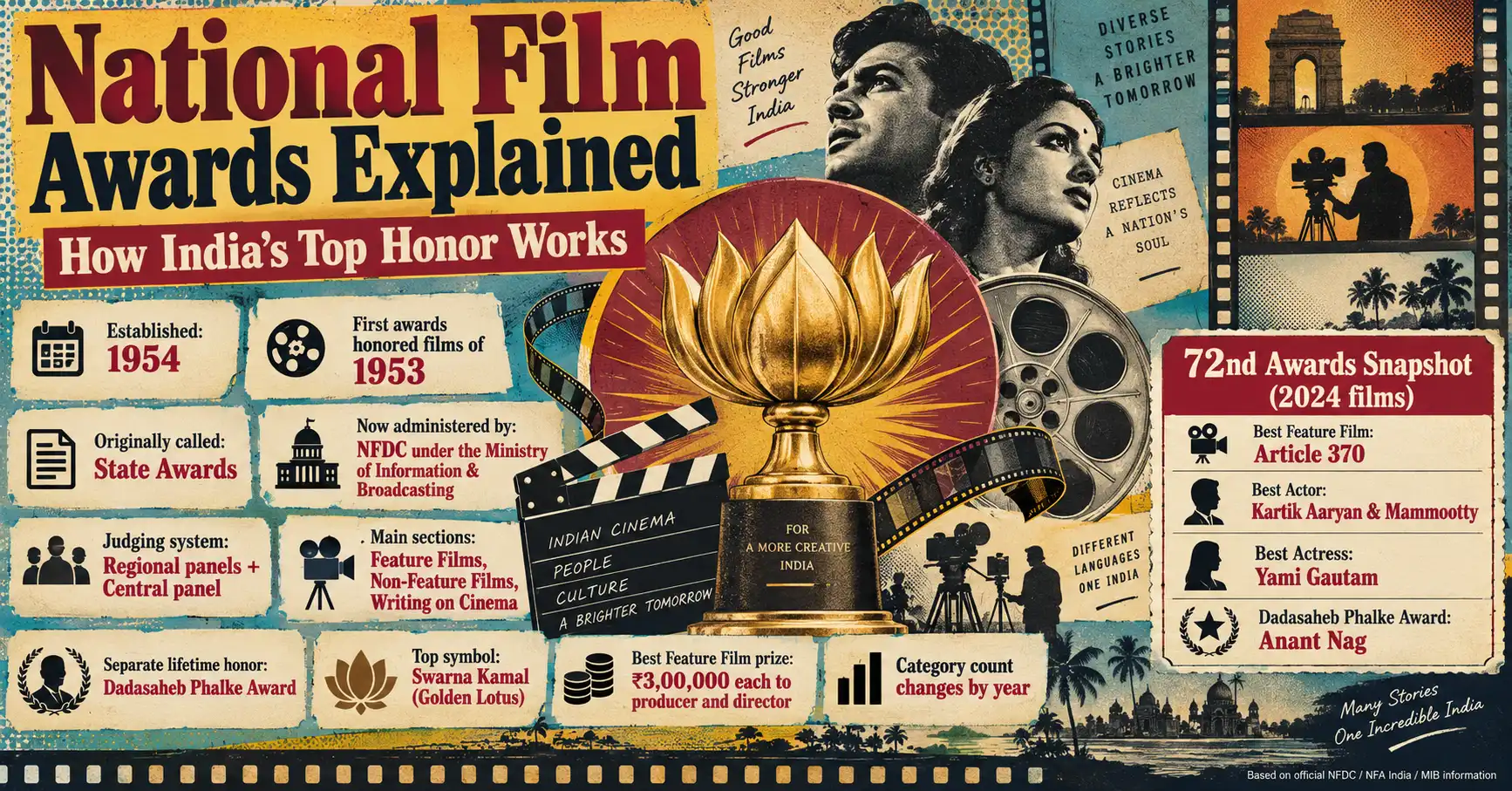
₹3,00,000. Split between the producer and the director. That’s the cash that comes with Best Feature Film, India’s highest film honour. Not crores. Three lakh. Anyone who wants the National Film Awards explained should start right there, because the money tells you exactly what this award refuses to be.
It isn’t a popularity contest. Your vote counts for nothing. Neither does the opening weekend.
The Government of India set these up in 1954 under a much duller name. Seventy-two editions later, a jury still sits in a room and argues over a small Malayalam film, a Telugu blockbuster and a documentary almost nobody has seen. Same season. Same pool.
Most pages online hand you one slice of this. The history on one site, the winners list on another, a jury footnote somewhere else. Here’s all of it in one go.
So What Are the National Film Awards, Exactly?
The Government of India instituted them in 1954 to recognise excellence in Indian cinema nationally, across every language (Wikipedia). That scope is the whole trick. A Marathi film competes against a Tamil one. A tiny non-feature entry sits in the same process as a studio production.
Three different bodies have run the awards over the decades. The National Film Development Corporation of India handles them now, a public-sector outfit under the Ministry of Information & Broadcasting, and it took charge in 2023.
So does the government pick winners? The official framing says no. Neither the Government nor the organisation influences which films come up for consideration or which ones ultimately win. Juries decide.
Whether you buy that line is your call. What nobody disputes: ticket sales play zero part in it. The year’s biggest Bollywood grossers can walk out of the season empty-handed.
National Film Awards Explained: The 1954 Origin Story
The first ceremony happened on 10 October 1954. Nobody called it the National Film Awards then. The official name was “State Awards for Films,” and it stayed that way for thirteen more editions. The rename arrived at the 15th edition in 1967.
The Best Feature Film prize actually predates the ceremony. It began in 1953 as the “President’s Gold Medal for the All India Best Feature Film.” First winner: Shyamchi Aai, a Marathi film.
The administrative handovers matter more than they sound:
- 1954–1973 — the Ministry of Information & Broadcasting ran the whole thing.
- 1974–2022 — the Directorate of Film Festivals took over, covering the 21st through 68th editions.
- 2023 onwards — the NFDC.
Then there’s the money trail, which is quietly fascinating. Best Feature Film paid ₹20,000 in 1957. It reached ₹40,000 by 1970 and ₹50,000 by 1980. The big jump came in 2006, to ₹2,50,000. Since 2022 it sits at ₹3,00,000, shared by the producer and the director.
Seventy years. A fifteen-fold rise. Compare that to what a single crore-level marketing push costs today and you see the point of this trophy. Prestige, not payday.
Who Actually Picks the Winners? Inside the Two-Tier Jury
This is the part nobody explains properly, and it’s easily the most interesting mechanic in Indian awards.
Since the 57th edition, feature films clear two rounds of judging, not one.
Round one: five regional panels. Each panel seats a chief plus four members. Here’s the smart bit. The chief and at least one other member always come from outside the region that panel is judging. A regional panel never gets stacked with people from that region alone. That cross-posting works as a built-in bias check.
Round two: the central panel. A director heads it. Every regional chief sits on it, along with five additional members. This group makes the final call on who wins what.
Non-Feature Films and Best Writing on Cinema run entirely separate juries. They never touch the feature-film process.
That’s the National Film Awards explained at a structural level. Regional shortlist, national decision, fresh eyes at both stages.
Which films even qualify?
Three rules do most of the filtering:
- The Central Board of Film Certification must certify the film within the calendar year under consideration, meaning 1 January to 31 December of the qualifying year.
- The director has to be an Indian national.
- Co-productions with foreign entities have to satisfy six specific conditions.
And entries don’t enter themselves. Somebody files them. A brilliant film with a careless producer simply never reaches a jury table.
Every National Film Award Category, Broken Down
Readers always ask how many categories exist. There’s no clean answer, and anyone quoting you a fixed number is guessing.
The awards split into three sections, plus one standalone lifetime honour:
- Feature Films
- Non-Feature Films
- Best Writing on Cinema, covering books on cinema and film criticism
- The Dadasaheb Phalke Award, which sits outside all three
The count inside those sections moves year to year. The 59th edition ran 38 feature-film categories, 20 non-feature categories and 2 for writing on cinema. A different edition, a different spread.
Swarna Kamal vs Rajat Kamal
Every winner gets a lotus. Which lotus depends on the tier of the category.
- Swarna Kamal, the Golden Lotus, goes to the top-tier awards.
- Rajat Kamal, the Silver Lotus, covers the rest.
Both arrive with a certificate and a cash prize. Best Feature Film takes the Swarna Kamal and that ₹3,00,000, which the producer and director divide between them.
The one category that nods at the box office
Best Popular Film exists for the crowd-pleaser. It’s the closest these awards get to admitting that people actually buy tickets. Read it alongside how box office collection is calculated in India, and the gap becomes obvious. Trackers fight over nett versus gross. The jury isn’t reading any of those numbers.
The Dadasaheb Phalke Award: The One That Isn’t About a Film
India instituted this in 1969, naming it after Dadasaheb Phalke (1870–1944), the director of Raja Harishchandra (1913), India’s first feature film. Actress Devika Rani took the first one, at the 17th National Film Awards.
Here’s what makes it different from everything else on this page. A committee of eminent film personalities chooses the recipient for outstanding contribution to the growth and development of Indian cinema. Not for one film. Not for one year. For a career.
The honour comes with a Swarna Kamal medallion, a shawl and a cash prize. The general figure quoted for the award is ₹15 lakh, though the 72nd edition specifically records Anant Nag’s 2026 prize as ₹10 lakh.
Winning it means the industry has decided your body of work changed something. You can’t campaign for that.
National Film Awards vs Filmfare Awards: The Difference Nobody Gets Right
Both started in 1954. Genuinely, the same year. After that they diverge completely.
Filmfare magazine, part of The Times Group, founded its awards as a private, media-run honour. Early winners came out of a reader poll, with up to 20,000 votes deciding a trophy. The modern format blends public online voting, which shortlists the nominees, with a jury that makes the final decision. Filmfare grew out of Hindi cinema and has since launched separate South, Marathi, Bengali, Punjabi and OTT ceremonies.
Now the myth-check, because almost every explainer online gets this wrong.
People frame it as “government jury versus public vote.” That’s lazy. Filmfare’s final round goes through an industry jury too. Only the nomination stage is public-voted. The real differences sit elsewhere:
- Who instituted it. One is a government honour, one is a magazine’s.
- Scope. The National Awards judge every Indian language in one pool. Filmfare built separate ceremonies per industry.
- What the trophy signals. Filmfare reflects industry standing and audience heat. A National Award reflects what five regional panels and one central panel agreed on.
A film can absolutely win both. Plenty have. They’re measuring different things.
Nobody Has Beaten Lagaan’s Eight Wins
Lagaan (2001) still holds the record for the most National Film Awards won by a single film: 8 at the 49th edition, including Best Popular Film, Best Music Direction, Best Lyricist, Best Male Playback Singer, Best Costume Design, Best Art Direction and Best Choreography (DNA India).
Bajirao Mastani came closest in 2015 with 7. RRR managed 6 in 2022.
Twenty-five years on, that 8 still looks safe.
Who Won at the 72nd National Film Awards (2026)
Treat this section as the worked example. The jury announced the 72nd edition on 18 July 2026, honouring films certified during calendar year 2024. The ceremony lands on 22 September 2026 at Kevadiya, Gujarat.
The volume of entries tells you how big this process runs: 400 feature films, 161 non-feature submissions, 38 books on cinema and 24 critics’ entries. An 11-member jury headed by filmmaker Jayaraj worked through the lot (Gulf News).
The headline winners:
- Best Feature Film — Article 370, directed by Aditya Suhas Jambhale
- Best Popular Film — Kalki 2898 AD
- Best Actor (shared) — Kartik Aaryan for Chandu Champion and Mammootty for Bramayugam
- Best Actress — Yami Gautam for Article 370
- Best Director — Rajkumar Periasamy for Amaran
- Dadasaheb Phalke Award — actor Anant Nag
Look at that spread. A shared Best Actor across Hindi and Malayalam. A Telugu tentpole taking the popular prize. A Tamil war film winning direction. If you follow South cinema’s run at the box office, none of this should surprise you, but seeing it on one winners list is still something.
The shared Best Actor also answers a question people ask every year. Yes, juries split awards. It happens.
So Is This Trophy Actually Worth Anything?
Three lakh rupees and a lotus, for beating 399 other films. On paper it’s a terrible return.
But that’s the appeal. This is the only Indian award where a first-time director nobody’s heard of can knock over a superstar vehicle, because five regional panels and one central panel genuinely liked the film more. No studio campaign fixes that. No fan army votes it through.
The system has its critics, and they’re not wrong about everything. Juries change every year, tastes swing hard, and plenty of deserving films never get filed in the first place. Fine. Name a better-designed film award in this country and I’ll listen.
Next July, when the list drops and your group chat erupts, you’ll know who decided it and how. Bookmark this the next time someone wants the National Film Awards explained in plain language, and tell us in the comments which win you’re still annoyed about. Ours is a long list.