
Evolution of Bollywood Film Music: Lata to AI Composers
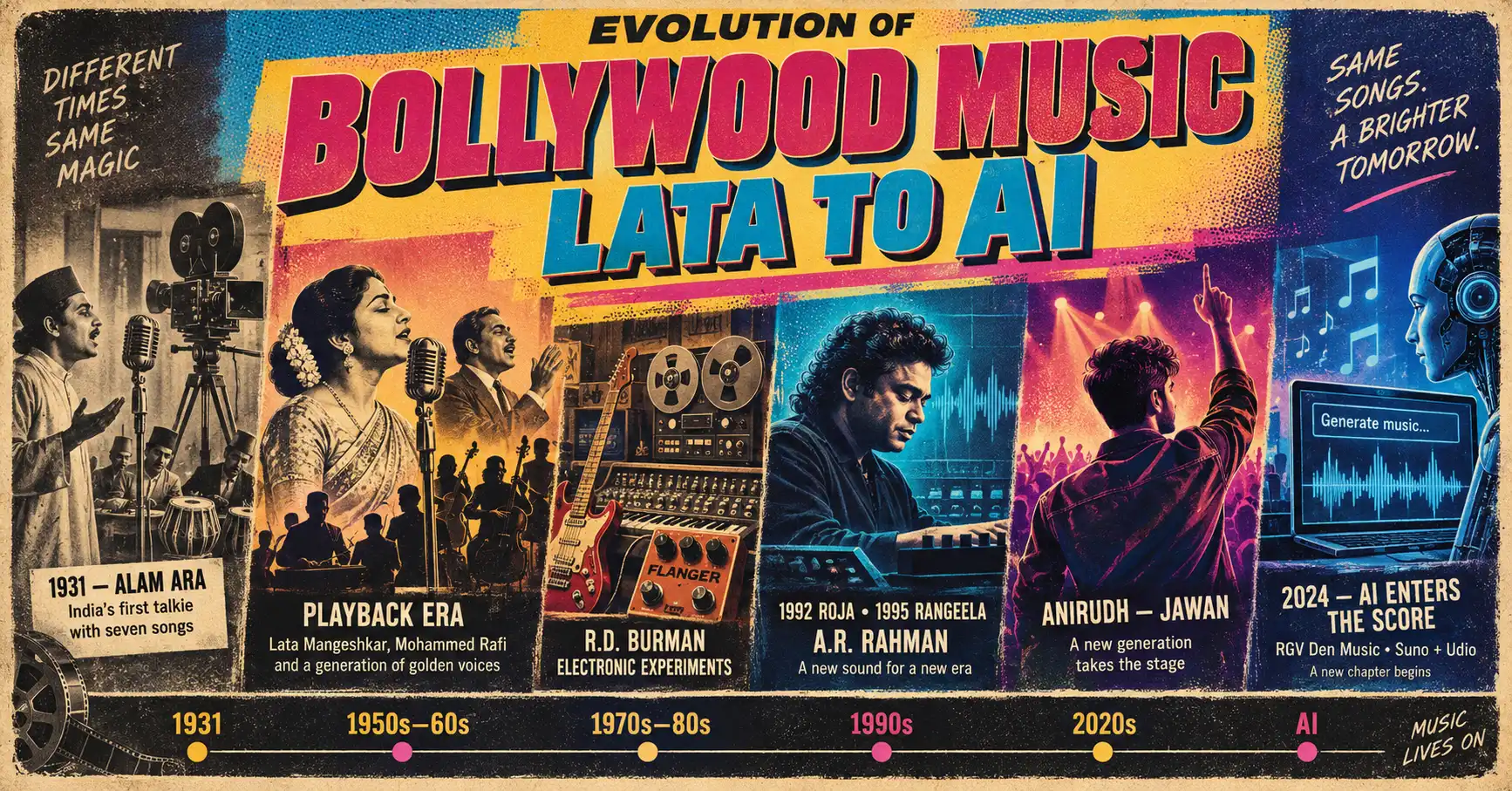
Mute a Hindi film and you lose half of it. Not the plot. The feeling. That’s the evolution of Bollywood film music in one line: the songs kept outliving the films around them.
Soundtracks here have always moved faster than the movies wrapped around them. Songs sold the tickets. Your parents can still hum a tune from a 1960s flop they never actually watched.
And now a filmmaker has handed an entire background score to an AI app, then told human composers they’re slower and pricier than software.
Here’s the strange bit. That filmmaker is Ram Gopal Varma. In 1995 he gave A.R. Rahman his Bollywood debut with Rangeela. Three decades later, he’s the loudest voice in Indian cinema arguing that machines should take the job. One man standing at both ends of this timeline.
The evolution of Bollywood film music in one timeline
Quick version first. Details below.
- **1931 — Alam Ara.** India’s first talkie lands with seven songs, sung live on camera.
- 1940s–60s — The Golden Age. Naushad builds 100-piece orchestras. Lata Mangeshkar, Mohammed Rafi and Kishore Kumar turn voices into brands.
- 1970s–80s — R.D. Burman. Flanger pedals in 1971, synth brass and four-on-the-floor beats by the next decade.
- 1990s — A.R. Rahman. Roja (1992) rewrites the rulebook, Rangeela (1995) brings it to Bollywood.
- 2000s–10s — The album splits. Multi-composer soundtracks, remix culture, then streaming.
- 2020s — Anirudh Ravichander. One Tamil composer scoring the biggest Hindi releases going.
- 2024 — AI shows up. Suno, Udio, and a Telugu film with no human composer at all.
Alam Ara, 1931: the year Hindi cinema learned to sing
Ardeshir Irani’s Alam Ara opened on 14 March 1931 with seven songs in it. The first one, “De De Khuda Ke Naam Par,” came from Wazir Mohammed Khan under music director Firozeshah Mistry. Irani reportedly wanted Khan for his coarse, fakir-like voice. Not a polished classical instrument. A texture.
The crowds outside the theatre grew big enough that police had to step in.
But nobody was “playing back” anything yet. The actor sang, the musicians played just off-frame, and the camera caught all of it in one go. Studios only worked out proper pre-recording later that decade, and once they did, the actor and the voice split into two different jobs.
That split created the playback singer. Everything after this point sits on top of it.
The Golden Age: when playback singers got bigger than the stars
Naushad scored 65 films. Just 65. Out of that small pile came Baiju Bawra (1952), Mother India (1957) and Mughal-e-Azam (1960).
He also worked at a scale that would terrify a modern producer. A 100-instrument orchestra for Aan. A 100-singer chorus for one song, “Ae Mohabbat Zindabad,” in Mughal-e-Azam. And he’s credited as the first Hindi film composer to record voice and music on separate tracks.
Read that last line again, because it matters more than the orchestra size. Separate tracks mean you can balance a voice, redo one line, sit the singer above the strings instead of inside them. Hindi film music stopped being a performance and became a production.
Something else happened across these decades that I think gets undersold. The composer’s name on a poster started working like a genre label. Naushad promised one kind of grandeur. S.D. Burman promised another, lighter on its feet and closer to folk, at least to my ear. Regulars learned the difference and bought tickets accordingly.
Then the singers went one better and became the brands themselves.
That’s the part of the evolution of Bollywood film music people still argue about at family weddings. Not the arrangements. The voices.
Rafi or Kishore? Pick a side
Think about what a music director was actually casting when he picked between Mohammed Rafi and Kishore Kumar. Same hero, same scene, two completely different films. Rafi could carry devotion and heartbreak without ever pushing his volume. Kishore had mischief in him, plus a looseness that made a song sound improvised even when it wasn’t. My own bias, for whatever it’s worth: Kishore holds up better on a long drive, Rafi holds up better at 2 a.m. You’ll disagree. Everyone does.
And Lata Mangeshkar sat above that argument entirely.
She entered the Guinness World Records as the most-recorded artist in history, a title that later passed to her sister Asha Bhosle.
Worth being honest about this one, though. Mohammed Rafi’s estate disputed the claim and counted roughly 28,000 songs in 11 languages for him. So the “most recorded ever” line you’ve seen a hundred times on social media was never settled trivia. It was a genuine fight.
One thing nobody disputes: in this era, people bought tickets for a voice. The face on screen was almost incidental.
R.D. Burman plugged Bollywood into the mains
Most write-ups file R.D. Burman under “disco.” That’s lazy.
He ran a flanger pedal through a guitar for “Dhanno Ki Aankhon Mein” back in 1971, years ahead of India’s disco boom. By the time he scored The Burning Train‘s opening track, he had synth brass, four-on-the-floor beats and a disco toms and laser sound stacked into a mainstream Hindi film. Writers now trace India’s later electronic music scene straight back to this work.
He wasn’t following the trend. He got there first and waited.
This is also where Bollywood music picked up its habit of stealing whatever sound the world was making and bending it into a film song. The habit never left.
A.R. Rahman and the 1990s reset
Rahman didn’t walk in through Bollywood’s front door. He came through Tamil cinema.
Roja (1992) was his debut score, and it mixed reggae, classical and soft melody instead of obeying standard Hindi film orchestration. It won him his first National Film Award and a Filmfare Award (South). Hindi cinema got him three years later with Rangeela (1995), then Dil Se.. (1998) and Taal (1999) (A.R. Rahman’s full record).
Then came the part nobody in 1992 would have predicted. Slumdog Millionaire (2008) won him two Academy Awards, for Best Original Score and for Best Original Song with “Jai Ho,” making him the first Asian composer to take that song award. Add a Golden Globe and two Grammys to the shelf.
A Bollywood composer, holding Oscars, for a soundtrack built on Indian film music logic. That’s the moment the industry’s sound stopped being a regional curiosity abroad.
And remember who directed Rangeela. Ram Gopal Varma. Hold that thought for about 30 years.
The 2000s and 2010s: the album breaks into singles
This is the stretch where the shape of a soundtrack changed, not just the sound.
One composer per film became a suggestion rather than a rule. What I remember from the CD sleeves, and later the app screens, is credits getting longer. Two or three composers on one album. Often a different name again on the background score. To my ear, Pritam, Vishal–Shekhar and Amit Trivedi owned the radio in those years. Each had a different instinct about how much Indian and how much imported a hit should be.
Then the cassette and the CD stopped mattering. Nobody bought the album anymore. They streamed the one song from the trailer, and the label learned to build a soundtrack around whichever track could survive on its own.
You could feel that shift as a listener. An album used to be a sequence you sat through, side A then side B, filler track and all. By the mid-2010s I was doing exactly what everyone else was doing. Hear the hook in a trailer, search the title, add one song to a playlist, never open the rest. The fourth track on a good album basically stopped existing for most of us.
Here’s my honest read on that stretch of the evolution of Bollywood film music. The industry got much better at reach. It got worse at albums.
Nothing wrong with a great single, obviously. But a soundtrack used to build a mood across forty minutes. That skill went quiet while everyone chased whatever track the algorithm would push.
Some of the craft got thinner. The reach got enormous. Both things are true.
Anirudh Ravichander and the pan-India takeover
The 2020s broke the language wall for composers, and Anirudh Ravichander walked through the hole.
Look at 2023 alone. He scored Jailer, his third Rajinikanth collaboration after Petta and Darbar, a film made for roughly ₹200–220 crore that grossed somewhere around ₹605–650 crore worldwide. Those wide ranges aren’t sloppiness on our part, by the way. Indian collections genuinely get reported differently by different trackers, which we broke down in how box office collection is calculated in India.
The same year, he delivered his first full Hindi film score for Shah Rukh Khan and Atlee’s Jawan, and picked up Zee Cine Awards for Best Music Director and Best Background Music.
Read that sequence again. A Tamil composer, scoring the year’s biggest Hindi blockbuster, while his Tamil work outgrosses most of Bollywood. Audiences stopped caring about the language a beat came from.
Audio launches turned into events of their own too, with tracklists dropped like film releases. Anirudh’s 15-track blast at the Lokesh Kanagaraj DC audio launch is the current template for how a score gets sold to fans before the film exists.
So that’s the human arc. Ninety-odd years of it. Now the awkward part.
Enter AI: Suno, Udio and Bollywood’s first fully AI-composed score
On 20 September 2024, Ram Gopal Varma announced a new venture called RGV Den Music. Its method: generate full scores using AI apps including Suno and Udio. His film Saree, then slated for a November 2024 multi-language release, was built around a completely AI-generated background score, reported as the first Indian feature to go that route (the original report).
His reasoning was blunt. Composers miss deadlines and juggle other films. Lyricists, he argued, often miss what a song is actually about. AI hands him music in seconds and, in his words, at absolutely no money.
“There is going to be no human being who will be able to win against artificial intelligence,” he said.
He also said something quieter that I think is closer to the truth: “Eventually, the music comes from your thoughts. You need to have clarity on what you want the app to produce. It’s the taste that will matter.”
That’s a different claim from the first one. Taste is still a human job. The prompt isn’t the song.
And there’s a bill nobody has paid yet. Critics flagged the obvious problem straight away: these tools learned from human recordings, and the copyright and compensation questions around that training data remain open. Paisa vasool for the producer, maybe. Not for the musicians whose work fed the machine.
When AI makes Lata Mangeshkar sing again
January 2024. An AI-generated version of “Ram Aayenge To Angana Sajaungi” in Lata Mangeshkar’s voice spread across Indian social media, timed to the Ram Mandir consecration in Ayodhya.
The reaction split down the middle, hard. Some listeners called it ultra melodious and said it moved them. Others pushed back flatly: “AI [is] not meant for melodious Indian singers” (the reaction as it happened).
Both camps heard the same file. That’s what makes this the hardest question in Indian film music right now.
A synthetic voice can copy the tone. It cannot copy the decision. Every Lata recording carries a thousand small choices about where to breathe, where to hold back, where to let a word crack. Those choices came from a person who had sung that emotion before.
You’re not mourning a frequency range when a legend dies. You’re mourning the judgement.
Threat or tool? My honest take
Here’s where I land, and you’re free to disagree in the comments.
AI is going to eat the boring work first. Background beds. Temp tracks. The 40-second sting under a montage nobody remembers. Small producers with no money will use it, and plenty of people who currently earn a living from session work will feel that.
What I don’t buy is the headline version, where the composer disappears. The evolution of Bollywood film music has never been a story about tools. It’s a story about somebody with taste picking a strange sound and betting a film on it. Naushad betting on 100 voices. Burman betting on a flanger pedal. Rahman betting that a Tamil score could go global.
A prompt box can’t make that bet. It waits for you to make it.
There’s a practical version of this too. Somebody still has to sit in a room and say no. No to the take that’s technically perfect and emotionally dead, no to the hook that sounds like last year. That judgement is slow, expensive and human. It’s also the entire job.
The real fight of the next few years won’t be human versus machine anyway. It’ll be about consent and credit: whose voice, whose recordings, whose royalty. Settle that badly and Indian film music loses something it won’t get back.
So keep an ear on this one. If you want to see which of these soundtracks is actually shifting tickets right now, our running list of the highest-grossing Bollywood movies of 2026 is the quickest way to check.
And tell us straight: would you stream an AI-composed Bollywood album, or does that one break the deal for you?