Bollywood Stars on YouTube: India’s Creator Crossover
Open YouTube on a random Tuesday night. Somewhere between a cricket recap and a ten-minute biryani tutorial, you’ll hit a face you last saw on a 70mm screen, talking straight into a phone camera in her own kitchen. Bollywood stars on YouTube stopped being a novelty years ago. For plenty of them, the channel is a whole second business now.
Now flip the direction.
The same month, a studio signs a 26-year-old who has never shot a single scene. His qualification? He already has more subscribers than the film needs ticket buyers. That half of the story usually gets covered in a completely different article, by a completely different writer, as though the two things aren’t the same thing.
They are. One economy, two doors. So here’s the full map, the money that explains it, and a straight verdict on who actually made the jump work.
What the Film-to-Creator Crossover Actually Is
For seventy-odd years, Indian fame ran in exactly one direction. A film made you a star. Everything else arrived afterwards: the TV ads, the magazine covers, the endorsement cheques, eventually something like a star on the Hollywood Walk of Fame. The screen was the source. The rest was downstream.
That pipe now runs both ways.
Direction one: working film actors build their own channels and publish straight to an audience, with no distributor sitting in the middle. Alia Bhatt and Kartik Aaryan both run personal YouTube channels on top of full film calendars.
Direction two: digital-first creators, people who built their entire fame on a phone, get cast in scripted shows and theatrical films.
Same economy. The only real difference is where the audience got built first.
Kill one myth early. This isn’t celebrities “trying out social media.” A star’s channel is a distribution asset. It talks to fans on the day the actor wants, in the words the actor chooses, without a publicist trimming the quotes. And a creator’s subscriber base isn’t a vanity number to a producer. It’s pre-sold attention, and attention is the one thing marketing budgets exist to buy.
What Bollywood Stars on YouTube Actually Post
Most articles about Bollywood stars on YouTube are just a name list with subscriber counts bolted on. Those numbers rot fast. Half the roundups still ranking in search quote figures from 2020 to 2024, which tells you almost nothing about 2026 and even less about why any of this is happening.
Group the channels by what they do instead. That framing survives.
The personal vlog channel. House tours, travel diaries, shoot-day routines, the occasional unfiltered rant. This is the format the Alia Bhatt and Kartik Aaryan style of channel leans on: low gloss, high frequency, fan-facing.
The second-innings channel. Actors with a thinner film calendar use YouTube as an active career rather than a scrapbook. Cooking, travel and long-form conversation all sit here. It’s the most honest use of the platform, and often the most watchable.
The promo channel. Trailer drops, behind-the-scenes reels, song teasers, cast banter timed to a release week. Functionally it’s a marketing arm that happens to live on a subscribe button.
The format channel. Recipe series, interview shows, reaction episodes, anything with a repeatable structure and an episode number. This is the one that behaves most like an actual media company.
None of these are accidents. A film release gives an actor roughly two weeks of visibility, twice a year if the calendar is kind. A channel gives 52 weeks. That’s the whole calculation, and it’s why Bollywood stars on YouTube keep multiplying rather than quietly deleting their channels after one promo cycle.
Creators Who Crossed Into Bollywood
Now the reverse route. Four careers are documented well enough to actually learn from, and they rhyme more than you’d expect.
Bhuvan Bam: the longest runway
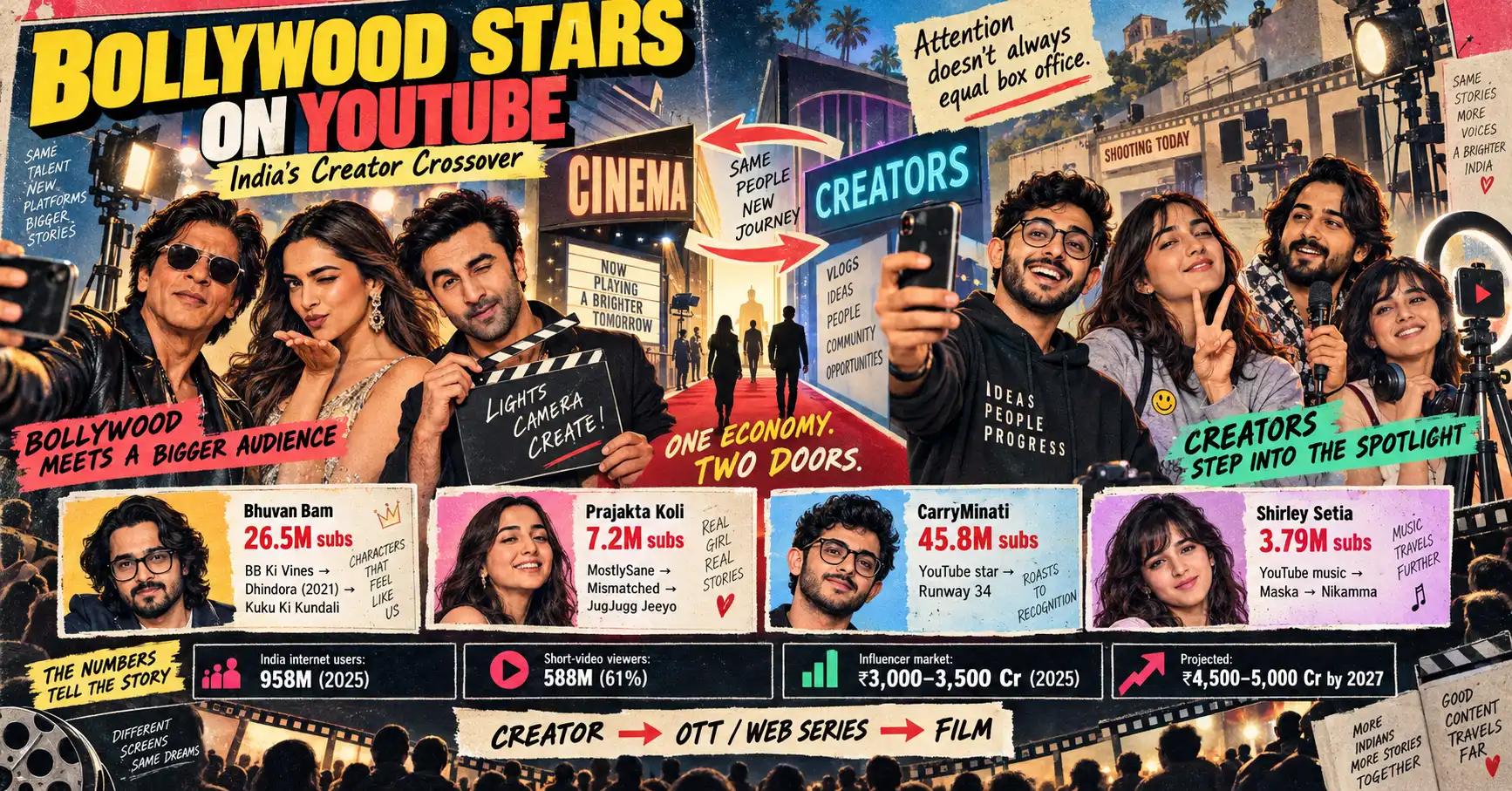
Bam shifted from Facebook to YouTube in June 2015. BB Ki Vines crossed 3 billion cumulative views by January 2021, and by June 2026 the channel sat at 26.5 million subscribers and 5.34 billion total views.
His acting move came in stages. Dhindora launched in October 2021 as an eight-episode scripted series on YouTube itself, then moved to Netflix for season two. He’s now reported to be filming Kuku Ki Kundali opposite Wamiqa Gabbi, described as his Bollywood debut.
Read those dates again. Eleven years from the first upload to a feature film. Nobody teleported.
Prajakta Koli: the studio-backed debut
Koli built MostlySane, moved into Netflix’s Mismatched, then landed the biggest creator debut yet: Ginny Saini in Dharma Productions’ Jugjugg Jeeyo, released 24 June 2022, with a Prime Video premiere on 22 July.
The numbers matter here. The film earned ₹101.23 crore domestically and ₹34.90 crore overseas, so ₹140.13 crore worldwide against a ₹120 crore budget. Trade reporting called that average, not a hit. If the gap between “₹140 crore” and “average” confuses you, our explainer on how box office collection is calculated in India unpacks the nett-versus-gross maths.
CarryMinati: cast as himself
Ajay Devgn’s Mayday announced CarryMinati’s casting in December 2020 and released on 29 April 2022. He played a social-media sensation, sharing screen space with Devgn and Amitabh Bachchan. At the time of casting he had 27.5 million YouTube subscribers and 10.5 million Instagram followers.
His own framing was telling. He called himself “absolutely thrilled and honoured” to play a character built on his own persona, then added that “content creation will always be my passion and true calling.” Note the order of loyalty. The film was the side quest.
Shirley Setia: the music side door
Setia came up posting cover songs, a channel that stood at 3.79 million subscribers and over 411 million views as of April 2026. Her acting debut arrived through Netflix’s Maska in 2020, and her big-screen debut followed with Nikamma in June 2022.
Music is the softest entry point in this whole story. A singing career already carries a public persona, a fanbase and a camera-ready presence, so the leap into acting is shorter than it looks.
The staircase nobody names
Here’s the pattern all four share, and it’s the thing the listicles keep missing.
- Digital fame first — a channel with a measurable, loyal audience.
- An OTT or web-series stepping stone — Dhindora, Mismatched, Maska. A lower-risk scripted credit with real production discipline.
- A theatrical role last — Mayday, Jugjugg Jeeyo, Nikamma, Kuku Ki Kundali.
Not one of them jumped straight from a vlog to a Friday release. Streaming is the audition room, which is also why the platform wars between Netflix, Prime Video and JioHotstar matter far beyond what you watch on a Saturday night. Those commissioning budgets are deciding who gets to become a film actor next.
Why It’s Happening: Follow the Money
Sentiment doesn’t explain this. Scale does.
India’s influencer marketing sector was worth ₹3,000–3,500 crore in 2025 and is forecast to hit ₹4,500–5,000 crore by 2027 at a 22% CAGR. A separate EY-cited estimate lands in the same neighbourhood: ₹3,375 crore for 2026, spread across more than 10 crore digital creators. That’s roughly one creator for every ten internet users in the country.
Then look at the audience side. India’s active internet base crossed 958 million users in 2025, growing about 8% year on year, per the IAMAI–KANTAR report. Rural users make up 57% of that, some 548 million people. And 588 million of them, 61% of the active base, already watch short-video content.
Sit with that last number. Short video reaches more Indians than any single film release ever has.
Creator-podcaster Ranveer Allahbadia put the earnings side bluntly in August 2026, arguing the hierarchy runs the opposite way to what people assume: “only maybe thirty people at the very top of Bollywood make real money, while content creation has room for thousands of people to build something sustainable, most of them without ever becoming famous the way an actor has to.”
He has a point. He’s also selling his own side of the trade, so hold it loosely.
The counterweight is brutal and almost nobody quotes it: only 8–10% of India’s creators monetise effectively. Ten crore creators, and the overwhelming majority earn close to nothing. The creator economy has its own thirty-people-at-the-top problem. It just hides it better, because the pyramid is so much wider at the bottom.
For a producer, the maths is simpler still. Casting a creator converts an unknown into a number. You can’t forecast whether an audience will like a newcomer, but you can absolutely count their subscribers before signing the cheque. That’s risk reduction dressed up as talent scouting, and it explains why Bollywood stars on YouTube and YouTubers in Bollywood grew out of the same pressure at the same time.
Paisa Vasool Ya Time Waste? The Honest Verdict
Time for the site’s favourite question, applied to careers instead of tickets.
Paisa vasool. Bhuvan Bam. He treated each step as an actual craft upgrade and spent six years between YouTube fame and a scripted series. Dhindora worked as a show, not as a stunt. A film debut after that reads earned.
Paisa vasool, with an asterisk. Prajakta Koli. Getting cast by Dharma in an ensemble alongside established leads is a genuine win, and she took the OTT route before the theatre route. But Jugjugg Jeeyo landing at ₹140.13 crore worldwide on a ₹120 crore budget proves the uncomfortable bit: a huge subscriber count does not drag a film to blockbuster status. Fans watch you for free. Paying ₹300 for a ticket is a different relationship entirely.
Jury’s out. CarryMinati and, to a degree, the whole persona-casting trend. Both he and Bam were cast largely as fictionalised versions of their online selves. That’s not a career path. That’s a cameo strategy with a longer runtime. Studios are importing an audience, not betting on a dramatic actor, and there’s a ceiling built into that deal.
The real time waste is the assumption underneath all of it: that 20 million subscribers converts neatly into opening-weekend footfall. Look at any list of the highest-grossing Bollywood movies of 2026 so far and count how many were carried by a creator’s follower count. The answer will keep you honest.
Attention and box office are different currencies. The exchange rate is terrible, and it moves.
What This Means for the Next Generation of Indian Stars
The next big Hindi-film lead is probably posting already. Not in a “manifest it” way. In a structural way.
If 61% of nearly a billion connected Indians watch short video, then the single cheapest audition room in the country is a phone. Casting directors get a searchable, sortable, numbers-attached talent pool that never sleeps. Film schools and star families no longer control the front door.
Three things follow, and they’re worth watching over the next two or three years:
- Persona casting will hit its ceiling. Once a few creators get cast as characters who share nothing with their online selves, and pull it off, the whole category gets re-rated.
- The OTT step stays mandatory. Streaming carries the risk that theatres can’t. Expect the digital-to-OTT-to-theatre staircase to harden into a standard route, not an exception.
- Film stars will keep publishing. Bollywood stars on YouTube are not going back to press junkets and controlled interviews. Once you own the channel, you don’t hand the microphone back.
The old star system took a decade to build one name. This one builds thousands, sorts them by a public metric, and lets the films pick from the top of the sheet. Rougher, faster, far less romantic.
The Test That Actually Matters
Forget subscriber counts. Here’s the only question worth asking about any creator-turned-actor: could this role have gone to someone else?
If yes, they’re an actor now. If no, if the part only exists because of who they are online, they’re still a creator with a film credit. Both are fine careers. They’re just not the same career, and the trade press keeps blurring them.
So watch for the first big Indian film that casts a YouTuber in a role with no phone, no vlog, no meta-joke about followers. That’s the one that changes everything.
Think Bam pulls it off first? Or are you backing someone who hasn’t crossed over yet? Tell us in the comments, and keep this page handy — we’ll be linking every creator debut, channel launch and crossover box office verdict back here.