
Single Screen vs Multiplex Cinema in India: The Real Math
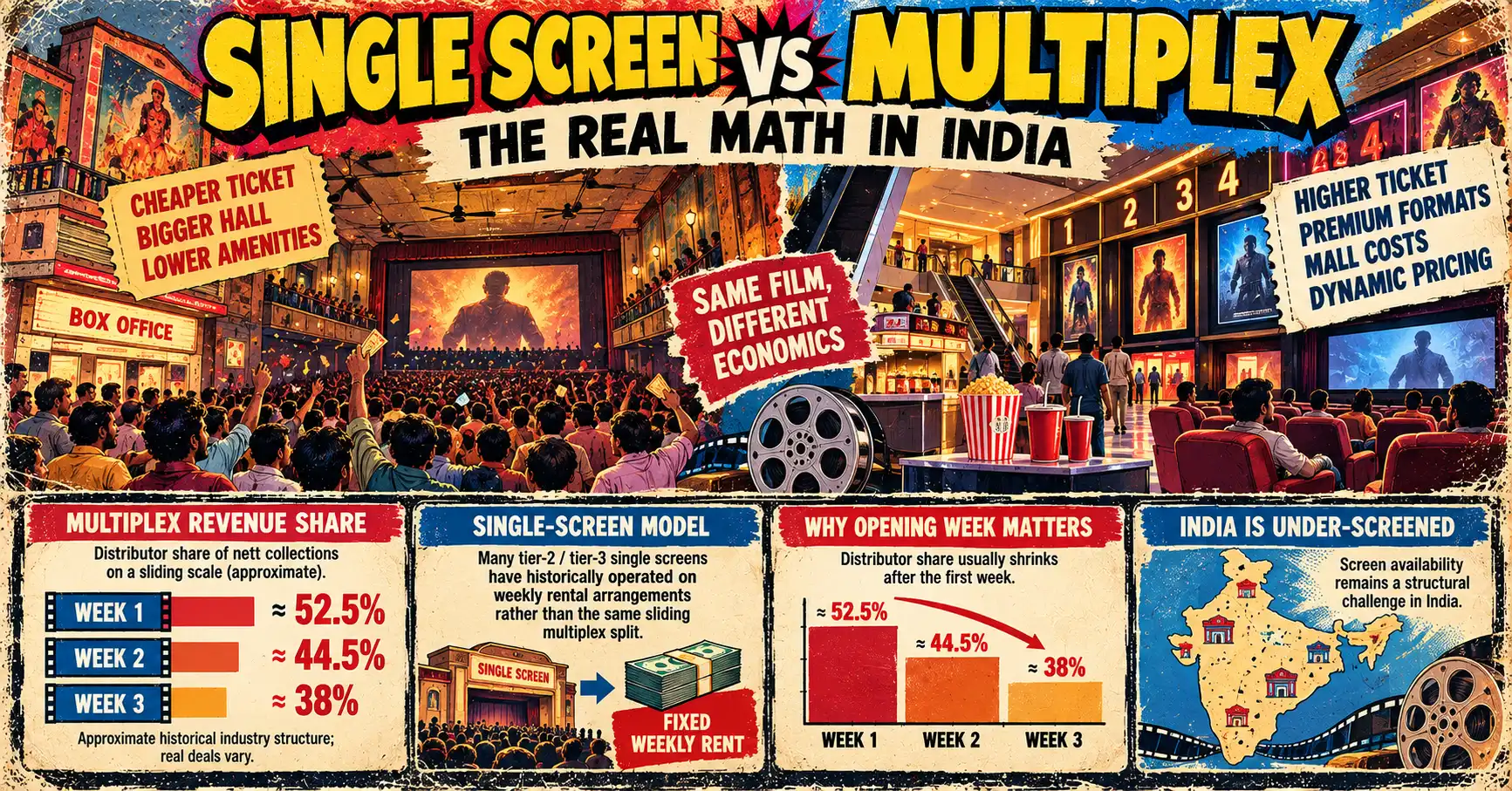
Same film. Same Friday. One hall charges you ₹70, another asks for ₹300 and a bit more for the recliner. That, in one line, is the single screen vs multiplex cinema in India story. Most of us just pay, grab the popcorn and move on.
But the gap isn’t random. It comes from rental deals, sliding revenue splits, tax slabs and a famous hall in Jaipur that decided fewer seats was the smarter bet. Once you see where your money goes, the price on your ticket starts making sense.
So does the reason your neighbourhood talkies probably shut down.
Single Screen vs Multiplex Cinema in India: The Price Gap in Numbers
Let’s start with the numbers everyone argues about in the ticket queue.
A standard 2D multiplex ticket in a metro like Mumbai costs about ₹220–₹320 at prime time. A single screen in a tier-2 or tier-3 city usually charges ₹50–₹110. Bhopal’s Rajhans Cinema, for instance, sells seats at roughly ₹60–₹85.
That’s a two-to-four-times gap for the same movie.
Here’s the twist, though. The national average for a standard 2D multiplex ticket was only about ₹134 in 2024, according to a widely shared ticket-price round-up. Metro prime-time shows skew our sense of “normal.” Plenty of multiplexes in smaller cities charge far less than a Saturday night in Andheri.
Premium formats: a different price planet
Standard 2D is just the entry ticket. Upgrade the format and the bill jumps fast:
- 3D: ₹180–₹230
- IMAX 2D: ₹280–₹360
- IMAX 3D: ₹350–₹480, sometimes more
- VIP / Gold Class: ₹250–₹420
Single screens mostly don’t play in this league at all. IMAX screens and luxury recliner halls need serious capital, and multiplex chains have that money. A 60-year-old hall running on thin margins doesn’t.
The clock matters too
Multiplexes price by demand. Morning shows across India typically cost ₹70–₹110. The same seat at prime time carries a 25–40% premium.
That’s dynamic pricing in its simplest form. Want the cheapest multiplex ticket in your city? Book the 10 am show. Seriously, it’s the most underrated hack in Indian moviegoing.
Why Multiplex Tickets Cost More (Spoiler: It’s Not the Tax)
Plenty of people assume multiplexes pay more tax and pass it on. They don’t. We’ll get to GST properly further down, but the short version is simple: the tax rate depends on the ticket price, not the building.
The real reasons are more boring and more interesting at the same time.
- Premium formats pull the average up. Every IMAX or Gold Class seat sold lifts the blended ticket price of a multiplex chain. Single screens rarely have those formats to sell.
- Time-of-day pricing. Prime-time shows cost a quarter to 40% more than the morning slot.
- Real estate and seating. Malls, recliners, carpeted lobbies and air-conditioned everything cost money every single month. You’re paying rent on that sofa for three hours.
Our take? A multiplex doesn’t sell a movie. It sells an evening. The film is almost the excuse. Whether that’s worth ₹300 depends entirely on what you’re watching, and we’ll get to that verdict at the end.
This is the part nobody puts on a ticket-price listicle, and it explains almost everything.
First, a quick refresher. Box office trackers talk about “gross” and “nett” collections, and the difference is mainly tax. If that still confuses you, our guide on how box office collection is calculated in India breaks it down. For now, just remember one thing: the revenue split happens on the nett amount.
The multiplex sliding scale
In a multiplex, the distributor and the theatre split the nett money on a sliding scale. As Koimoi’s explainer on box office business lays out, the distributor’s share looks roughly like this:
- Week 1: about 52.5% to the distributor, 47.5% to the multiplex
- Week 2: about 44.5% to the distributor, 55.5% to the multiplex
- Week 3: about 38% to the distributor, 62% to the multiplex
- After that: the distributor’s cut keeps shrinking
See why producers obsess over opening weekends? The first week is when the distributor’s side earns its biggest slice. That’s why the early numbers in reports like our Jana Nayagan box office Day 6 update get so much attention. A film that crawls to its numbers in week four hands a bigger share to the theatre.
The multiplex wins the long game. The distributor wins the sprint.
The single-screen deal: fixed rental
Single screens, especially in tier-2 and tier-3 markets, usually skip this sliding split. They typically work on a fixed weekly rental arrangement instead.
That changes who carries the risk. The theatre owner’s income stays basically flat, whether the film flops or runs houseful all week. If the movie turns into a monster hit, the extra upside flows mostly to the distributor. Meanwhile the owner still pays for electricity, staff and maintenance no matter how many people turn up.
Cinema owner and author Vishek Chauhan put it bluntly to Forbes India: “A single screen, even if it makes a comparable collection to a multiplex, will often end up giving more revenue to the distributor than a multiplex.”
Read that again. Same box office, more money to the distributor, less to the hall. Forbes India describes single screens as having “zero negotiation power, zero elbow room” against multiplex chains on booking terms and release timing.
This is the missing link most articles skip. Cheap tickets and struggling single screens aren’t two separate stories. They’re the same story. A single screen can’t charge IMAX money, and even when it fills every seat, the deal structure caps what it keeps.
Why Single Screens Keep Shutting Down
The numbers here are grim, and they’ve been grim for a while.
India’s total screen count rose just 1% in 2025, to 10,033 screens. Behind that tiny growth: 124 screens closed, mostly single screens, while 240 new ones opened. That comes from the Ficci-EY 2026 media and entertainment report, as cited by Forbes India.
Finshots’ analysis of exhibition economics paints the long-term pattern. Roughly 150 single-screen cinemas close for every ~200 new multiplex screens that open each year. The new screens don’t replace the old halls one-for-one. They move the cinema experience into malls.
Maharashtra shows how deep the cut goes. Its single-screen count fell from roughly 1,200 to 475 theatres. Pune alone lost around 20–22 historic halls, including Vijayanand, Neelayam, Alka, Vasant, Minerva and Prabhat. If you grew up in Pune, some of those names probably hurt a little.
The daily maths of a struggling hall
Finshots cites one Telangana single screen that earned about ₹4,000 on a slow day. Its fixed costs for power, maintenance and staff? Around ₹7,000 a day.
You don’t need a finance degree to see the problem. Many single screens end up netting under ₹5 lakh a year. That’s less than what a lot of salaried folks in a metro take home. And the owner is sitting on prime city land that a developer would happily turn into a mall.
Why Single Screens Survive Anyway
Now for the part that makes us hopeful.
India is badly under-screened. We have just 6.8 screens per million people. Compare that with 109 in the US, 95 in France, 66 in the UK and 64 in China. Worse, only 3,150 of India’s roughly 19,500 pin codes have any cinema at all.
In a lot of small towns, the single screen has no multiplex rival. It’s the only big screen for miles. When a mass hero’s film releases there, the first-day-first-show crowd doesn’t care about recliners. They care about whistles, the hero’s entry scene and watching it together.
Fewer seats, better seats
The smartest single screens have stopped chasing volume. Two famous halls show the playbook:
- Raj Mandir, Jaipur cut its seats from 1,184 to 856. It used the space for extra legroom and sofas, then added 4K projection with Dolby Atmos and laser projection.
- New Excelsior, Mumbai went from 1,100 seats to 596 and added a café.
Neither turned into a multiplex. They kept the character and fixed the comfort. Honestly, that’s the version of single-screen cinema we’d happily pay a little more for.
GST, Quotas and the Rulebook
Government rules play into ticket prices too, just not always the way people assume.
GST 2.0 on movie tickets
Under the GST 2.0 reform, effective 22 September 2025, the slabs for cinema tickets work like this, per busy.in’s GST guide:
- Tickets up to ₹100: 5% GST (down from 12% earlier)
- Tickets above ₹100: 18% GST
The same slabs apply to single screens and multiplexes. Only the ticket price decides the rate.
Here’s where it gets interesting. Most single-screen tickets in tier-2 and tier-3 cities sit in that ₹50–₹110 band, so a lot of them fall under the 5% slab. A ₹300 multiplex ticket pays 18%. The law treats both halls equally. The price points just land differently, and that quietly helps the cheaper hall.
Maharashtra’s Marathi film quota
State rules can cut the other way. Maharashtra requires every cinema screen to show 44 Marathi films a year.
For a five-screen multiplex, that’s manageable. It can park the quota on one screen and run a big Hollywood or Bollywood release on the other four. A single screen has exactly one screen. Every quota slot is a slot that can’t go to the week’s biggest film. Supporting regional cinema is a fair goal, but this rule lands hardest on the halls with the least room to absorb it.
So Which Is Better Value for You? Paisa Vasool Ya Time Waste?
Our honest verdict: it depends on the film, not the hall.
- Big-screen spectacle? Pay for the multiplex, and go premium if you can. A Hollywood tentpole like the one in our Spider-Man: Brand New Day India Day 1 verdict earns its IMAX ticket. Watching that on a tired old projector is a waste.
- Mass-hero masala film? Go single screen, no question. The crowd is half the experience, and you’ll pay a fraction of the price.
- Mid-budget drama or comedy on a budget? Catch a multiplex morning show. You skip that 25–40% prime-time premium and still get the good seats.
- Not fussed about the big screen at all? Wait for streaming. Our Netflix vs Prime Video vs JioHotstar comparison will tell you which subscription is actually worth it.
One last thing. Every time you pick a single screen for a big release, you’re voting for it to still be around next year. Only 3,150 pin codes have a cinema at all. How many more halls can India really afford to lose?
Tell us in the comments: which single screen from your childhood is still standing, and which one do you miss?