
How Bollywood Release Dates Are Decided: The Real Rules
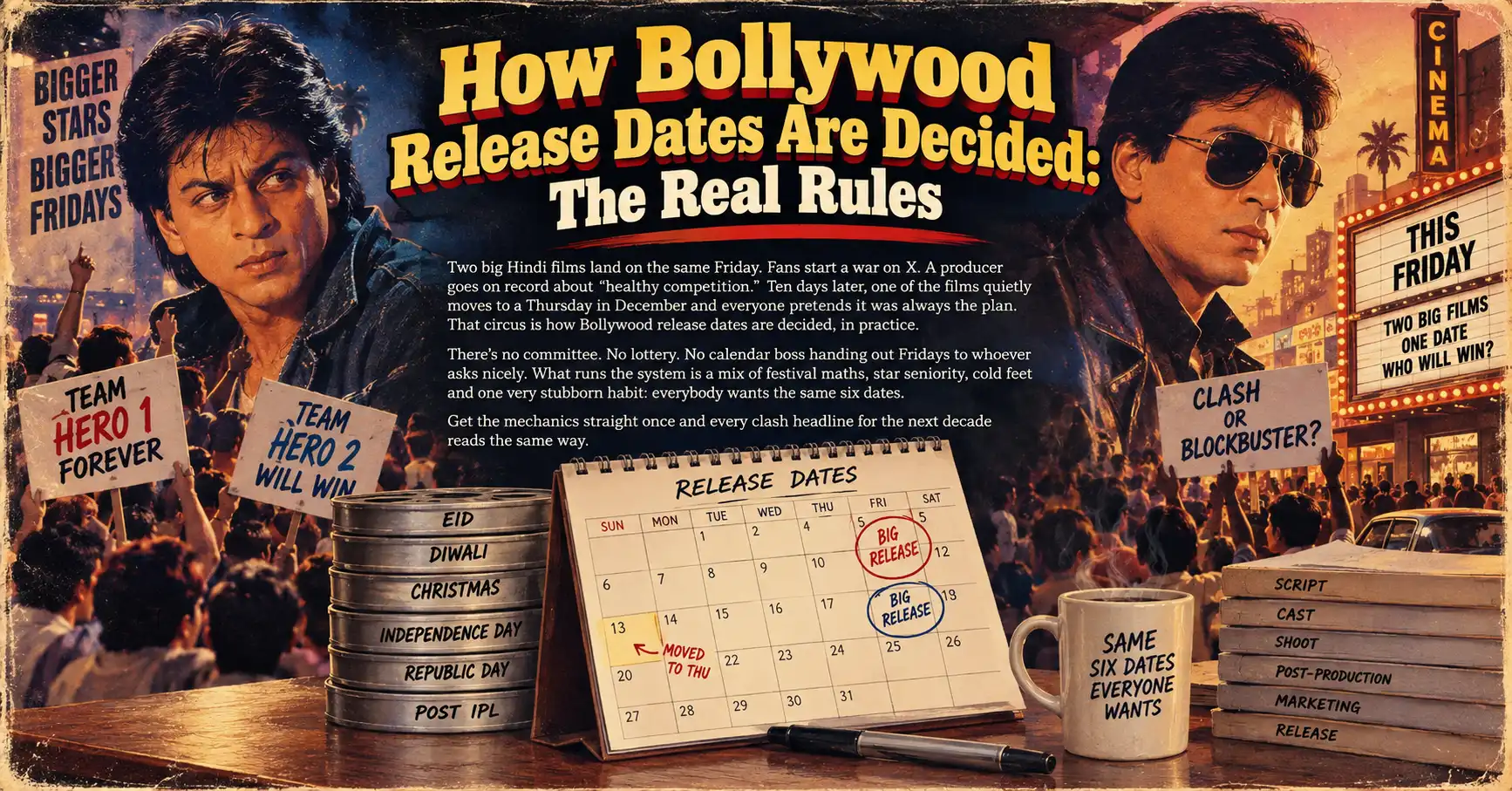
Two big Hindi films land on the same Friday. Fans start a war on X. A producer goes on record about “healthy competition.” Ten days later, one of the films quietly moves to a Thursday in December and everyone pretends it was always the plan. That circus is how Bollywood release dates are decided, in practice.
There’s no committee. No lottery. No calendar boss handing out Fridays to whoever asks nicely. What runs the system is a mix of festival maths, star seniority, cold feet and one very stubborn habit: everybody wants the same six dates.
Get the mechanics straight once and every clash headline for the next decade reads the same way.
Why the date matters more than the movie
A Hindi film makes most of its noise in the first three days. Word of mouth can rescue a slow starter, sure, but nobody plans for that. Producers plan for a big opening, and a big opening needs bodies in seats on day one.
Holidays supply the bodies. That’s it. That’s the entire logic.
A regular Friday in February asks a working audience to skip something. A Diwali Friday hands you a nation on leave, family groups booking four tickets at a time, and a Saturday-Sunday cushion behind it. The film doesn’t get better. The footfall does.
There’s a second reason the date carries so much weight, and it’s about screens rather than crowds. Exhibitors allocate shows on Thursday night based on advance bookings. A film that walks in with a holiday behind it gets more slots per day, better timings, and the big-format screens. A film that opens cold gets four shows in a small auditorium and has one weekend to prove it deserves more.
So the fight isn’t really about screens. It’s about the calendar that decides screens. If you want the numbers side of this, our breakdown of how box office collection is calculated in India explains why two trackers can report the same opening differently.
The Bollywood festival calendar: six dates everyone fights for
Six windows get treated as premium property. Big stars book them one to two years out, sometimes before a cast is even locked.
| Window | The trade’s reasoning for prizing it | What usually lands there |
|---|---|---|
| Eid | Widely described as the most lucrative window of the year | Salman Khan tentpoles; mass-entertainer action-comedy |
| Diwali | Longest stretch of family holiday footfall | Big-star spectacle and family drama |
| Christmas | A full holiday week with schools shut | Star vehicles riding the year-end break |
| Independence Day (Aug 15) | National holiday plus a patriotic mood | Patriotic and nationalist-themed films |
| Republic Day (Jan 26) | The first holiday of the year, after a quiet January | Patriotic drama, early-year tentpoles |
| First Friday after the IPL final | Cricket stops owning living rooms and prime time | Anything big that avoided the IPL months |
Those middle-column lines are how the trade talks about the calendar, not verified law. Treat them as the industry’s own reasoning, then check the reasoning against numbers.
Independence Day is the clearest genre pattern of the lot. Look at the run: Ek Tha Tiger (2012), Singham Returns (2014), Mission Mangal (2019), Gadar 2 (2023), then Stree 2 in 2024, which became the biggest August 15 release ever. On the holiday itself, Gadar 2 took ₹55.40 crore, Ek Tha Tiger ₹32.93 crore, Singham Returns ₹32.10 crore and Mission Mangal ₹29.16 crore.
Same date. Same national mood. Wildly different numbers. The date opens the door, but it doesn’t guarantee the size of the crowd.
Stree 2 is worth pausing on, because it broke the column’s own logic. A horror-comedy took the record on a slot the trade had spent a decade calling the patriotic-film Friday. The holiday delivers a crowd that’s free to go out; it doesn’t specify what that crowd wants to watch.
Diwali and Christmas earn their reputations in a different way, and the evidence sits later in this piece. Diwali 2016 held two big films at once and still put both in the year’s top 10. Christmas 2018 was crowded enough that Simmba moved a week to sit inside it rather than beside it. That’s what a genuinely deep window looks like: it absorbs traffic instead of splitting it.
How Bollywood release dates are decided, step by step
There’s a process here, even if it looks like chaos from outside.
Step one: the flag plant
A producer announces the date publicly, usually on social media, often before the shoot wraps and sometimes before it starts. That announcement isn’t a booking. Nobody approved it. It’s a flag planted on a Friday, and its only real power is social pressure on rivals.
Corporate studios pushed this habit hard. They need lead time for marketing spends, satellite and streaming negotiations, and slate planning, so dates now get called one to two years ahead.
The side effect is that a date gets claimed while the film is still an idea. Scripts change. Stars fall out. Post-production runs long. By the time the film is real, the Friday it booked may suit a completely different movie, and the producer is still standing on it out of pride.
Step two: everyone reads the board
Once a big name claims a date, rival producers do the maths. Do we have the same audience? The same age group? Will exhibitors give us enough shows if we go head to head?
That last question is the one that decides it. Two films with the same target crowd don’t get half the shows each in practice. The one with bigger advance bookings takes the prime evening slots, and the other gets pushed to morning and late-night shows where occupancy is thin.
Most of the time, one side blinks.
Step three: the quiet reshuffle
This is where the real decision-making happens, and it barely makes headlines.
Take Simmba. Rohit Shetty’s film was set for December 21, 2018, then moved to December 28 to stay out of Shah Rukh Khan’s Zero. Read that as a retreat and you’ve read it wrong. Shetty gave up the first Friday of the Christmas block and took the second one instead, which put Simmba inside a holiday week with Zero already a week old and losing shows. The bigger star got the opening date. The other film got the run.
Kahaani 2 is the plainer version of the same instinct. Vidya Balan’s thriller was booked for November 25, 2016, then slid one week to December 2 to avoid Dear Zindagi. Both films were mid-budget, urban, adult and aimed at almost exactly the same multiplex audience. There was no version of that Friday where both got the shows they needed, so the film with less star wattage stepped aside rather than fight for morning screenings.
The third example is the bluntest. John Abraham’s Satyameva Jayate 2 was booked for May 13, 2021, an Eid slot, and gave it up rather than face Salman Khan’s Radhe, with COVID pushing the decision along too. A mid-budget action film does not out-book a Salman Khan Eid release. Vacating cost nothing except a press cycle. Staying would have cost a weekend.
Notice the direction of travel in all three. The smaller film moves. Almost always. And it usually moves late, once advance-booking signals and exhibitor conversations have made the outcome obvious to everyone inside the room.
Star scheduling and date blocking: why Eid belongs to Salman
Some dates aren’t contested at all, because one star has effectively colonised them.
Salman Khan released a film on Eid in 11 of roughly 15 years, and the only break in that run was Shah Rukh Khan’s Chennai Express in 2013. His Eid grosses climbed from ₹93.24 crore worldwide for Wanted in 2009 to ₹590 crore for Sultan in 2016, according to Gulf News. Karan Johar didn’t even pretend to fight it. “Eid is owned by Salman Khan,” he said, and pledged to keep his own productions off that window.
Read that quote again. A producer with one of the biggest studios in the country publicly gave up a date. That’s date blocking working exactly as intended.
The mechanism is simple enough. A star wins on a date once, so distributors expect him there again. Exhibitors hold shows for him. Rival producers plan around the gap rather than into it. The date stops being contested, which makes the next win easier, which makes the claim stronger. Nobody enforces any of it.
The Eid record books back him up. All five of the biggest Eid-day grossers are Salman films: Bharat (₹42.30 crore in 2019), Race 3 (₹38.14 crore), Sultan (₹36.54 crore), Bajrangi Bhaijaan (₹36.60 crore) and Sikandar (₹33.36 crore in 2025). Sikandar pushed Chennai Express off that list after SRK had held his spot for 4,254 days, as Koimoi tracked.
Nearly 12 years of ownership, ended by the same man who owns the window anyway. Funny industry.
Why clashes keep happening anyway
If the reshuffle usually works, why does the calendar still pile up? Trade commentary keeps landing on four reasons, and honestly, all four ring true.
Chasing guaranteed footfall. A producer who doesn’t fully trust the film books a crowd instead of earning one. The holiday brings people to the multiplex regardless, so even a shaky opener catches walk-ins and family group bookings it would never see in February. That’s insurance, not strategy, and it’s exactly why weak films crowd strong dates.
Deliberate sabotage. Screens are finite and showtimes are allocated on Thursday. Parking a film on a rival’s Friday doesn’t need to beat that rival; it only needs to take enough advance bookings to knock a few evening shows off his allocation in the top city multiplexes. Those are the shows that make the day-one number the whole trade then reports. A film can lose the clash and still cost the winner its headline.
Ego and rivalry. Moving first is read as an admission that your film is the weaker one. Trade press writes it up that way, fan accounts amplify it, and the star’s team hates the framing. So dates get held long past the point where holding makes commercial sense, and the shift comes at the last minute, when the numbers finally overrule the optics.
No referee. No Bollywood body can force two films apart or allocate a Friday. There’s no arbitration, no registry, nothing binding. Every de-clash is a private phone call between two producers who both have a reason to hang up first.
Dussehra 2024 shows all four running at once. Four films aimed at the same weekend: Jigra, Vicky Vidya Ka Woh Wala Video, Kanguva and Vettaiyan. That’s two Hindi releases and two Southern tentpoles chasing one holiday, across a screen pool that can comfortably carry maybe two of them. Nobody could make anyone else move, and each one had a reason to believe the others would blink first. December 6 that year did the same thing on a smaller scale, putting Chhaava on a collision course with Pushpa 2.
Here’s the part that annoys me. The calendar isn’t full. The industry has simply agreed to pretend that only a handful of Fridays exist, and then acts shocked when they get crowded.
What happens when two films actually clash
Now the interesting bit, because the “clashes destroy both films” line is lazy.
Diwali 2016: both films walked away fine
Ae Dil Hai Mushkil and Shivaay went head to head on Diwali 2016. Ranbir Kapoor’s romantic drama opened at ₹13.3 crore. Ajay Devgn’s action-survival film opened at ₹10.24 crore. That’s a gap of about ₹3 crore on day one, roughly 30% in favour of ADHM, and small enough that both camps could credibly claim a win in the Saturday papers.
Now follow it forward. ADHM finished at ₹239.67 crore lifetime and closed the year sixth on the 2016 chart. Shivaay finished eighth. The opening gap didn’t collapse into a rout; it held roughly its shape across the whole run, and both films ended up inside the year’s top 10 Hindi grossers.
That last detail is the one that kills the standard clash narrative. If a shared Friday genuinely halved both films, at least one of them should have dropped out of the top 10. Neither did. Diwali’s footfall was deep enough to carry two big releases at once, and the holiday week behind the date gave both of them multiple high-occupancy days rather than one.
The reason is genre. A Karan Johar relationship drama and an Ajay Devgn survival-action film weren’t fishing in the same pond. Couples and multiplex audiences went one way, action and single-screen crowds went the other, and exhibitors could justify keeping shows for both because both were filling seats. Swap Shivaay for a second urban romance and that Diwali reads very differently.
So the real question before any clash isn’t “how big is the rival.” It’s “how much of my audience is also his audience.”
August 2025: one side won outright
The other kind of clash looks like War 2 versus Coolie on August 14, 2025. This one broke the usual template, because it wasn’t Bollywood against Bollywood. Hrithik Roshan and Jr NTR’s Hindi tentpole ran into Rajinikanth’s Tamil film on an Independence Day weekend Friday.
Coolie opened at roughly ₹150 crore worldwide, the biggest Indian opening of 2025 to that point. It led the two-day domestic cume ₹118.5 crore to ₹108.35 crore, even though War 2 beat it by about ₹3 crore on day two alone.
So a traditionally Bollywood-owned date got taken by the “away” team. If you want the wider picture on how that year-round scoreboard reads, compare our lists of the highest-grossing Bollywood movies of 2026 so far and the highest-grossing South Indian movies of 2026.
The lesson from both cases is the same. Audience overlap decides the damage, not the date.
The OTT window changed the maths
Ask what a festival Friday is worth now and you get a different answer than you would have in 2019.
Hindi films used to sit in theatres for a standard eight weeks before going digital, a window the industry agreed in August 2022 after COVID. That gap has shrunk toward shorter, performance-based deals. A film that underperforms can now hit streaming much faster. That cuts both ways. A weak festival opening ends a theatrical run quicker than it used to, while a modest film no longer needs a holiday date to make its money back.
Follow that to its conclusion and the festival window loses some of its terror. If a film can recover through a digital deal, the cost of taking an ordinary March Friday drops. In theory the calendar should be spreading out. In practice the flags still land on the same six dates, because a big theatrical opening is what sets the price of the digital deal in the first place.
Aamir Khan pushed back on this loudly. He turned down a reported ₹150 crore streaming offer for Sitaare Zameen Par, which opened in theatres on June 20, 2025, and insisted on roughly a six-month gap instead. He put the reasoning plainly: “If you have not watched it in six months, there is very little chance of you watching it in theatres at all,” he told trade press. He eventually went with YouTube pay-per-view about two months after release rather than a subscription deal.
₹150 crore, refused. That number tells you exactly how much a shrinking window is worth to a platform, and why producers now weigh a festival date against a digital cheque.
What South Indian cinema does differently
The popular take is that the South just clashes less. That’s not quite right, and Coolie proves it.
The real difference is structural. Southern producers have a shared body, the South Indian Film Producers Association, built from five organisations:
- Telugu Film Producers Council
- Active Telugu Film Producers Guild
- Tamil Film Producers Council
- Tamil Film Active Producers Association
- Kerala Film Producers Association
It runs joint stakeholder meetings on industry-wide questions such as OTT windows and exhibitor terms. Worth being precise here: the documented coordination is on policy, not on individual release dates. Nobody in Chennai is assigning Fridays either.
Bollywood has no equivalent forum at all. That’s the whole gap.
A body like that doesn’t hand out dates. But when producers across three languages already sit in one room several times a year, a phone call about a date collision is a much shorter conversation than it is in Mumbai. Familiarity does the work an authority would otherwise have to do.
What to watch for next time
Next time a clash trends, skip the fan war and check three things. Do the two films share an audience? Which one announced the date first? And which producer has less to lose by moving?
That’s usually enough to predict who blinks, often before the trade press calls it. Our monthly upcoming Bollywood release-date roundups are where you’ll see the flags being planted.
My honest take? The six-window habit costs the industry more money than any single clash ever has. There are 52 Fridays a year. Bollywood keeps behaving like there are six.