
Box Office Verdict Meaning: Hit, Super Hit, Flop Explained
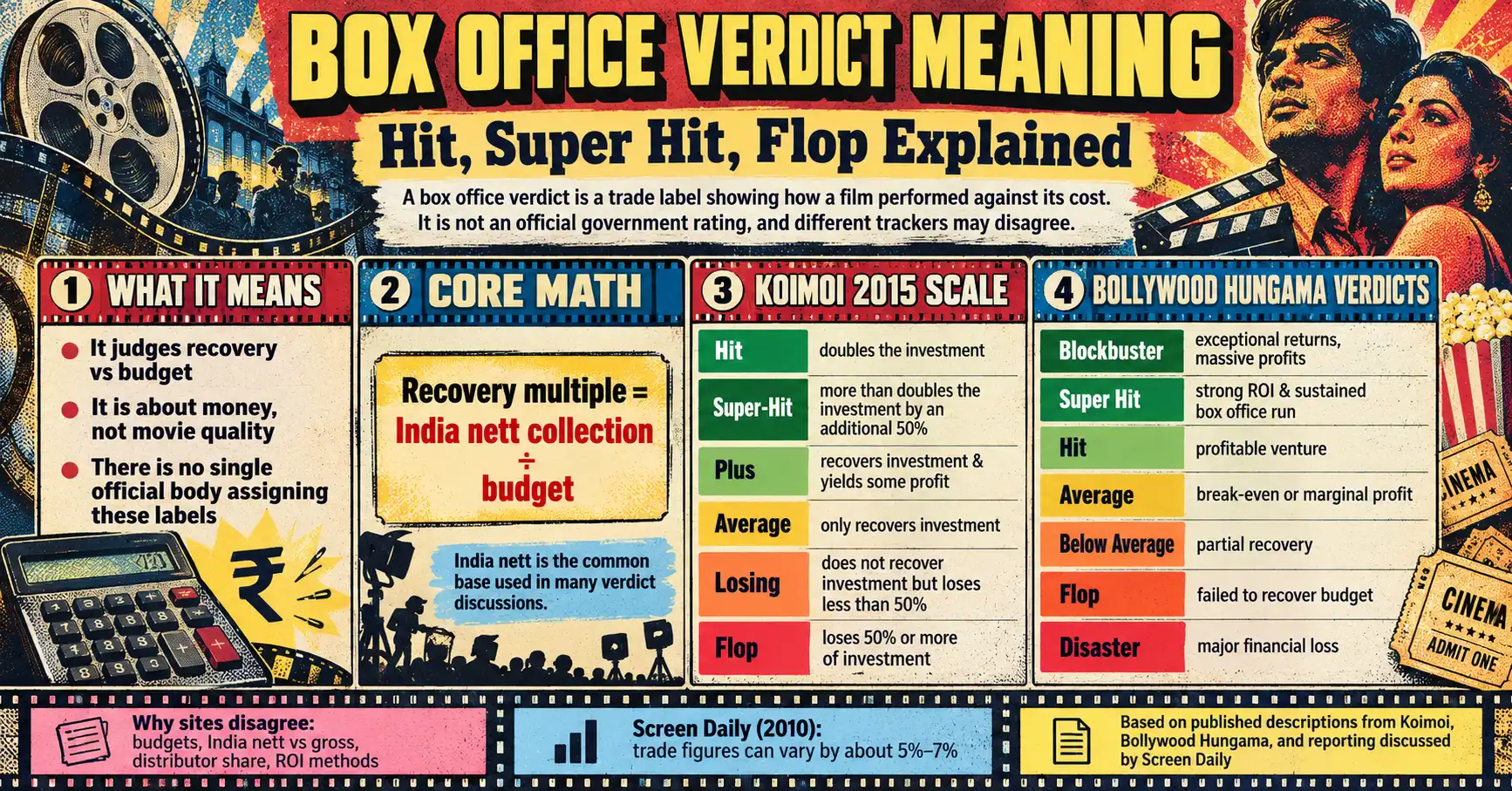
A film crosses ₹100 crore. Fans throw a party online. Two days later, a tracker calls it a flop. Unfair? Not once you get the box office verdict meaning: it’s a trade publication’s judgement of how much money a film earned back against what it cost. It has nothing to do with how big the number on the poster looks.
Here’s the part most people miss. No official body hands out these labels. Koimoi, Bollywood Hungama and other trackers each run their own scale. Most of the raw numbers come from producers and distributors. So one site’s “Hit” can sit next to another site’s “Average”, and neither has to be lying.
And once you know the math, you can work out most verdicts on your phone calculator in about thirty seconds. No fan page required.
Box office verdict meaning in one line (and who decides it)
A box office verdict is a label that says whether a film made back its investment, and by how much. That’s the whole idea.
It’s a money judgement, not a quality certificate. Great films flop. Loud, forgettable ones turn into Super Hits. Your favourite film’s verdict says nothing about whether it was any good.
So who actually decides? Trade publications and trade analysts. Not the CBFC, not a ministry, not some secret producers’ committee.
The real problem sits underneath. As Open magazine’s look at Bollywood’s number game put it, “the absence of a central data collection agency compels the media to rely on the producer/distributor” for figures. Screen Daily flagged the same gap back in 2010. It put the deviation in trade-reported figures at 5%–7%. Part of the reason: single-screen theatres relied on numbers the producers supplied, while Hollywood studios submitted weekly estimates.
“With no real-time box-office data, we’re hampered by a lack of accurate information,” Siddharth Roy Kapur, then CEO of UTV Motion Pictures, told Screen Daily at the time.
So read every “Verdict: Hit” as shorthand for “this tracker thinks it’s a Hit, based on these numbers.” That one mental edit will save you a lot of comment-section fights.
The verdict ladder at a glance: hit vs super hit vs blockbuster
Two big trackers, two different ladders.
Koimoi spelled out its scale in plain words in its 2015 year-end verdict article. Bollywood Hungama lists seven labels on its 2026 box office collections page, each with a one-line descriptor and zero numbers. Here’s how they line up, top to bottom.
| Label | Koimoi’s Rule (2015 scale) | Bollywood Hungama’s Descriptor | In Plain English |
|---|---|---|---|
| Blockbuster | Not on the scale | “Exceptional returns, massive profits” | Huge profit, no fixed number |
| Super Hit | “More than doubles the investment by additional 50%” | “Strong ROI & sustained box office run” | Roughly 2.4x and up, depending on who counts |
| Hit | “Doubles the investment” | “Profitable venture” | About 2x the budget |
| Plus | “Recovers investment & yields some profit” | Not on the scale | Small profit |
| Average | “Only recovers investment” | “Break-even or marginal profit” | Money back, little else |
| Below Average | Not on the scale | “Partial recovery” | Lost some money |
| Losing | Doesn’t recover investment, but loses less than 50% | Not on the scale | Lost some money |
| Flop | “Loses 50% or more of investment” | “Failed to recover budget” | Depends heavily on the site |
| Disaster | Not on the scale | “Major financial loss” | Very bad news |
A few things jump out.
- Nobody puts a number on “Blockbuster”. Koimoi’s 2015 scale doesn’t use the word at all. Hungama defines it only as “exceptional returns, massive profits”.
- “Flop” means two different things. Koimoi calls a film a Flop only when it loses half its investment or more. Hungama’s Flop is any film that “failed to recover budget”. Same box office verdict, different meaning, depending on the site. A film that recovers 70% is merely Losing on Koimoi’s scale, yet could be Below Average or Flop on Hungama’s.
- Koimoi’s labels have moved on. Its current tracker shows SUPER DUPER HIT, SUPER HIT, HIT, PLUS, AVERAGE, LOSING and FLOP. The page prints no thresholds for any of them. It calls its own figures “official to almost accurate”.
Hungama, for its part, says its verdicts weigh “budget, recovery, distributor share, and return on investment across domestic and overseas markets.” That’s a different recipe from a straight budget-versus-collection multiple. It explains a lot of the disagreement you’ll see later.
The core math: budget, nett collection and recovery %
Strip out the jargon and the box office verdict meaning comes down to one ratio:
Recovery multiple = India nett collection ÷ budget
Koimoi’s own example makes it concrete. Bajrangi Bhaijaan cost ₹90 crore and collected ₹320.34 crore in India. That’s 3.56x. Koimoi’s verdict: Super-Hit.
Simple, right? The trouble starts with the inputs.
Budget: the number you take on trust
The budget comes from the producer’s side. You rarely see it backed by anything more than their word. And it swings verdicts hard. Shave ₹30 crore off a claimed cost and a borderline Average suddenly looks like a Plus.
Nett vs gross
Trackers usually quote India nett, the figure after taxes come off ticket sales. Gross is the bigger, pre-tax number. Worldwide gross is bigger still. Compare gross against budget and every film looks healthier than it really is.
Our explainer on how box office collection is calculated in India walks through nett vs gross properly.
Here’s the bit fans forget. The theatre keeps a cut. The nett number doesn’t land in the producer’s bank account.
A 2017 Onmanorama breakdown of the Malayalam market shows how this works. Distributors there got 60% in week one, 55% in week two and 50% after that. For held-over runs, the share dropped to 40%. Pulimurugan collected ₹90 crore in Kerala, but its producer took home only about a third after deductions.
That’s one regional market, years ago. Still, the principle carries across: collection isn’t income.
Non-theatrical money
Ticket sales aren’t the whole story either. In that same Open piece, Siddharth Roy Kapur put theatrical collections at only “50-55 per cent of the total revenue of a film”. Satellite and overseas rights fill the rest.
Koimoi-style verdicts mostly ignore that income. So a film that’s “Losing” on paper isn’t always a loss for its producer.
Why “Hit” means 2x (my read)
Nobody official explains why a Hit needs double the budget. Here’s my theory.
Say roughly half the nett reaches the producer-distributor side once theatres take their cut. Then a film needs about 2x its budget in nett just to send the investment back to the people who paid for it. So 2x isn’t greed. It’s roughly theatrical break-even. Treat that as back-of-envelope logic, not a rule.
Even the trackers bend their own rules
Koimoi’s Super-Hit wording says a film “more than doubles the investment by additional 50%”. Read it one way and that’s 2.5x. Read it another and it’s 3x.
Koimoi’s own Krrish 3 math doesn’t settle it. With a budget of ₹115–120 crore, it said the film needed ₹230–240 crore to be a Hit. For Super-Hit, it wanted “a lifetime amount of 285+ crores”. That works out to roughly 2.4x. Meanwhile Bajrangi Bhaijaan wore the same Super-Hit badge at 3.56x.
Same label. Very different films.
Five worked examples, Paisa Vasool style
This is where the box office verdict meaning gets real. Meet Crore Kahani, an imaginary film with a ₹100 crore budget.
All figures below are illustrative, not real collections. I’m applying Koimoi’s 2015 wording and Hungama’s descriptors as written. The last column uses a rough “half reaches the producer side” haircut.
| India Nett | Multiple | Koimoi (2015 scale) | Hungama-style Label | Producer-Side Share |
|---|---|---|---|---|
| ₹40 crore | 0.4x | Flop | Flop or Disaster | ~₹20 crore |
| ₹75 crore | 0.75x | Losing | Below Average or Flop | ~₹37 crore |
| ₹110 crore | 1.1x | Plus | Average | ~₹55 crore |
| ₹200 crore | 2x | Hit | Hit | ~₹100 crore |
| ₹350 crore | 3.5x | Super-Hit | Super Hit or Blockbuster | ~₹175 crore |
₹40 crore: Time Waste, financially. The film lost 60% of its budget. Both scales call it a Flop. Hungama’s “major financial loss” line points towards Disaster. Honestly, I wouldn’t expect even a fat satellite deal to rescue this one.
₹75 crore: where trackers split. Koimoi says Losing, because the loss stays under 50%. Hungama’s “partial recovery” fits Below Average. But its Flop definition (“failed to recover budget”) fits too. Expect two different headlines for the same film.
₹110 crore: the poster says hit, the accountant says wait. Theatrically, it recovered its cost. Koimoi calls that Plus, and Hungama’s “break-even or marginal profit” reads like Average. But only about ₹55 crore reaches the producer side. Satellite and streaming money has to close the gap.
₹200 crore: proper Paisa Vasool. Clean 2x, Hit on both scales. Around ₹100 crore comes back from theatres alone. Every non-theatrical rupee after that is profit.
₹350 crore: everybody’s happy. That’s Bajrangi Bhaijaan territory, a Super-Hit on Koimoi’s 2015 scale by any reading. Is it a Blockbuster? That depends entirely on who’s labelling, because nobody publishes a cut-off.
Small films can post wilder multiples, by the way. Open cites Murder 2 earning ₹52 crore against a ₹7 crore investment. That’s more than 7x. Good luck getting that kind of ratio out of a ₹300 crore spectacle.
Who assigns verdicts, and why trackers disagree
You’ve seen the pieces. Put them together and the disagreements stop looking suspicious. Here’s why the box office verdict meaning shifts from site to site:
- Different ladders. Koimoi and Hungama use different labels, and they define Flop differently.
- Different budgets. One outlet hears ₹150 crore, another hears ₹180 crore. Same film, different multiple.
- Different collection bases. India nett, India gross, worldwide gross. Pick one and the ratio moves.
- Shares or no shares. Hungama explicitly factors in distributor share and overseas markets. Koimoi’s scale works off investment and India collection.
- Noisy base numbers. Screen Daily’s 5%–7% deviation sits under every calculation before any verdict logic kicks in.
- Non-theatrical income. Koimoi’s scale leaves it out. Hungama’s talk of “return on investment” leaves room for it.
Timing plays a part too. A verdict can firm up over a film’s run, but early numbers still tell you plenty. “Seldom does the performance of a film deviate from what reflects on its first day,” filmmaker Mahesh Bhatt told Open. That’s why opening-day reads like our Spider-Man: Brand New Day India Day 1 verdict get so much attention.
Why a ₹100 crore film can still be a flop
This is the question behind the biggest fan fights. The answer is boring but brutal: ₹100 crore only sounds huge if the film cost ₹50 crore.
Asianet Newsable’s 2025 year-ender listed eight films that crossed ₹100 crore and still fell short of their budgets (figures in ₹ crore):
| Film | Collection (₹ Cr) | Budget (₹ Cr) | Shortfall (₹ Cr) |
|---|---|---|---|
| Game Changer | ₹131.20 Cr | ₹450.00 Cr | -₹318.80 Cr |
| Sikandar | ₹110.36 Cr | ₹200.00 Cr | -₹89.64 Cr |
| War 2 | ₹236.55 Cr | ₹325.00 Cr | -₹88.45 Cr |
| Housefull 5 | ₹183.38 Cr | ₹250.00 Cr | -₹66.62 Cr |
| Coolie | ₹285.01 Cr | ₹350.00 Cr | -₹64.99 Cr |
| They Call Him OG | ₹194.16 Cr | ₹250.00 Cr | -₹55.84 Cr |
| Thamma | ₹134.78 Cr | ₹140.00 Cr | -₹5.22 Cr |
| Jolly LLB 3 | ₹117.50 Cr | ₹120.00 Cr | -₹2.50 Cr |
One caveat. Asianet set these collections straight against budgets. It didn’t say whether they’re gross, nett or worldwide, and it applied no distributor share. Treat them as illustration, not audited accounts.
Now apply the haircut. War 2 shows ₹236.55 crore against ₹325 crore. If roughly half reaches the producer side, that’s about ₹118 crore coming back on a ₹325 crore bet. Ouch. And Game Changer at ₹131.2 crore against ₹450 crore? That’s a different universe of pain.
Two forces push big-number films into flop territory.
- Budgets at the top end. A ₹450 crore budget needs ₹900 crore in nett for a Koimoi-style Hit. Very few films ever get near that.
- The whole money chain. In a 2014 Open column, Mayank Shekhar sketched how costs stack up. A ₹10 crore film sells to a studio at ₹20 crore, and marketing adds about 25%. Distributors spend ₹50 crore buying rights, and exhibition costs reach ₹70 crore collectively. By his math, that film must earn at least ₹70 crore to break even across the chain. Seven times what it cost to make.
There’s a flip side, and it’s fair to say it out loud. Open noted that films “no longer live and die at the box office”, since satellite and overseas money now fill a big chunk of revenue. So a theatrical flop can still be a profitable product for its producer. Several of these sources (2010, 2014) also predate the streaming era. OTT deals add another layer they never measured.
Can you trust budgets and verdicts? Red flags to watch
Short answer: partly.
In December 2025, The Star ran a long piece on Bollywood’s “box office bluff”. It reported allegations that Sky Force made about $6 million against roughly $9 million reported. It reported similar claims about Thamma: around $15 million actual versus about $18 million reported. Director Aditya Sarpotdar pushed back and called the $18 million figure “most accurate”. Many of these allegations came from anonymous sources, so keep the salt handy.
The same report described claims of producers and actors buying tickets in bulk, plus influencer “rate cards” for hype. Cinema owner Sudhir Kasliwal didn’t mince words: “Producers, directors and actors themselves buy tickets. The future of Bollywood looks very bleak if this practice continues.”
Raj Bansal described the pressure from the other side: “Whenever I (post) that the film has opened with weak collections, I receive a barrage of calls from actors, producers asking me to remove it.”
The incentive isn’t new. A studio-side voice in Open back in 2014 summed up the logic: “My share prices go up, I may earn Rs 200 crore. What is Rs 20 crore.” Bombay Times even discontinued its box office column over fudging.
My red flags when I read these numbers:
- The budget only shows up after release, or changes between interviews.
- One tracker’s figure runs far ahead of everyone else’s, well beyond the normal 5%–7% noise.
- A headline sets worldwide gross against the budget as if it were profit.
- Someone shouts “Blockbuster” and there’s no budget anywhere in sight.
- Collection posters come only from the producer’s own social handles.
South vs Hindi vs Hollywood in India: same rules?
Mostly the same logic, different plumbing.
Koimoi’s verdict tracker covers Hindi films, including Hindi-dubbed South releases, with data going back to 2011. So the Hindi version of a Telugu or Tamil film can carry its own Koimoi verdict.
Regional markets run on their own share splits, though, as that Kerala example shows. I also couldn’t find a published South-industry verdict scale as explicit as Koimoi’s 2015 one. Until someone publishes one, the box office verdict meaning stays the same down South: ask which ladder and which numbers. Our list of the highest-grossing South Indian movies of 2026 is a good place to practise.
Hollywood releases come with a cleaner data trail. Screen Daily noted back in 2010 that Hollywood studios submitted weekly estimates. But their budgets are global numbers. Setting an India-only collection against a worldwide budget tells you almost nothing. Judge those films in India against comparable releases instead.
How to read a box office verdict yourself: a 7-step checklist
Here’s the box office verdict meaning turned into a routine you can run on any film.
- Find the budget, and who said it. Producer statement, trade estimate or rumour?
- Check the collection base. India nett is the usual verdict number. Gross or worldwide will flatter the film.
- Divide collection by budget. Under 1x means the theatrical run lost money. 1x is Average territory, and 2x is a Hit on Koimoi’s scale. Roughly 2.4x upward is Super-Hit country.
- Mentally halve it. About half the nett reaching the producer side is a decent rough guide. It’s illustrative, not a rule.
- Ask which ladder. Koimoi-style multiples or Hungama-style descriptors? “Flop” means different things on each.
- Compare two trackers. A gap of 5%–7% is normal noise. Much bigger, and someone’s using different inputs.
- Remember non-theatrical money. Satellite, overseas and streaming deals can turn a theatrical “Losing” into a decent business outcome.
So, Paisa Vasool or Time Waste?
Verdicts are useful. Just don’t treat them like court judgements. Each one is a tracker’s opinion with a calculator attached, built on numbers the industry mostly reports about itself.
My honest take? The 2x Hit rule is the most sensible shortcut we’ve got, because it roughly matches what survives after theatres take their share. “Blockbuster” is the label I trust least. Nobody ever pins a number on it, which makes it perfect for PR and useless for analysis.
Want to test yourself? Open our highest-grossing Bollywood movies of 2026 so far, find each film’s reported budget and run the division. A few of those “hits” will wobble. Which film’s verdict would you fight over? Tell us in the comments.