
Hindi Film Distribution Circuits Explained: Mumbai to Nizam
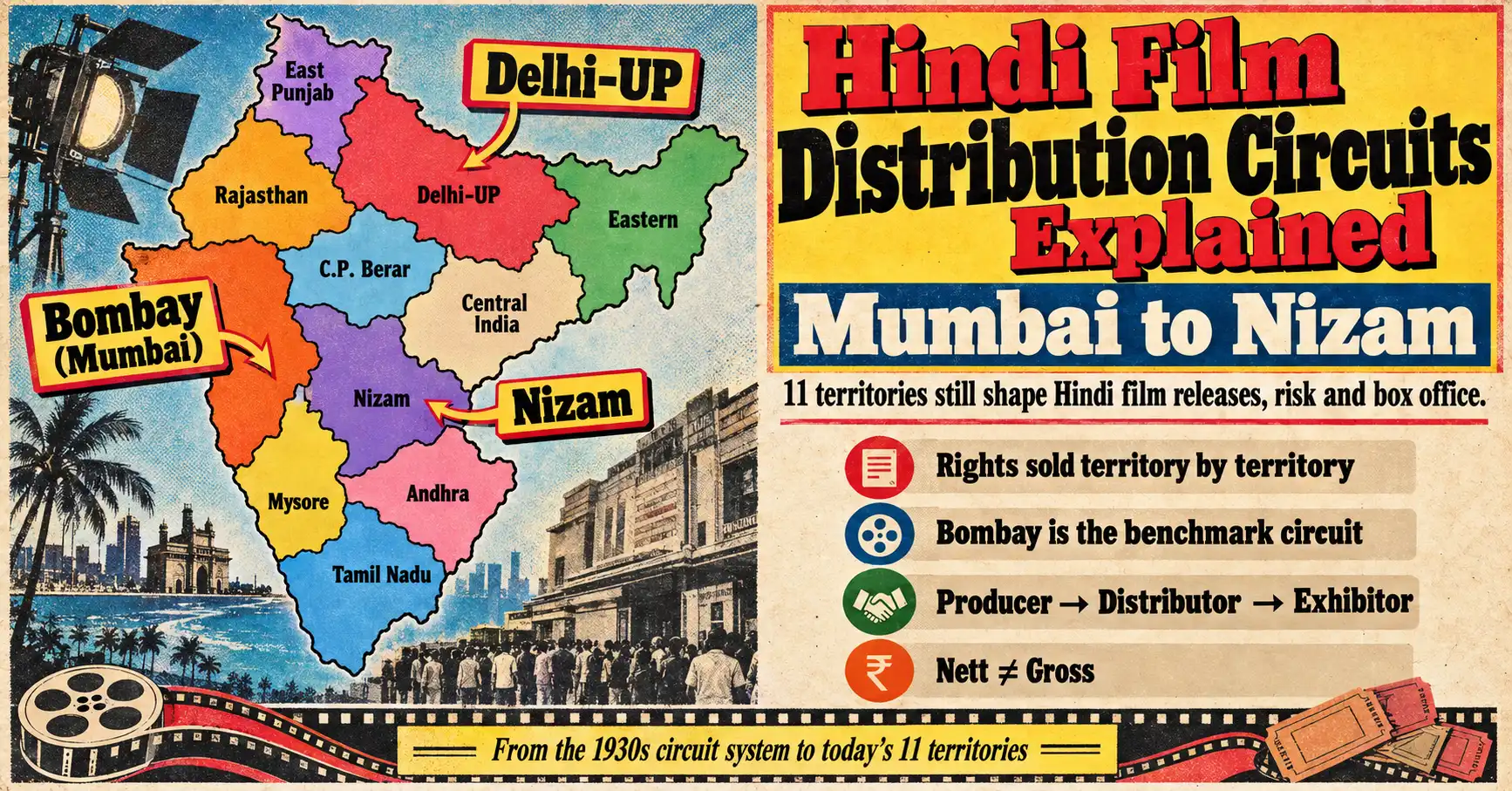
Open any Bollywood box office tracker and you’ll hit a wall of jargon. “Mumbai circuit strong. CP Berar dull. Nizam decent.” Kya matlab? Those names are Hindi film distribution circuits, the regional territories that decide who releases a film where, and who pockets which rupee.
Once you crack them, trackers stop reading like code. You’ll see why a film can look solid in one belt and shaky in the next. You’ll also see why a ₹100 crore nett headline doesn’t mean the producer banked ₹100 crore.
Not even close.
Quick answer: what are Hindi film distribution circuits?
A circuit is a distribution territory. Producers sell a film’s theatrical rights territory by territory. The distributor who holds a circuit releases the film in the theatres there and carries the risk.
The system is old. Really old. After India’s first talkie arrived in 1931, the trade carved the country into six circuits during the 1930s: Bombay, Eastern, Delhi-U.P., C.P.-C.I.-Rajasthan, Punjab and South, according to Wikipedia’s page on Hindi film distribution circuits.
Almost a century later, those names still run the show. A Koka Sync essay on film distribution makes the same point: the divisions still matter because rights get licensed along these lines. That’s why your daily tracker talks in circuits and not states.
11, 14 or 9? Why nobody agrees on the count
Now the confusing bit. Different sources count differently:
- Wikipedia: 11 current territories. Bombay, Delhi, Nizam, East Punjab, Eastern, C.P. Berar, Central India, Rajasthan, Mysore, Tamil Nadu and Andhra.
- Indicine: 14 circuits. It breaks Eastern into Bihar, West Bengal, Assam and Orissa, and lists Kerala apart from Tamil Nadu. Andhra doesn’t get its own line.
- Koka Sync: nine groupings. Think North India, Maharashtra/Goa/Central, Bengal and East and so on, plus overseas as one extra territory.
My take? Nobody’s wrong. They’re slicing the same map with different knives. The 11-circuit list is the cleanest reference, so that’s what we’ll use below.
All 11 Hindi film distribution circuits at a glance
Save this table. It answers half the questions trackers throw at you.
| Circuit Name | Regions Covered |
|---|---|
| Bombay (Mumbai) | Mumbai, parts of Maharashtra and Karnataka, Gujarat, Goa, Dadra & Nagar Haveli and Daman & Diu |
| Delhi (Delhi-UP) | Delhi, Uttar Pradesh, Uttarakhand |
| Nizam | Telangana, parts of Maharashtra and Karnataka |
| East Punjab | Punjab, Haryana, Chandigarh, Himachal Pradesh, J&K, Ladakh |
| Eastern | West Bengal, Bihar, Jharkhand, Odisha, Assam and the rest of the North-East, Sikkim, Andaman & Nicobar, plus Bhutan and Nepal |
| C.P. Berar | Vidarbha, southern and eastern Madhya Pradesh, Chhattisgarh |
| Central India | Northern and western Madhya Pradesh |
| Rajasthan | Rajasthan |
| Mysore | Bengaluru and parts of Karnataka |
| Tamil Nadu | Tamil Nadu, Kerala, Puducherry, Lakshadweep |
| Andhra | Andhra Pradesh |
Notice something? Circuits ignore state borders all the time. Maharashtra alone gets split three ways: Bombay, Nizam and C.P. Berar (Vidarbha). Karnataka also lands in three circuits. Madhya Pradesh gets cut in two.
So when a tracker says “Mumbai circuit,” it doesn’t mean Mumbai city. It means a territory that runs all the way to Gujarat and Goa.
The big three: Mumbai, Delhi-UP and Nizam
Trade chatter keeps coming back to these three names, so start with them.
Mumbai (Bombay) circuit
This is the heavyweight. Wikipedia notes that distributors see the Bombay circuit as the one with the potential for maximum earnings. It doesn’t publish a percentage, and honestly, be suspicious of anyone who quotes a fixed one as gospel.
The territory is huge. Mumbai, Gujarat, Goa, parts of Maharashtra and Karnataka, plus Dadra & Nagar Haveli and Daman & Diu. If a Hindi film stumbles here, I’d start worrying about the whole run.
Delhi-UP circuit
Delhi, Uttar Pradesh and Uttarakhand. Wikipedia’s current list just calls it “Delhi,” but trackers stick with “Delhi-UP” and that’s no accident. Delhi-U.P. was one of the six original circuits from the 1930s, and the old name refused to die.
Nizam circuit
Nizam covers the old Nizam State area: Telangana plus parts of Maharashtra and Karnataka.
This next bit trips people up. In the 11-circuit list, Andhra is a separate circuit covering Andhra Pradesh. So whenever you see “Nizam” and “Andhra” as two different lines in a report, that’s the split. Keep it in mind when you scan the numbers behind our list of the highest-grossing South Indian movies of 2026.
The other eight circuits, one by one
The big three grab headlines, but the rest of the Hindi film distribution circuits fill in the map. Quick notes on each:
- East Punjab: Punjab, Haryana, Chandigarh, Himachal Pradesh, J&K and Ladakh. The 1930s list simply called it Punjab.
- Eastern: The monster on the map. It covers 13 states and union territories, including West Bengal, Bihar, the entire North-East and Andaman & Nicobar. It even stretches into Bhutan and Nepal. Yes, a Hindi film’s “Eastern” figure can include two other countries.
- C.P. Berar: Vidarbha, southern and eastern Madhya Pradesh and Chhattisgarh.
- Central India (CI): Northern and western Madhya Pradesh. Don’t mix it up with CP Berar. Trackers list them separately for a reason.
- Rajasthan: Just Rajasthan. The simplest one on the list.
- Mysore: Bengaluru and parts of Karnataka.
- Tamil Nadu: Tamil Nadu, Kerala, Puducherry and Lakshadweep.
- Andhra: Andhra Pradesh.
Fun fact: CP Berar, Central India and Rajasthan started life as one combined circuit, C.P.-C.I.-Rajasthan. Today they’re three.
Who’s who: producer, distributor, exhibitor
Every rupee moves through three hands.
- Producer. Pays for the film’s budget and its P&A (prints and advertising).
- Distributor. Buys the theatrical rights for a territory and takes on the profit-or-loss risk.
- Exhibitor. The theatre itself, whether it’s a single screen or a multiplex chain.
Indicine calls the distributor “the most vital link in this money chain by acting as a medium between Producers and Theatres.” Fair. The distributor sits between the people who make the film and the people who sell you the ticket.
Distributors also spend real money on a release. The Koka Sync essay points out that they recoup theatrical expenses like DCPs (the digital files theatres actually play), logistics and local advertising.
Deal models: commission, advance and minimum guarantee
How does a distributor get a circuit in the first place? Through a deal. Koimoi lays out three common models, and you’ll hear about them across all the Hindi film distribution circuits:
- Commission basis. The distributor releases the film and keeps roughly 7-8% of the distributor’s share, plus release expenses. The rest flows back to the producer.
- Advance basis. The distributor pays the producer a fixed amount upfront. If the film doesn’t recover it, the producer is on the hook for the losses.
- Minimum Guarantee (MG). An outright sale of the rights. The producer has no obligation to pay anything back, even if the film tanks.
Koka Sync adds that distributors can also charge a distribution fee, typically 10-20% of gross revenues.
Here’s the gamble in plain words. On an MG deal, a flop hurts the distributor, not the producer. On a commission deal, the distributor plays it safe and the producer rides the risk. Same film, very different nerves.
Now the fun part. Your ticket money doesn’t land in one pocket.
Step 1: Gross to nett
Gross is what audiences pay. Nett is gross minus taxes, and nett is the figure trackers usually report, per Koimoi.
The tax slice has shifted over the years. Koimoi cites 28% GST on tickets above ₹100 and 18% below ₹100, though those GST slabs have changed since. Indicine cites an all-India average entertainment tax of about 30%. Either way, a decent chunk vanishes before anyone in the film business sees a paisa. Our explainer on how box office collection is calculated in India goes deeper on nett vs gross.
The theatre keeps its cut. What’s left for the distributor is the distributor share, and in multiplexes it shrinks every week.
| Week Period | Indicine | Koimoi | Koka Sync |
|---|---|---|---|
| Week 1 | 50% |
about 52.5% |
about 50-55% |
| Week 2 | 42% | about 44.5% | about 42-45% |
| Week 3 | 37% | about 38% | about 30-35% (week 3+) |
| After that | 30% | not given | about 30-35% |
The numbers don’t match perfectly, so read them as approximate ranges. Real contracts vary.
Why the slide? Koka Sync puts it simply: “a film’s box office is almost always heavily weighted toward the first weekend.” Distributors want the fattest cut when the crowds actually show up. One more detail from Koka Sync: multiplex chains keep the convenience fees you pay while booking. Those stay out of the split.
Single screens work differently. Indicine says distributors take 70-90% of net collections, and that rate stays constant through the run. Koimoi describes another setup, where the distributor pays the theatre a weekly rental and keeps the net collection after tax. Which one applies depends on the deal.
Worked example: a ₹100 crore nett film (illustrative)
Let’s make this real. I made up these run numbers for the example; they aren’t from a real film. Assume the whole ₹100 crore nett comes from multiplexes and use Indicine’s weekly rates:
| Week Period | Nett (₹ cr) | Distributor Share Rate | Distributor Share (₹ cr) |
|---|---|---|---|
| Week 1 | ₹60.00 cr | 50% |
₹30.0 cr |
| Week 2 | ₹25.00 cr | 42% |
₹10.5 cr |
| Week 3 | ₹10.00 cr | 37% |
₹3.7 cr |
| Week 4 onwards | ₹5.00 cr | 30% |
₹1.5 cr |
| ★ Total Lifetime | ₹100.00 cr | ~45.7% Effective |
₹45.7 cr |
So a “₹100 crore film” hands its distributors about ₹45.7 crore. Run Koimoi’s rates over the same first three weeks and you get about ₹46.4 crore before week 4 even starts.
Now layer the deal on top. On a commission deal at 7-8%, the distributor keeps roughly ₹3.2-3.7 crore of that ₹45.7 crore, plus release expenses. The producer gets the rest, and remember, the producer already paid for the budget and P&A. On an MG deal, the producer took a fixed price before release, so all of this belongs to the distributor.
Flip the assumption and the picture changes. Say that same ₹100 crore came entirely from single screens at Indicine’s 70-90%. The distributor share would jump to ₹70-90 crore. That’s why the multiplex vs single screen mix matters so much.
One last thing. This math runs separately in every circuit. The Mumbai distributor works off Mumbai’s nett, the Nizam distributor off Nizam’s, and so on. That’s exactly why trackers break collections down territory-wise.
How to read a territory-wise box office report
This is where Hindi film distribution circuits stop being theory. Next time a trade update drops, run through this checklist:
- Nett or gross? Check the label first. Compare a nett number with a gross one and you’ll draw the wrong conclusion every time.
- Share or collection? A “distributor share” figure will look much smaller than nett. That’s not a crash; it’s a different number.
- Match the names. Bombay = Mumbai. Delhi = Delhi-UP. CP Berar and CI are two different circuits.
- Check the count. Is Eastern one line, or split into Bihar, West Bengal, Assam and Orissa? Does Kerala sit apart from Tamil Nadu? The source’s circuit list changes what each line means.
- Expect the week 2 drop. Collections lean heavily on the first weekend, so a fall in week 2 is normal. The real question is how steep.
- Nizam isn’t Andhra. For Telugu-state numbers, look for both lines.
Want to practise? Open a daily tracker like our Jana Nayagan Day 6 report and read it with this list beside you.
So, do circuits still matter?
Honestly, the map is ancient. The trade drew it in the 1930s, and some of it looks odd today. Bhutan and Nepal sitting inside a Hindi film’s “Eastern” figure is the obvious example.
But money follows rights, and rights still follow these Hindi film distribution circuits. The old map isn’t going anywhere.
Most fans miss the flip side. A film can feel totally paisa vasool to you. It can still be a time waste for the distributor who paid a fat MG for CP Berar. When our highest-grossing Bollywood movies of 2026 list updates next, look past the big number. Ask which circuits carried it, and who actually got paid.