
OTT, Satellite and Music Rights Explained for Indian Films
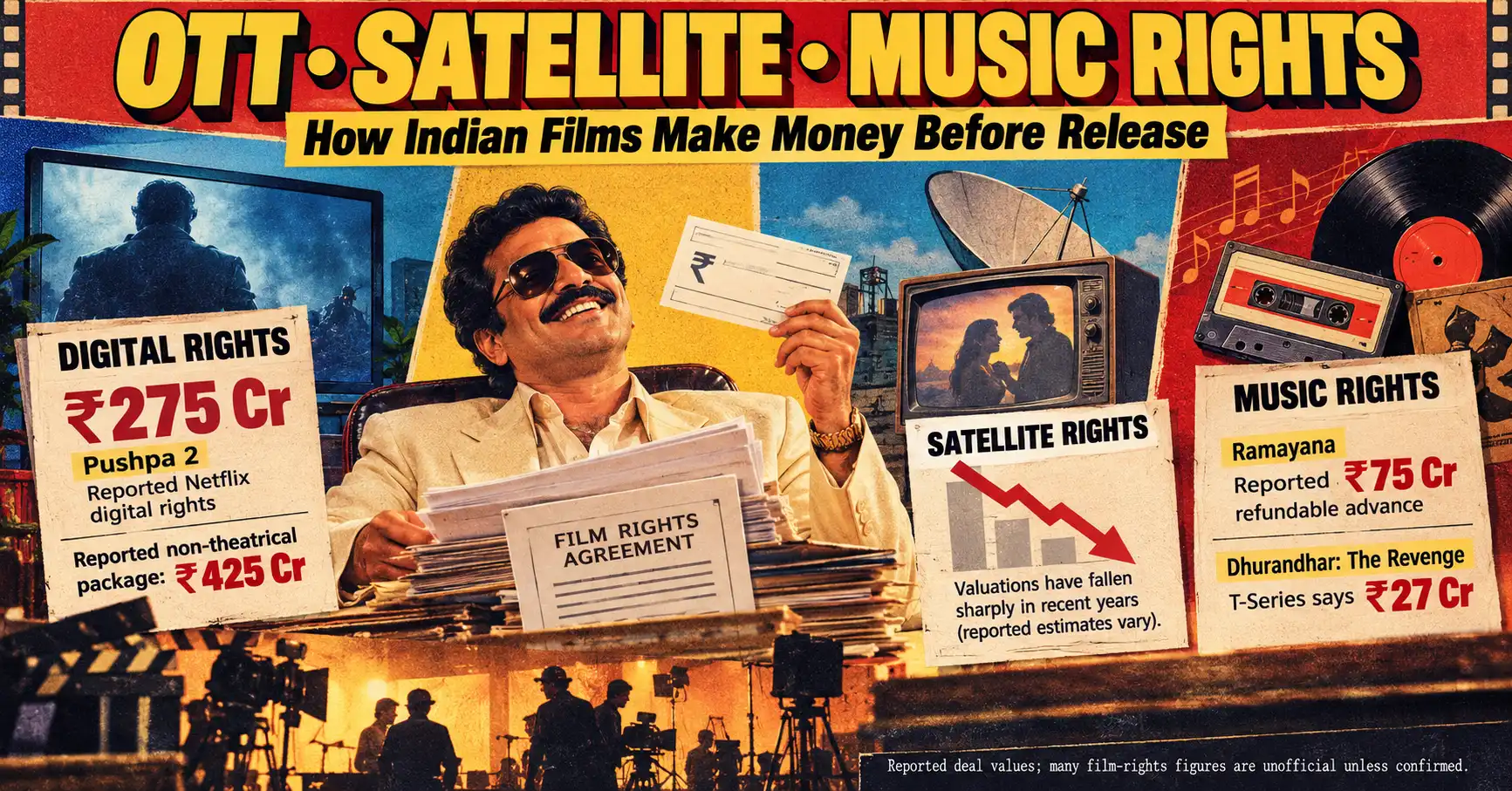
Ever seen a producer grinning like the film’s already a blockbuster, and it hasn’t even released yet? That grin usually has a price tag. Big Indian films sell their OTT, satellite and music rights months before the first show, and sometimes those cheques cover most of the budget.
So when a trade headline screams “recovered cost before release,” there’s no magic involved. It’s a rights sale. Some of those deals are enormous. Some are shaky rumours. A few get corrected later.
Who pays, when, and how much? And how do you tell a real pre-release win from a PR number?
Why Some Films Are “Hits” Before Release
Box office is just one money tap. A producer also earns from theatrical rights, which means selling the film to distributors territory by territory. Then there are non-theatrical rights: everything outside the cinema hall, from streaming to TV to music.
If you’ve read our breakdown of how box office collection is calculated in India, you know ticket money gets split many ways before any of it reaches the producer. Rights money works differently. It lands upfront, on signing or on delivery. It doesn’t care whether Friday’s shows run full.
Take Pushpa 2: The Rule. Bollywood Hungama reported in October 2024 that Netflix picked up its digital rights for ₹275 crore. The full non-theatrical package reportedly touched ₹425 crore. Theatrical rights reportedly fetched another ₹640 crore.
Add those up. That’s over ₹1,000 crore in reported deals before a single ticket sold.
Not every film plays in that league, obviously. But the logic is the same for a ₹25 crore thriller and a pan-India monster. OTT, satellite and music rights decide how much risk the producer still carries on release day.
OTT, Satellite and Music Rights at a Glance
Think of a film as a bundle of rights. The producer can sell each piece separately or club a few together. Here’s the menu:
- Theatrical rights: distributors buy the right to release the film in cinemas in a given region.
- Satellite rights: a TV broadcaster buys the right to air the film on its channels.
- OTT (digital) rights: a streaming platform buys the right to stream it.
- Music (audio) rights: a label buys the songs and soundtrack.
- Other rights: overseas release, dubbing into other languages, and syndication.
Everything except theatrical counts as non-theatrical. When the trade says a film’s “non-theatrical has closed,” it means buyers have locked in its OTT, satellite and music rights, plus whatever extras were on the table.
One catch before we get into numbers. These deals rarely come with a press release. Almost every figure below is a reported or unofficial number, so keep a mental “reportedly” stuck to all of them.
Satellite Rights: How the TV Deal Works (and Why It Shrank)
Satellite rights are the TV deal. A channel pays to premiere the film on television and replay it.
Industry explainers describe satellite rights as an outright sale. The broadcaster pays a fixed fee, and it doesn’t matter whether the TV premiere rates well or tanks. The money usually arrives in two parts: an advance, then the balance once the producer delivers the film.
For years, this was the safest money in Indian cinema. Then it cracked.
“Earlier, we were seeing satellite right deals going to triple digits for the biggest of films. That has drastically fallen by more than 50%,” producer and film business analyst Girish Johar told Bollywood Hungama in June 2025. He also said satellite has slipped from second to third priority in a producer’s release plans.
A later Bollywood Hungama report, from March 2026, went even further. It put the fall in satellite valuations at 80–90%. So the estimates don’t match. Either way, TV money isn’t what it used to be.
Why JioHotstar and Zee5 now buy satellite rights
Here’s the twist. Streaming platforms have started buying satellite rights themselves, bundled with digital. That same March 2026 report named two examples. Kis Kisko Pyaar Karoon 2 went to JioHotstar, and Mana Shankara Vara Prasad Garu went to Zee5.
Why would an app want TV rights? The report gives two reasons:
- It keeps the film from reaching tier 2 and tier 3 viewers through regular TV.
- It builds a library of 50–60 films that the platform can license to channels later.
Smart move, honestly. Our read for producers is less cheerful: one buyer for both rights probably means less room to bargain.
OTT Rights: Advance, Balance and Box-Office Slabs
OTT rights are where the big numbers live now. A platform like Netflix, Prime Video or JioHotstar buys the right to stream the film.
Explainers describe the payment rhythm like this. The platform pays an advance of 20–30% of the deal on signing. The rest comes when the producer delivers the finished film.
What changed is how platforms set the price. Johar put it bluntly:
“OTT has gotten smarter with the times. Earlier, they used to pay whatever the producers demanded – 2x or 3x the cost of the film.”
Now the offer looks like a base price plus a bonus. In Johar’s words, “The OTT will say ‘We can give you 30-40% of the budget’.” Then box-office slabs kick in. His example:
- The film beats its expected collection by ₹5 crore, and the producer gets ₹1 crore over the base.
- It beats the estimate by ₹10 crore, and the producer gets ₹2 crore over the base.
So a flop gets the base and nothing more. A hit earns its bonus. Fair? For platforms, totally. For a producer who once pocketed double the budget from streaming alone, it stings.
The biggest OTT deals so far
Even with the new caution, the top end stays wild. Wikipedia’s running list of the highest digital rights for Indian films compiles these reported post-pandemic figures:
- Kalki 2898 AD: ₹375 crore
- RRR: ₹325 crore (digital and satellite combined)
- KGF Chapter 2: ₹320 crore
- Pushpa 2: The Rule: ₹275 crore
- Adipurush: ₹200 crore
Notice the RRR caveat. That figure covers two rights, so comparing it head-to-head with Pushpa 2’s digital-only number isn’t apples to apples. Deals split across several platforms make these lists messier still.
And Adipurush sitting at ₹200 crore? That’s your reminder that a giant OTT cheque says nothing about quality. We got into exactly that in Ramayana vs Adipurush.
Curious which platform is actually worth your subscription after spending all this? Our Netflix vs Prime Video vs JioHotstar verdict settles it.
Music Rights: Why Labels Pay Up Early
Music rights are the quiet earner. A label buys the songs and soundtrack, then earns from them for years. Explainers note that music deals usually close and get paid before release, sometimes before the shoot even wraps.
That makes music some of the earliest money a producer sees. For big films, it’s no small change.
Ramayana’s ₹75 crore music deal
T-Series reportedly bagged the music rights for the two-part Ramayana against a refundable advance of ₹75 crore. Outlook India carried the report in July 2026, citing Hindustan Times. Several labels reportedly chased the deal. The film’s reported budget sits above ₹4,000 crore, with Part 1 aimed at Diwali 2026 and Part 2 at Diwali 2027.
Note the word refundable. A refundable advance isn’t a gift. The label recovers it from the music’s future earnings, so the headline number isn’t pure profit for the producer. It’s also a single-source report, so hold it loosely.
Dhurandhar: The Revenge and the ₹50–60 crore that wasn’t
This one’s a lesson in headline hygiene. Variety India first reported the music deal for Dhurandhar: The Revenge at ₹50–60 crore. T-Series pushed back. In its own fact-check, the label put the real figure at ₹27 crore across Hindi, Tamil, Telugu and Kannada, citing a T-Series source.
That’s still a big jump. The first Dhurandhar’s music went for ₹15 crore. But ₹27 crore is roughly half of what went viral first.
Music hype and audio launches go hand in hand. It’s why events like Lokesh Kanagaraj’s DC audio launch feel like a mini release of their own.
Other Rights: Overseas, Dubbing and Syndication
These rarely make headlines, but they add up.
- Overseas rights: distributors buy the right to release the film outside India. Producers sometimes club it with domestic territories.
- Dubbing rights: the right to release dubbed versions in other languages.
- Syndication: licensing the film again later, to other channels or platforms. The film libraries JioHotstar and Zee5 are building work exactly this way.
Solid numbers for these are hard to pin down, so we won’t guess. Odela 2, our worked example below, shows one pattern. Its makers reportedly sold overseas theatrical rights in the same package as Telangana and Andhra Pradesh.
Why Star and Pan-India Films Get Pre-Sold (and Small Films Don’t)
Look at that record list again. Kalki 2898 AD, RRR, KGF Chapter 2, Pushpa 2. Every one is a big-star, multi-language release.
No coincidence there.
Buyers pay early when they feel sure. A star-led film from a proven franchise feels safe. A film releasing in several languages gives a platform or label more audience for the same cheque. Dhurandhar: The Revenge’s ₹27 crore music deal spanned four languages, which shows that math in action.
Small films face the opposite problem. Under the slab system Johar described, a platform can offer the base price and let the box office prove the rest. So a small film may only learn what its OTT deal is worth after its theatrical run.
Harsh? Yes. But it rewards films that actually work in theatres, and that’s not the worst outcome for audiences.
Worked Example: How Odela 2 Reportedly Recovered Its Cost
Let’s run the numbers on a real film. In April 2025, just before Odela 2 hit theatres, Koimoi reported these figures:
- Budget: about ₹25 crore.
- Theatrical rights (Telangana, Andhra Pradesh and overseas): ₹10 crore.
- Non-theatrical rights: ₹18 crore.
- Total rights income: ₹10 crore + ₹18 crore = ₹28 crore.
- Pre-release surplus: ₹28 crore − ₹25 crore = ₹3 crore.
On paper, that’s a film in profit before its first show. That’s the “recovered cost before release” headline, start to finish.
Now the fine print. The makers hadn’t confirmed any of these numbers. Telugu satellite talks were reportedly still on at the time, so the final picture could have shifted.
One more point, and this one’s our own reasoning, not Koimoi’s. A production budget doesn’t usually cover everything. Marketing and publicity spend, plus interest on borrowed money, can eat into that ₹3 crore fast. So “profit before release” often really means “budget covered before release.” Different thing entirely.
What Changed in 2025–26: OTT Waits for the Box Office
Put the pieces together and the shift is obvious.
A few years ago, producers could lean on two fat cheques, streaming and TV, and treat the box office as a bonus. By Johar’s account, OTT paid 2x or 3x a film’s cost. Satellite deals for the biggest films ran into triple digits.
Now the picture looks like this:
- OTT pays for performance. Expect a base of 30–40% of the budget, plus slabs if the film overdelivers.
- Satellite has dropped to third priority. Estimates of the fall range from over 50% to 80–90%, depending on whom you ask.
- Platforms are swallowing TV rights. JioHotstar and Zee5 are building their own film libraries.
- Music still pays big for big films, going by the Ramayana and Dhurandhar: The Revenge deals.
Of OTT, satellite and music rights, music looks the steadiest right now. The result for everyone else? A film has to earn its streaming price in theatres. The old “sell everything, relax, release” era is fading for anyone below the top rung of stars.
How to Read “Pre-Release Profit” Headlines
Here’s our Paisa Vasool Ya Time Waste? test for any headline claiming a film recovered its cost before release. Run it through five questions:
- Reported or confirmed? Most deal numbers come from trade sources, not the producer. Odela 2’s figures never got official confirmation.
- One right or a bundle? RRR’s ₹325 crore covers digital plus satellite. Pushpa 2’s ₹425 crore is a whole non-theatrical package.
- Fee or advance? Ramayana’s ₹75 crore music deal is a refundable advance, not a straight sale.
- Has anyone corrected it? Dhurandhar: The Revenge went from ₹50–60 crore to ₹27 crore in one T-Series statement.
- What’s missing from the cost side? Budget-versus-rights math usually skips marketing and interest.
If a headline survives all five, call it Paisa Vasool. If it collapses at question one, file it under Time Waste and wait for better sourcing.
Our Verdict: Rights Money Is the Real Opening Weekend
For big films, the real opening weekend happens months early, in a meeting room where a platform, a broadcaster and a label sign cheques. That room has gotten stingier, though. OTT wants proof now. TV barely shows up. Only music still writes big cheques early without blinking.
Honestly, we think that’s healthy. A film that earns its OTT, satellite and music rights money in theatres has actually won something.
So next time someone calls a film a hit before release, ask three things. Which rights sold? To whom? And has anyone confirmed it? Then wait for Friday’s collections, because that’s where the slabs, and the truth, kick in.