
Bollywood Remakes of South Indian Films: The Complete Guide
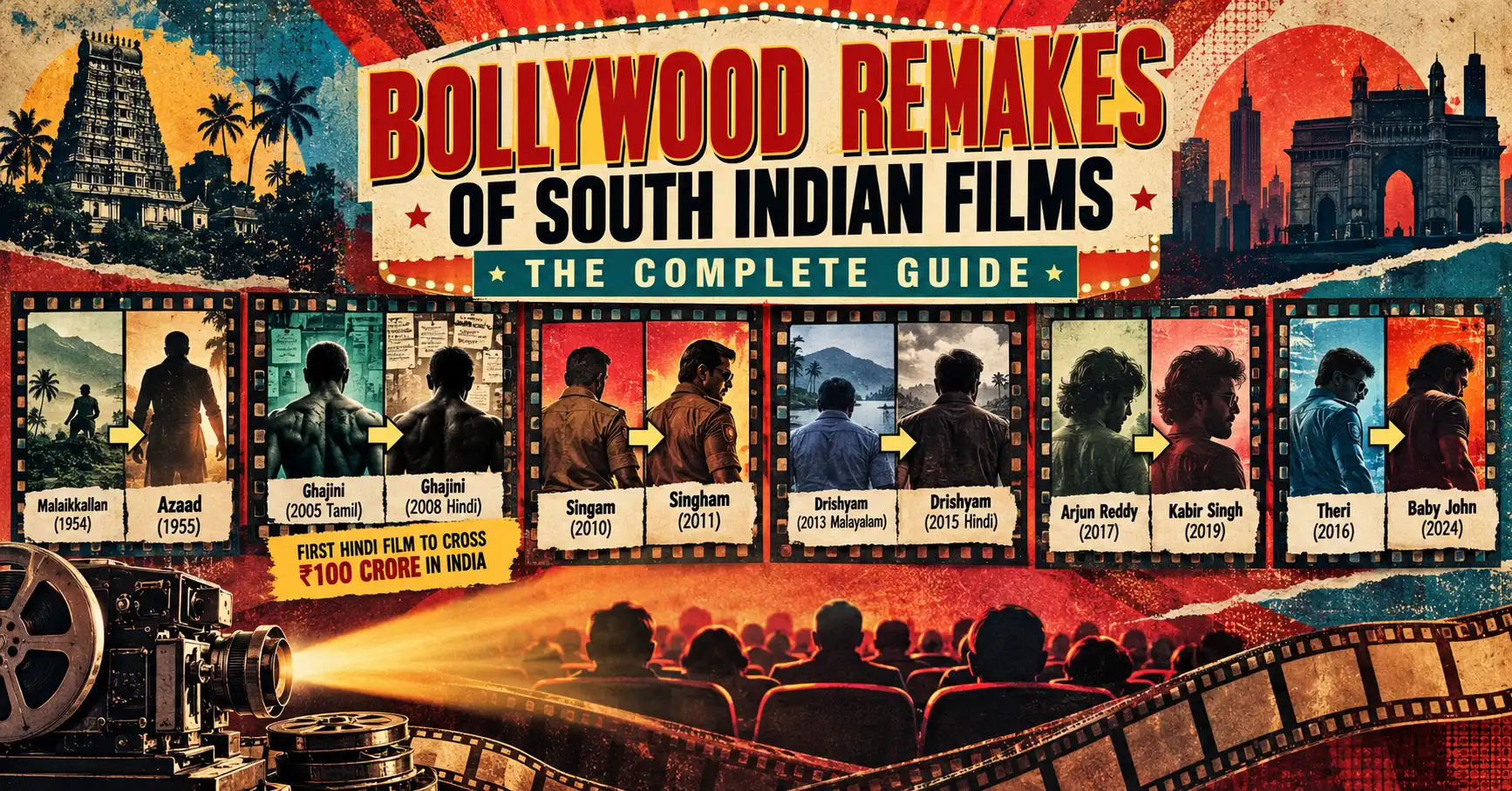
Think Bollywood remakes of South Indian films are a recent trend, something that started when Kabir Singh blew up in 2019? Nope. Dilip Kumar was doing it in 1955. Hindi cinema has been buying stories from the South for about seventy years. Some of its biggest box office milestones came straight out of that pipeline.
The first Bollywood film to cross ₹100 crore net at the domestic box office? A remake. Salman Khan’s biggest film of 2014? A remake. Ajay Devgn’s Drishyam, one of the biggest Hindi hits of 2022 in its second instalment? Also a remake.
So here’s the whole story, decade by decade and language by language, with the numbers. We’ll also call out where the remake beat the original, where it just copied it, and what’s coming next.
Why Bollywood Remakes of South Indian Films Keep Coming
Short answer? Risk.
A Southern hit has already been tested on a real audience. It worked in its own language, and often in dubbed versions too, before any Hindi producer signs a cheque. That’s a far safer bet than an untested original script. Nandini Ramnath laid this out in her Scroll.in analysis of why Bollywood loves Southern action films, and the logic still holds.
There’s a formula angle too. The classic South mass-action template goes like this:
- An almost invincible hero
- A fight against corruption
- Comedy, romance and songs packed around the action
That’s basically Hindi commercial cinema’s own recipe. It transfers without much surgery. One trade voice in the same Scroll piece put it bluntly: “Remakes from Telugu and Tamil in Hindi connect to larger sections of audiences, cutting across single screens and multiplexes.”
That last bit matters. A remake that plays in both a small-town single screen and a metro multiplex is the dream for any Hindi producer.
The Early Era: Azaad, Dilip Kumar and the First Blueprint
Azaad (1955): where the habit starts
If you want a clear, documented starting point, it’s Azaad (1955). Dilip Kumar starred in this Hindi remake of the Tamil film Malaikkallan (1954).
The wild part? Director S. M. Sriramulu Naidu didn’t stop at two versions. He remade the same story again in Telugu, Kannada, Malayalam and Sinhala. One source film, six languages. Pan-India before anyone used the phrase.
And Azaad was a proper hit:
- 36 weeks at Bombay’s Minerva theatre
- 40 weeks at Kolkata’s Paradise cinema
- Dilip Kumar’s second Filmfare Best Actor award
Forty weeks in one theatre. Imagine that happening today.
Dilip Kumar keeps the pipeline running
Azaad wasn’t a one-off. Dilip Kumar went on to headline more South-originated remakes, including Ram Aur Shyam (1967) and Aadmi (1968). So within roughly a decade, the South-to-Hindi route had become a normal part of how Bollywood found stories.
This guide jumps ahead from here to 2000. We’re sticking to the remakes with solid, checkable records rather than padding the timeline with guesses.
The 2000s Boom: Hera Pheri, Saathiya and Ghajini
Hera Pheri (2000): the scene-by-scene copy
Here’s a fact that surprises a lot of fans. Hera Pheri is a remake of the 1989 Malayalam cult comedy Ramji Rao Speaking by Siddique–Lal.
And not a loose one. Director Priyadarshan has said he made it scene by scene, translating the dialogue straight from the Malayalam original. Does that make it less funny? Not really. But it does make the Malayalam writers the real heroes of those memes.
Saathiya (2002): Mani Ratnam sells the rights
Saathiya remade Alaipayuthey (2000), Mani Ratnam’s Tamil musical. Shaad Ali directed, while Ratnam produced and wrote.
This one’s interesting for a behind-the-scenes reason. It marked one of the first times Ratnam sold remake rights instead of dubbing his own film into Hindi. The original creator was now handing the story to someone else.
Ghajini (2008): the ₹100 crore moment
Now for the big one. Ghajini (2008) is A. R. Murugadoss remaking his own 2005 Tamil film, which starred Suriya. Aamir Khan took the lead in Hindi.
The numbers:
- It grossed ₹194.58 crore.
- It became the first Bollywood film to cross ₹100 crore net in India, getting there by its fourth week.
- The Tamil original grossed roughly ₹46.20 crore on a ₹7 crore budget, a big hit in its own right.
Koimoi’s comparison puts the Hindi version about 239% ahead of the original at the box office. The whole “₹100 crore club” conversation we still obsess over? It opens with a South Indian remake. Kind of poetic.
The Blockbuster Era: Singham, Kick, Drishyam and Kabir Singh
After Ghajini, studios got the message loud and clear. The 2010s turned Bollywood remakes of South Indian films into a proper blockbuster factory.
Singham (2011)
Rohit Shetty and Ajay Devgn remade Singam (2010), the Tamil cop drama with Suriya. Singham cost ₹41 crore and earned an estimated ₹141.3 crore. The Tamil original made around ₹90 crore on a ₹15 crore budget.
That’s roughly a 57% higher gross for the Hindi version. Not bad for a remake.
Kick (2014)
Salman Khan’s Kick remade the 2009 Telugu film of the same name, which starred Ravi Teja. The Telugu film collected roughly ₹21 crore in share. Sajid Nadiadwala’s Hindi version went massive: a ₹140 crore budget and a gross of roughly ₹402 crore.
It was Bollywood’s highest-grossing film of 2014. Pure Paisa Vasool territory for the producers.
Drishyam (2015) and Drishyam 2 (2022)
Jeethu Joseph’s 2013 Malayalam thriller Drishyam is probably the smartest story Bollywood has ever borrowed. Ajay Devgn’s Hindi version grossed an estimated ₹107.87 crore.
Then things got bigger. The Hindi Drishyam 2 (2022) grossed ₹342.31 crore worldwide:
- ₹282.81 crore India gross
- ₹59.50 crore overseas
- The 5th-biggest Hindi film of 2022
That’s a rare case where the remake franchise’s second film crushed its first. If you’re still following Georgekutty’s saga, our Drishyam 3 ending explained breaks down where the story goes next.
Kabir Singh (2019)
Sandeep Reddy Vanga did what Murugadoss did. He remade his own film. Arjun Reddy (2017) starred Vijay Deverakonda in Telugu, and Vanga brought the same story to Hindi as Kabir Singh.
The gap here is huge. Kabir Singh grossed over ₹379 crore worldwide on a ₹60 crore budget. It ranked as the second-highest-grossing Hindi film of 2019. Arjun Reddy’s global gross was about ₹51 crore.
That’s nearly 7.5x, the largest remake-vs-original multiple in this guide. Love the film or hate its politics, you can’t argue with that math.
Remakes by Language: Tamil, Telugu, Malayalam and Kannada
Not every South industry feeds Bollywood the same way. Here’s how the four big ones actually stack up.
Tamil: Bollywood’s favourite action supplier
Look at the Tamil list and a pattern jumps out: action and thrillers, again and again.
- Ghajini → Ghajini (2008)
- Singam → Singham (2011)
- Theri → Baby John (2024)
- Anniyan → Hindi version announced
Across the 2010s and 2020s, Tamil action and thriller vehicles have been Bollywood’s most consistent remake source. Theri is a Thalapathy Vijay film, so if you’re a Vijay fan, our best Thalapathy Vijay movies ranked list is a good place to start before you judge Baby John.
Telugu: the most remade stories in the South
Telugu cinema gave Bollywood Kick and Arjun Reddy. But its real flex is how many times its films get remade everywhere.
According to Film Companion’s count of the most-remade South Indian films:
- Nuvvostanante Nenoddantana leads with 9 remakes, more than any other South Indian film.
- Okkadu (2003) has 6 versions, including Vijay’s Tamil blockbuster Ghilli.
- Pokiri has 4 remakes, including Tamil’s Pokkiri.
Meanwhile, the Tamil film Sethu racked up 5 remakes of its own. And when Film Companion wrote that piece in 2021, Bollywood alone had roughly 11 South-originated remakes in production at once. Eleven!
Malayalam: small industry, huge stories
Malayalam cinema punches way above its size here. It gave Bollywood Hera Pheri (via Ramji Rao Speaking) and Drishyam.
And Drishyam is the champion of cross-industry travel. Besides Hindi, it became:
- Drishya (Kannada, 2014)
- Drushyam (Telugu, 2014)
- Papanasam (Tamil, 2015)
- A Sinhala version
- Sheep Without a Shepherd in China
That Chinese version made Drishyam the first Indian film remade in Chinese. A Kerala family thriller ended up in China. Let that sink in.
Kannada: the honest gap
Here’s where most “complete” lists quietly fudge things. They promise Kannada coverage and then deliver nothing.
The truth? Direct Kannada-original-to-Bollywood remakes are rare in the verified record. Kannada shows up in remake chains mostly as a downstream language. Drishya, for example, is itself a remake of the Malayalam Drishyam. Azaad’s director also made a Kannada version of Malaikkallan, but that story started in Tamil.
So we won’t pad this section with shaky titles. If a solid Kannada-to-Hindi case lands, we’ll add it.
Box Office: Which Remakes Actually Beat the Originals?
Time for the scoreboard. These are the documented gaps between Bollywood remakes of South Indian films and their originals:
- Kabir Singh vs Arjun Reddy: about 7.5x (₹379 crore+ vs ₹51 crore)
- Ghajini (Hindi) vs Ghajini (Tamil): about 239% more, per Koimoi
- Singham vs Singam: about 57% more (₹141.3 crore vs ~₹90 crore)
Kick deserves a mention too. It made roughly ₹402 crore, while the Telugu Kick collected about ₹21 crore in share. Share and gross aren’t the same number, though, so we won’t force a clean multiple on that one. If you’ve ever wondered why trackers disagree on this stuff, our explainer on how box office collection is calculated in India clears it up.
Now, the reality check.
Bigger numbers don’t mean a better film. Hindi cinema simply reaches a larger audience than any single South market. Take Kabir Singh. A mid-budget, dialogue-driven drama had a far bigger pool of potential viewers in Hindi than in Telugu alone. The remake didn’t reinvent Arjun Reddy. It just played to a bigger room.
And this scoreboard only shows the winners. We’ve left out remakes that reportedly underperformed, because we’d rather skip a title than print numbers we can’t back up.
Upcoming Bollywood Remakes of South Indian Films to Watch
So what’s next in the pipeline?
Anniyan (Hindi): Ranveer Singh and Shankar
This is the big one. Ranveer Singh is attached to a Hindi remake of Anniyan (2005), the Tamil psychological thriller. Shankar, who directed the original, will direct.
The catch: there’s still no official release date. Treat it as announced, not locked. A director remaking his own hit has worked twice already with Ghajini and Kabir Singh, so we’re cautiously excited.
Baby John (2024): the most recent finished remake
Baby John, with Varun Dhawan, remade Atlee’s 2016 Tamil hit Theri, starring Thalapathy Vijay. It released on 25 December 2024. If you want the latest completed South-to-Hindi remake, this is it.
Sanki: rumour stage only
Entertainment reports have linked Varun Dhawan to Sanki, said to be a Hindi take on the Tamil thriller Dhuruvangal Pathinaaru. Nobody has confirmed it officially. File it under “maybe.”
Want to see how Hindi films are doing this year, remakes or not? Our tracker of the highest-grossing Bollywood movies of 2026 has the latest numbers.
Our Verdict: Are Remakes Paisa Vasool Ya Time Waste?
Here’s our take. The best Bollywood remakes of South Indian films didn’t win by reinventing anything. Hera Pheri copied scene by scene. Kabir Singh came from the same director telling the same story. What they got right was picking stories that would travel, then putting them in front of a much bigger audience.
The lazy ones just swap the star and hope. With originals a subtitle toggle away on streaming apps, that trick gets harder to pull off every year.
So before the Hindi Anniyan lands, do yourself a favour. Watch the original first. Then decide if the remake earned its ticket price. And tell us: which remake actually beat the original? We’re ready to argue.