
How Film Marketing Works in Bollywood: Teaser to Trailer
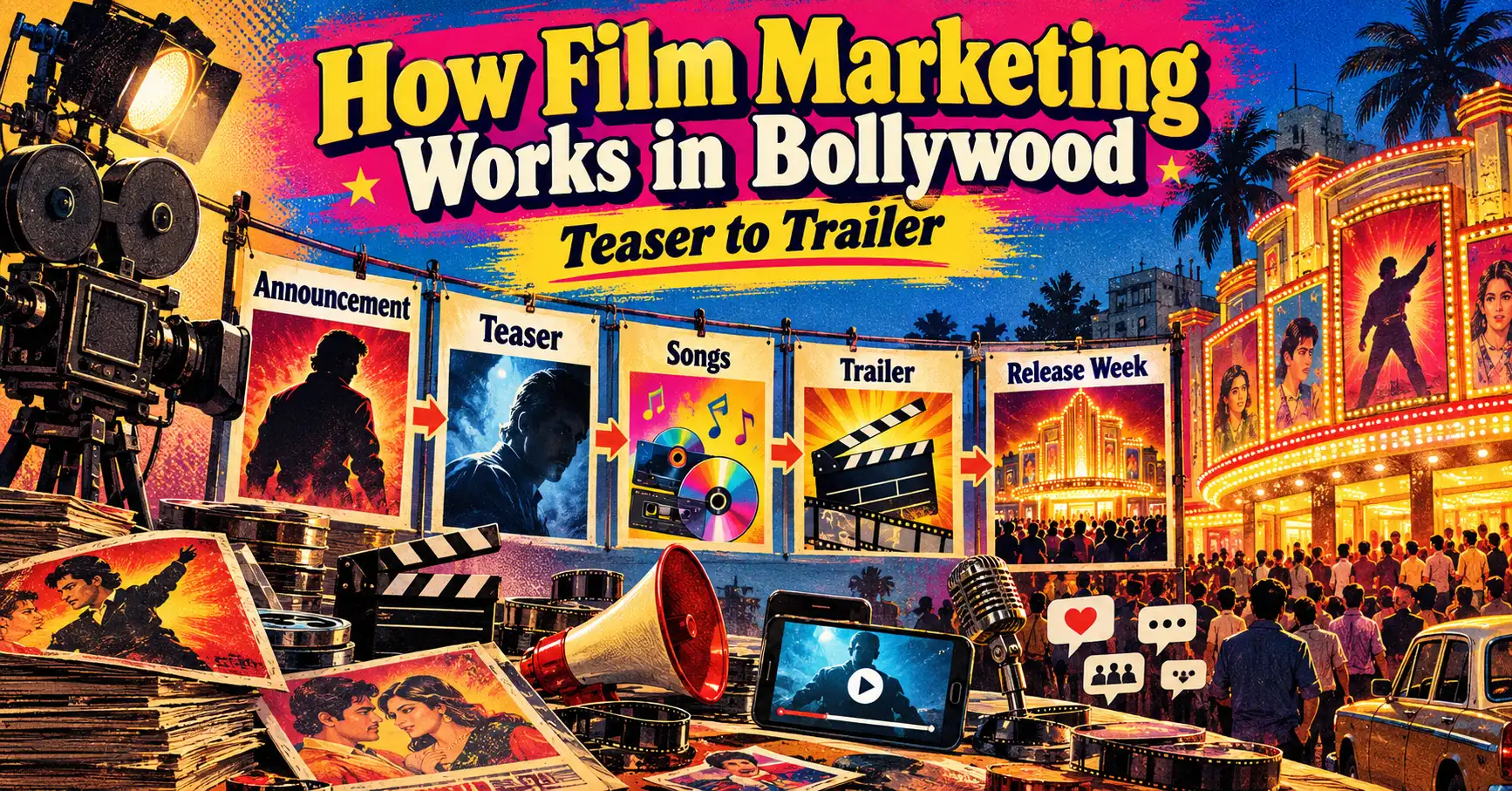
Here’s how film marketing works in Bollywood, in one line: it’s a slow, planned drip of content that starts long before the film is finished and peaks the week it hits theatres. That drip is why some films open to housefull boards. And why others open to empty seats you could stretch your legs across.
The fun part is the detail. A trailer chasing a 24-hour view record. A single dialogue that Tinder and Swiggy turned into memes within days. A Google Maps stunt that got everyone talking, for a film that still sank.
We cover trailers here every single week. So this is the guide we wish more people read before arguing about “hype” in the comments.
What Bollywood film marketing actually covers
Film marketing is everything a studio does to make you care before you buy a ticket. Posters, teasers, trailers, songs, influencer posts, interviews, TV couch appearances, the release-week blitz. All of it.
And it starts early. Really early.
Modern campaigns often drop teaser content before the cameras have even stopped rolling. Bade Miyan Chote Miyan put out an early announcement video long before the film was ready, which stretched its promo window to a year or more.
The spending has grown up too. Studios used to put roughly 5–6% of the production budget into marketing. A GroupM/ESP Properties “Showbiz” report found that share had climbed to 10–15%. That jump turned an old poster-and-press-junket routine into a proper, planned discipline.
The Bollywood promo timeline, phase by phase
Most big Hindi films follow a rough order. Studios shuffle it, and the smart ones break it on purpose, but the skeleton looks like this:
- Announcement or first look. A title, a poster, maybe a short video. Just enough to plant a flag and lock a date in your head.
- Teaser. Usually 20–30 seconds. It asks a question instead of answering one.
- Songs. One or more tracks, sometimes before the trailer, sometimes after.
- Trailer. Around two minutes, released as a tentpole event with a countdown.
- Final push. Interviews, city visits, TV shows, influencer collabs and advance-booking chatter right up to release day.
The order matters because each phase feeds the next. A teaser builds curiosity for the trailer. The trailer gives the songs context. The songs keep the film in your head during the weeks when there’s nothing new to watch.
Release timing sits under all of this. A campaign plans backwards from the date, which is why how Bollywood release dates are decided shapes the whole promo calendar.
People use the two words like they mean the same thing. They don’t.
A teaser is short, usually 20 to 30 seconds. Its job is to tease: a title, a face, a mood, a genre hint. It should leave you with a question. Who is that? What happened there? When does the full thing drop?
A trailer runs longer, often about two minutes. It sets up the genre, the tone and the central conflict. A good trailer tells you what kind of ride you’re buying without spoiling where it ends.
Our take? The best teasers withhold almost everything. When a teaser tries to explain the whole plot, the campaign has already lost a bit of its mystery. We see this constantly when we break down teasers like the Alpha teaser from the YRF Spy Universe. The fun lives in what they hold back.
For years the rule was simple. Trailer first, songs after.
Then producers started flipping it.
Aamir Khan released the song “Kahani” from Laal Singh Chaddha a full three months before the film’s release, and before any trailer existed. Trade press flagged it as a deliberate break from the trailer-first playbook.
Pathaan went a different route. It ran a teaser, then two songs, then the trailer just 15 days before release. That’s a tight, aggressive window, and the songs did the heavy lifting in between.
So why lead with music? The logic breaks down into a few parts:
- Songs build emotional connection in a way a two-minute cut often can’t.
- They add touchpoints. Every new track gives fans a fresh reason to talk about the film.
- They stretch the buzz. A song keeps the film alive on playlists and reels for weeks.
- They ride the fan base. Music travels through fan pages and dance covers on its own.
Honestly, this fits how Hindi cinema has always worked. Songs have carried Bollywood for decades, and the evolution of Bollywood film music shows why audiences here connect to a soundtrack before they connect to a story.
The trailer is the main event, and YouTube keeps score
If a campaign has a centrepiece, it’s the trailer. Studios don’t just upload it. They build a countdown, pick a premiere time and treat the drop like a match day.
Why? Because the industry now tracks 24-hour YouTube views like a public scoreboard. Here’s how the biggest Indian trailers stacked up in their first 24 hours, as tallied by Koimoi:
- Salaar: 113.2 million
- KGF Chapter 2: 106.5 million
- Adipurush: 74 million
- Salaar Trailer 2: 72.2 million
- Animal: 71.4 million
- Dunki: 58.5 million
- RadheShyam: 57.5 million
- Jawan Prevue: 55 million
- Singham Again: 51.95 million
- RRR: 51.1 million
Look at how that story got framed. Singham Again crossed 51 million, a massive number, and the headline still pointed out that Salaar’s figure ran 118% higher. That’s the game now. A trailer isn’t just marketing. It’s a public result that fans and trade watchers compare line by line.
Even the smallest number on that list is enormous. No wonder nobody drops a trailer quietly anymore.
A quick warning, though. View counts measure curiosity. They don’t sell tickets on their own, and a record-breaking trailer only buys a film its first look from you.
Why YouTube is the promo hub in India
TV used to be the launchpad. Now it’s YouTube, and the numbers make it obvious.
India has 550+ million monthly active YouTube users. They average about 42 minutes of watch time a day, and 85% of them watch on mobile. So a trailer premiere lands straight on the phone in your hand, right when you’re scrolling in bed.
That scale shapes the whole campaign:
- Trailer premieres and countdown pages go YouTube-first, not TV-first.
- Behind-the-scenes drops fill the gaps between the teaser, songs and trailer.
- Research happens there too. About 72% of Indian consumers look things up on YouTube before they decide on a product or piece of content.
There’s a regional angle as well. Consumption of Hindi, Tamil, Telugu and Bengali content on YouTube has grown about 60% year over year. That’s a big reason pan-India releases now cut separate trailer versions per language instead of pushing one dubbed cut everywhere.
For a studio, that means one film can need several trailer launches, not one. More work, sure. But a Telugu fan watching a Telugu cut feels spoken to, and that feeling is exactly what a campaign is paying for.
This is where Bollywood film promotion gets genuinely clever. Or genuinely lucky.
The Brahmastra “aag se” moment
When the Brahmastra trailer dropped, one line took off: “kuch rishta hai mera aag se.” Brands jumped on it within the same week. afaqs! documented the pile-on, and the list reads like your phone’s home screen:
- Tinder riffed on its own flame logo.
- Myntra swapped “aag” for “daag.”
- boAt, Swiggy, Zepto, Dunzo and BookMyShow posted their own spins.
Think about what that means. Seven major consumer brands pushed a trailer line to their own followers, and the film paid nothing for it. That’s organic virality, and it’s the dream outcome for any marketing team.
The #khabarpakkihai mystery campaign
Influencer marketing for Bollywood films has also moved past the “paid post with a poster” stage.
For Prime Video’s Bambai Meri Jaan, Mumbai-based influencers posted placard photos at iconic city spots. They did it a week before the trailer dropped. No film branding shown, no big reveal, just a hashtag: #khabarpakkihai. The mystery alone pulled 35 million YouTube views.
That’s the lesson we’d underline. Curiosity beats disclosure. A puzzle makes people search, while a plain announcement just makes them scroll past.
The old-school PR circuit still matters
All the digital noise hasn’t killed the classic stuff. Stars still sit on TV couches, give back-to-back interviews, visit cities and show up at trailer and music launch events.
What changed is the role. These appearances used to be the main event. Now they mostly feed the digital machine. A funny moment on a talk show becomes a clip, the clip becomes a reel, and the reel sends people back to the trailer.
Our honest view? The PR circuit rarely makes a film on its own anymore. But skip it, and the campaign loses the raw material its social team needs for the next three weeks.
What does Bollywood film marketing actually cost?
This is where most articles online get sloppy, so let’s be careful.
The one solid, industry-sourced benchmark says marketing now takes 10–15% of a film’s production budget, up from 5–6% about a decade earlier. That figure comes from a GroupM/ESP Properties “Showbiz” report, covered by Medianews4u. Later trade coverage still treats it as the standard ratio.
Here’s what that looks like in simple math. Take a hypothetical film with a ₹200 crore production budget. At 10–15%, its marketing spend would land somewhere around ₹20–30 crore. For a ₹50 crore mid-size film, the same ratio gives you roughly ₹5–7.5 crore.
Now, the caution. You’ll see huge “marketing budget” crore numbers floating around for big 2026 releases. Many of them lump production and marketing spend into one total. Treat any crore figure that doesn’t separate the two with a healthy dose of doubt.
How film marketing works in Bollywood when the film is bad
Here’s the uncomfortable truth every studio knows.
Thugs of Hindostan ran one of the more inventive stunts of its time. It did a Google Maps cross-promotion with an animated character guiding users around. People noticed. People talked.
Then the film released. Word of mouth turned sour, the script didn’t hold up, and it flopped anyway.
That’s the most important thing to understand about how film marketing works in Bollywood. Marketing amplifies interest that already exists. It can’t manufacture love for a film audiences don’t enjoy. Meme virality follows the same rule: a trending dialogue guarantees nothing if the film behind it disappoints.
Put the Brahmastra meme wave next to the Thugs stunt and you see the full picture. Both campaigns got attention. Only the audience decides what happens after Friday.
What the smartest campaigns have in common
Pull all these examples together and a pattern shows up. The campaigns that work tend to do a few things right:
- They start early and give fans something new every few weeks.
- They hold back. Teasers ask questions, and mystery campaigns like #khabarpakkihai make you go looking.
- They treat songs as marketing, not just soundtrack, and aren’t scared to drop one before the trailer.
- They build for the phone first, because that’s where India watches.
- They leave room for the internet to play. Nobody planned Myntra’s “daag” joke. The line just had to be quotable.
And the ones that fail? Usually they had the budget and the stunts. They just didn’t have the film.
Does promotion actually move the box office?
Yes, but mostly at the start.
Think of trailer views, search buzz and meme chatter as a leading indicator. They tell you how many people are curious going into opening day. That curiosity shows up in advance bookings and Day 1 numbers, which is where the marketing spend earns its keep.
After that first weekend, the campaign hands the baton to word of mouth. Good films hold. Bad ones drop fast, no matter how loud the promotions were. If you want to read those numbers properly, our explainer on how box office collection is calculated in India breaks down why trackers often disagree.
Our take: hype is a loan, not a gift
Great Bollywood marketing borrows attention from the future. The teaser, the song, the trailer premiere, the meme that Swiggy picks up: all of it pulls you into a theatre on opening weekend.
Then the film has to pay that loan back.
So next time a trailer smashes a 24-hour record, cheer if you want. Just keep one question in your pocket for release week: Paisa Vasool Ya Time Waste? That answer still comes from the film, not the campaign.
Which recent campaign actually got you to book a ticket? Drop it in the comments. We’re keeping score too.