
Ramayana Teaser Release | Ranbir Kapoor’s ‘Rama’ Avatar & The Global Challenge
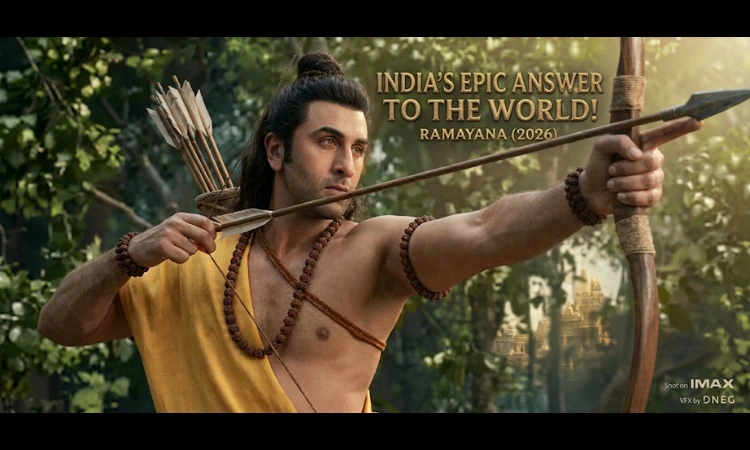
In the history of Indian cinema, certain projects transcend the boundaries of entertainment to become cultural milestones. Nitesh Tiwari’s ‘Ramayana’ is shaping up to be exactly that. This isn’t just another mythological retelling; it is a high-stakes, $500 Million (₹4000 Crore) bet intended to place Indian storytelling on the same pedestal as Hollywood’s The Lord of the Rings and Dune.
As a critic who has witnessed the rise and fall of many “Pan-India” spectacles, this project feels different. It feels intentional. Here is a breakdown of why Ramayana (2026) is the most anticipated cinematic event of the decade.
Mark your calendars for April 2, 2026. In a masterstroke of timing, the makers are set to release the first official teaser on the auspicious occasion of Hanuman Jayanti.
- The Certification: The teaser has secured a ‘U’ (Universal) certificate from the CBFC. This is a clear signal that the film is crafted for every generation-from children discovering the epic for the first time to elders who hold the story close to their hearts.
- The Runtime: At 2 minutes and 38 seconds, this is no mere “glimpse.” It is a comprehensive introduction to the visual world Nitesh Tiwari has spent years building.
2. Casting Masterclass: The Trifecta of Power
The casting of Ramayana is a brilliant blend of method acting, natural grace, and sheer stardom:
- Ranbir Kapoor as Bhagwan Rama: Moving away from his “urban” persona, Ranbir has undergone a spiritual and physical transformation. His ability to convey deep emotion through silence is exactly what the character of Rama requires-a blend of calm strength and divine poise.
- Sai Pallavi as Sita: In an industry obsessed with glamour, casting Sai Pallavi is a masterstroke. Her “no-makeup” authenticity and raw acting prowess will bring a much-needed groundedness to the role of Mata Sita.
- Yash as Ravana: The KGF Superstar Yash brings the necessary “larger-than-life” gravity. Reports suggest the teaser will only feature a fleeting glimpse of him, maintaining an air of mystery around the scholarly yet ego-driven antagonist.
3. Technical Prowess: India’s IMAX Revolution
For the first time in Indian cinema, a film has been shot entirely using IMAX cameras. This isn’t just about a bigger screen; it’s about a higher resolution, deeper colors, and an immersive aspect ratio that Hollywood legends like Christopher Nolan swear by.
The VFX Powerhouse
The film’s visual effects are being handled by Namit Malhotra’s DNEG, the same Oscar-winning studio behind Oppenheimer, Dune, and Interstellar. With a staggering budget of ₹4000 Crores for the two-part epic, the goal is clear: to ensure that the “Vanar Sena” and the “Golden City of Lanka” look realistic enough to compete with global standards.
4. Research & Structure: The Valmiki Foundation
The biggest pitfall for any mythological film is the deviation from the source material. Nitesh Tiwari has reportedly avoided the “modernized” traps of recent failures, choosing instead to base the film on the Valmiki Ramayana.
A Two-Part Epic
The filmmakers are dividing this vast narrative into two chapters. Part 1 arrives Diwali 2026, centering on the early life and exile. Part 2 follows in 2027 to showcase the climactic war.
Hidden Truths
The screenplay explores lesser-known facets of the Valmiki text. It offers a fresh perspective to even the most devoted followers of the story.
5. Critic’s Value Analysis: The “True Value” Report
Cultural Soul vs. Digital Brilliance
The real test for Ramayana isn’t the VFX-it’s the soul. While DNEG will provide the “Technical Brilliance,” the success depends on whether the “Cultural Soul” remains intact. If the audience connects emotionally with Rama’s journey, the 4000-crore investment will be worth every penny.
The Box Office Revolution (The 9000-Crore Potential)
If the makers successfully tap into the Chinese market (with its 90,000+ screens) and the Western diaspora, this film has the potential to reach a ₹9000 Crore global lifetime collection. This would be a financial revolution for Indian cinema, proving that our culture is our greatest export.
At a Glance: The “Ramayana” (2026) Fact Sheet
| Feature | Specification |
|---|---|
| Director | Nitesh Tiwari (Dangal, Chhichhore) |
| Producer | Namit Malhotra (DNEG / Prime Focus) |
| Budget | $500 Million (Approx. ₹4000 Cr) |
| Format | Shot for IMAX |
| Release Strategy | 2-Part Epic (Part 1: Diwali 2026) |
| Core Source | Valmiki Ramayana |
Final Verdict: India’s Answer to the World
Ramayana is more than a movie; it’s a statement. It’s an answer to the skeptics who believe India cannot produce a global-scale franchise. If the dialogues maintain the dignity of the epic and the emotions remain pure, this will be the definitive film of the century.