
Karuppu Review | A Supernatural Duel Where Ancient Faith Collides with the Gavel of Justice
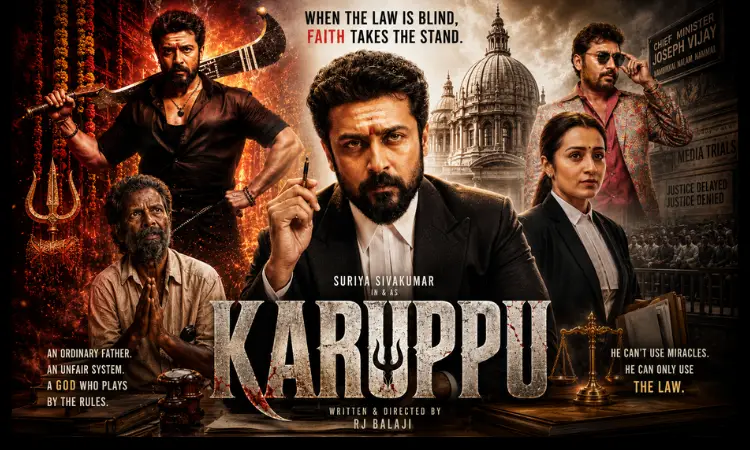
The summer of 2026 has witnessed a cinematic phenomenon that feels like a fever dream of faith and law. Directed by the witty RJ Balaji, Karuppu is not merely a film; it is a high-octane “God-as-hero” narrative that pits ancient folklore against the modern courtroom’s cold bureaucracy.
At its core, this is a story of the ultimate underdog. When an impoverished father (Indrans) is crushed by a legal system rigged by the flamboyant, corrupt lawyer Baby Kannan (RJ Balaji), the local guardian deity, Karuppaswamy, descends to Earth. Taking the form of a lawyer named Saravanan (Suriya), the deity must navigate the case under a “Divine Constraint”-he cannot use miracles and must win using only human evidence and the Indian Penal Code.
Inside the Sanctum: Rare Trivia & Production Secrets
- The ‘Maasani’ Origins: Long before Suriya entered the frame, the film was conceived as a female-led devotional thriller titled Maasani Amman, with Trisha in the lead. The script was later amplified with “mass” elements to fit Suriya’s superstardom.
- The Late-Night Rescue: The film faced a 24-hour release delay on May 14th due to financial settlement issues. Reports suggest Suriya himself stepped in with financial support at the eleventh hour to ensure the screens flickered to life on May 15, 2026.
- The Rahman Miss: Originally, A.R. Rahman was the choice for music. However, young sensation Sai Abhyankkar took over, infusing the film with a unique “Indie-folk-pop” energy that has redefined the traditional devotional sound.
- A Political Nod: The film caused a stir by referencing Thalapathy Vijay as “Chief Minister Joseph Vijay,” a bold meta-commentary on the real-world political shift in Tamil Nadu.
The Critical Scale: Personal Opinion & Breakdown
The Highs (Pros)
- Suriya’s “God Mode”: Suriya delivers a performance that oscillates between fierce divinity and sharp-witted legal brilliance. His “aura-farming” screen presence is the film’s strongest asset.
- Interval Block: The transition from a gritty drama to a supernatural reveal is arguably the best sequence in RJ Balaji’s career-pure cinematic adrenaline.
- Socio-Legal Satire: The film brilliantly mocks media trials and the loopholes used by elite criminals to evade justice.
The Lows (Cons)
- The ‘Reels’ Mode: As highlighted in the Moneycontrol review, the second half loses its intellectual grip, trading courtroom logic for loud, predictable “mass” moments.
- Trisha’s Sidebar: Despite being the “South Queen,” Trisha’s role as the honest lawyer Preethi feels sidelined, serving more as a spectator to Suriya’s divinity than a co-player.
- Logic vs. Spectacle: The Indian Express review correctly notes that while Suriya is in top form, the film eventually abandons its own “Human Rules” premise for “Divine Spectacle,” making the ending feel unearned.
What Could Have Been Better?
The film would have been a masterpiece if the climax stayed grounded. Imagine a God winning a case not through a supernatural showdown, but through a brilliant, overlooked legal technicality. That would have truly honored the “Divine Constraint” established in the first half.
Film Dossier: Key Highlights
| Feature | Details |
|---|---|
| Director | RJ Balaji |
| Starring | Suriya Sivakumar, Trisha Krishnan, Indrans |
| Genre | Fantasy / Courtroom Drama / Action |
| Total Runtime | 2 Hours 31 Minutes |
| Budget | ~₹140 Crores |
| Key Highlights | Sai Abhyankkar’s BGM & The Interval Reveal |
The Deep Dive: Final Thoughts & Analysis
In the final analysis, Karuppu is a fascinating cultural artifact of 2026. It represents a shift in how Indian cinema handles divinity. We are moving away from the “O My God” style of satire and toward a more heroic, vigilante portrayal of faith. By framing a deity as a “Mass Hero,” the film taps into a collective subconscious that feels the modern justice system is so broken that only a literal God can fix it.
However, the film’s biggest flaw is its lack of confidence in its own courtroom premise. The first half is a masterful setup of “Human vs. Divine,” but the second half panics and falls back on loud CGI and punch dialogues. It tries to cater to “Reels” culture-constant elevation shots and oversaturated frames-at the cost of emotional depth. The father-daughter duo, who are the emotional core, almost disappear by the end, replaced by the spectacle of Suriya’s “God Mode.”
Despite these writing gaps, the film is an essential theatrical experience. Suriya’s performance is magnetic, and Sai Abhyankkar’s score ensures the energy never dips. It is a bold, flawed, and vibrant experiment that proves that even if the law is blind, the audience is still looking for a hero-divine or otherwise.
1-Line Review: A electrifying fusion of faith and law that succeeds on Suriya’s sheer charisma, even when the logic starts to blur.
Final Rating: ⭐⭐⭐ (3/5)